
Related videos:
A prose poem by the Cuban writer Ángel Martínez Niubó, published on Facebook, has surpassed 601,000 views as it recalls the Pre-University Institutes in the Countryside (IPUEC), schools that shaped entire generations of young Cubans and that today have been left in silence and neglect.
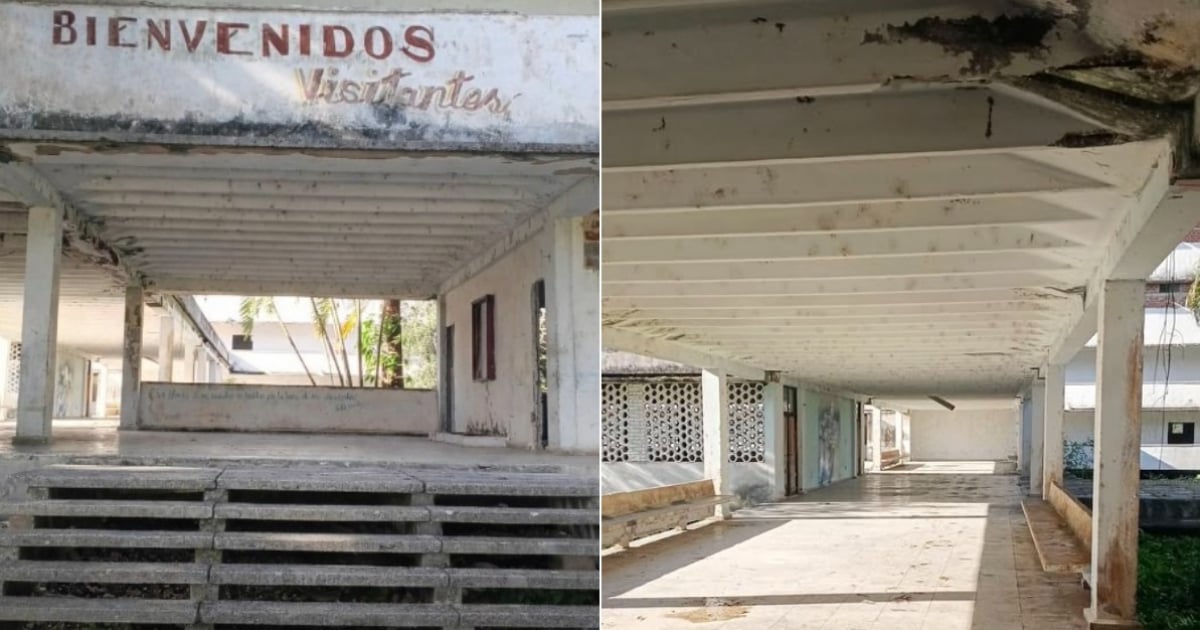
The reel, titled "Where Are You, Boys?", is accompanied by images of an empty and dilapidated place, featuring peeling paint, moisture stains, crumbling columns, and accumulated dirt.
The video summarizes the fate of hundreds of abandoned educational facilities that the regime built starting in the 1970s and then left to their own devices.
Martínez Niubó, born in 1966 in Fomento, Sancti Spíritus, and a member of the National Union of Writers and Artists of Cuba (UNEAC), traverses in the poem the hallways, classrooms, dormitories, dining areas, and sports courts of those schools as if searching for someone who is no longer there.
"Where are you, guys? I searched for you with an almost childish stubbornness, as if you might suddenly appear around any corner, as if it had all just been a pause," he writes.
The text ends with a question that has resonated with thousands of Cubans inside and outside the Island: "Tell me where you are, guys, and why am I still here, looking for you."
In another post, the author describes that hallway as "the center of the universe" for his generation: "There we sat, in our blue uniforms with books under our arms. Nothing else was needed: a bench, a conversation, and the whole world fit in our gazes."
The comments on the reel reflect the collective emotional impact. Cubans residing in Miami, Houston, and other diaspora destinations mix nostalgia with indignation.
"They have destroyed everything, it's unbelievable," wrote a resident in Houston.
A user recalled the physical labor involved in that experience: "Picking oranges, lemons, grapefruits, changing irrigation systems that were heavy... yes, we paid for our education even if they say otherwise."
A woman from Matanzas who was a teacher at just 16 years old lamented that her school is "today destroyed and forgotten."
Not all memories are bitter. Another user wrote: "How much nostalgia for that time when so many of us were very happy at our schools, where we learned to be independent, where many found their best friend."
The IPUEC were created by the Cuban regime under the Marxist principle of linking education with agricultural work.
At its peak, the system comprised approximately 350 pre-university institutes and around 1,400 Basic Secondary Schools in the Countryside (ESBEC), where adolescents aged between 14 and 18 alternated classes with up to 90 days a year of work in the fields. The official goal was to cultivate the so-called "new man" under the principles of Marxism-Leninism.
As filmmaker Lilo Vilaplana asserted years ago, the scholarships in the countryside were meant for indoctrination, and some young people remember their time in those institutions as a traumatic experience.
The system began to crumble in 2009, when the government started the gradual elimination of pre-university scholarships without public explanations. Guideline 148 of the Communist Party, approved in 2011, formalized the reduction of boarding students by acknowledging that the students did not produce enough to justify the costs.
By 2018, most of the centers had been converted into housing for workers, self-sufficient farms, or simply abandoned like ghost towns. Some, such as a facility in Pinar del Río, ended up being converted into quail farms.
In August 2024, the Cuban government announced the return of rural schools for the 2024-2025 school year, with 15-day sessions for certain grades.
The initiative was met with skepticism due to the lack of textbooks, transportation, and teachers, in a country that has lost more than a million inhabitants since 2021 due to emigration, and whose population is currently estimated to be between 8.6 and 8.8 million people.
Filed under: