
Related videos:
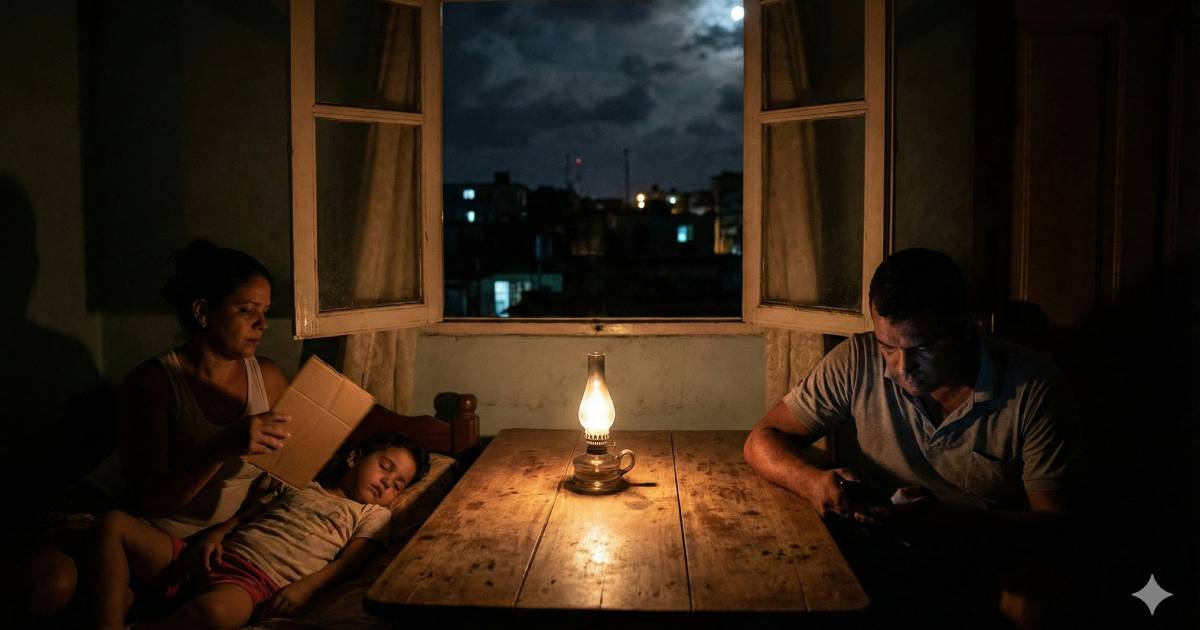
Cuba woke up on Monday plunged into another day of massive power outages, with the energy crisis deepening and showing no signs of a short or medium-term solution.
The Electric Union (UNE) confirms a critical scenario where power outages persist uninterrupted throughout the day, reflecting a collapsed system after years of deterioration, lack of investment, and inefficient management.
According to the official statement, on Sunday the electric service was disrupted for 24 hours, and the situation continued into the early morning.
The highest recorded impact reached 1696 MW at 7:40 PM, a figure that highlights the system's inability to meet national demand.
At 6:00 am, the availability of the National Electric System (SEN) was 1160 MW against a demand of 2290 MW, resulting in 1143 MW affected.
For the average schedule, a further impact of 1250 MW is anticipated, confirming the continued power outages in large areas of the country.
The system status shows multiple accumulated failures.
Regarding the main incidents, four units are reported out of service due to breakdowns, located at the thermoelectric power plants of Santa Cruz, Felton, and Antonio Maceo.
This is in addition to five units currently under maintenance, distributed among the thermoelectric plants of Mariel, Renté, and Nuevitas, which further reduces the already limited generation capacity.
Furthermore, the report itself acknowledges 350 MW out of service due to limitations in thermal generation, which exacerbates a situation already characterized by the structural fragility of the system.
As the peak hours approach, the forecasts do not provide any relief either.
The entry of unit 5 from Energás Jaruco with 20 MW and unit 5 from CTE Renté with 60 MW is expected, contributions that are clearly insufficient compared to an estimated demand of 3050 MW.
With a projected availability of only 1230 MW, the deficit would reach 1820 MW, with an estimated impact of 1850 MW at that critical time of day.
Although the UNE highlighted that the 54 photovoltaic solar parks generated 4,389 MWh, with a maximum power output of 663 MW during peak hours, these contributions do not manage to offset the enormous structural deficit of the electrical system.
The situation in Havana also reflects the impact of this crisis.
According to the Electric Company of the capital, the service was interrupted for 14 hours and 13 minutes, with a maximum impact of 210 MW at 7:40 PM.
Additionally, it was necessary to implement 55 MW of emergency cuts, and it was not possible to fully restore the service due to a deficit.
At the end of the report, six blocks, equivalent to 219 MW, remained without electricity, with an expected recovery forecast for the morning hours.
This situation confirms that blackouts are a permanent condition in the lives of Cubans.
The prolongation of these issues, along with the system's inability to stabilize, highlights the accumulated deterioration of the electrical infrastructure, a result of years of neglect, erratic decisions, and management that has failed to anticipate or respond effectively to the crisis.
Meanwhile, the population continues to face days marked by uncertainty, with unclear service hours and outages that affect both daily life and economic activity, in a country where electricity has become an increasingly scarce resource.
Filed under: