
Related videos:
Russian Deputy Prime Minister Dmitry Chernyshenko announced on Wednesday that during this the assembly of vehicles at the Gorky Automobile Plant (GAZ) in Cuba will resume, along with the opening of a distributor for their sale on the island.
According to RT en Español, the announcement was made during the XXIII session of the Russian-Cuban Intergovernmental Commission for Commercial, Economic, Scientific, and Technical Cooperation, held in Saint Petersburg and co-chaired by the Cuban Deputy Prime Minister and Minister of Foreign Trade and Foreign Investment, Óscar Pérez-Oliva Fraga.
"This year, we plan to resume the assembly of GAZ vehicles and open a sales office in Cuba," stated Chernyshenko before the bilateral commission.
The official specified that vehicles from the brands GAZ, UAZ, KamAZ, and Lada are already being supplied to the island, and that "in the last two years, more than 230 units of machinery and equipment" have been exported to Cuba.
Chernyshenko also revealed that plans for this year include progressing in the "organization of a taxi park in Havana in cooperation with the Government of Moscow," for which "the Russian side will provide 50 vehicles of the Moskvich brand."
The announcement regarding GAZ is part of a broader Russian-Cuban automotive strategy.
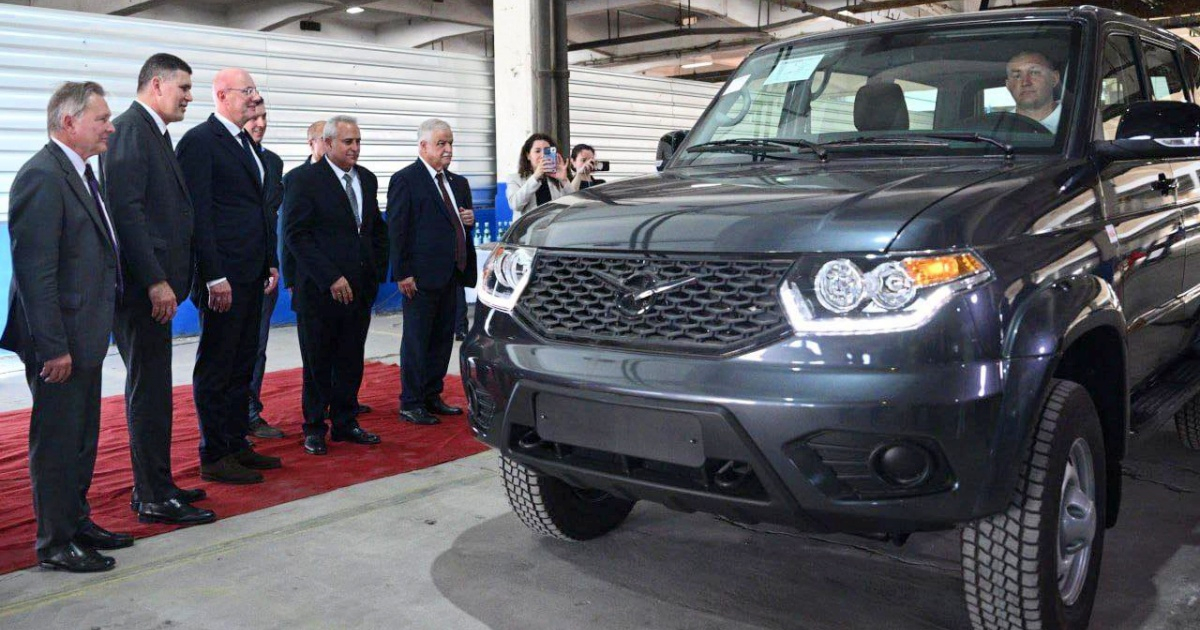
The UAZ vehicle assembly line at the Cuban EISA plant was inaugurated in 2025, and Chernyshenko indicated that mechanical equipment is already being sent for that line.
However, UAZ production in Cuba was temporarily suspended on March 25 due to the "severe restrictions on electrical supply" on the island, as reported by the company itself.
This is not the first time GAZ has attempted to establish itself in Cuba.
In 2018, GAZ and the Ural plant signed an agreement to assemble 120 GAZ vehicles and 500 Ural trucks on the island, but the project failed.
Cuba claimed that the vehicles were not working, while Ural pointed out that the trucks were seen in military parades.
In August 2023, Ural filed a lawsuit against two Cuban companies and the Russian state bank VEB.RF for 23.4 million euros.
In April 2025, Chernyshenko himself had already reported that the GAZ distributor was in the registration process in Cuba, so the announcement this week confirms that this process will move forward to completion this year.
The meeting in St. Petersburg took place amidst a period of intense bilateral diplomatic activity.
Chernyshenko emphasized that, following the agreements of our presidents Vladimir Putin and Miguel Díaz-Canel, they continue to develop cooperation in all areas.
He also mentioned the arrival of the Russian tanker Anatoly Kolodkin at the port of Matanzas on March 31, with 100,000 tons of crude oil, the first significant shipment in almost three months.
"We hope that this assistance will ensure the functioning of the country's critical and social infrastructure, especially the health system, hospitals, schools, and of course, the homes of the island's residents," stated the Russian Deputy Prime Minister.
Automotive cooperation is another component of a comprehensive Russian presence strategy in Cuba that includes investment plans exceeding 1,000 million dollars, the establishment of a Russian university branch in Havana, and eight centers for teaching the Russian language on the island with over 1,300 graduates.
For the Cuban regime, which is experiencing its worst energy and transportation crisis in decades, these announcements represent a political and economic lifeline that deepens its dependence on Moscow.
Filed under: