
Related videos:
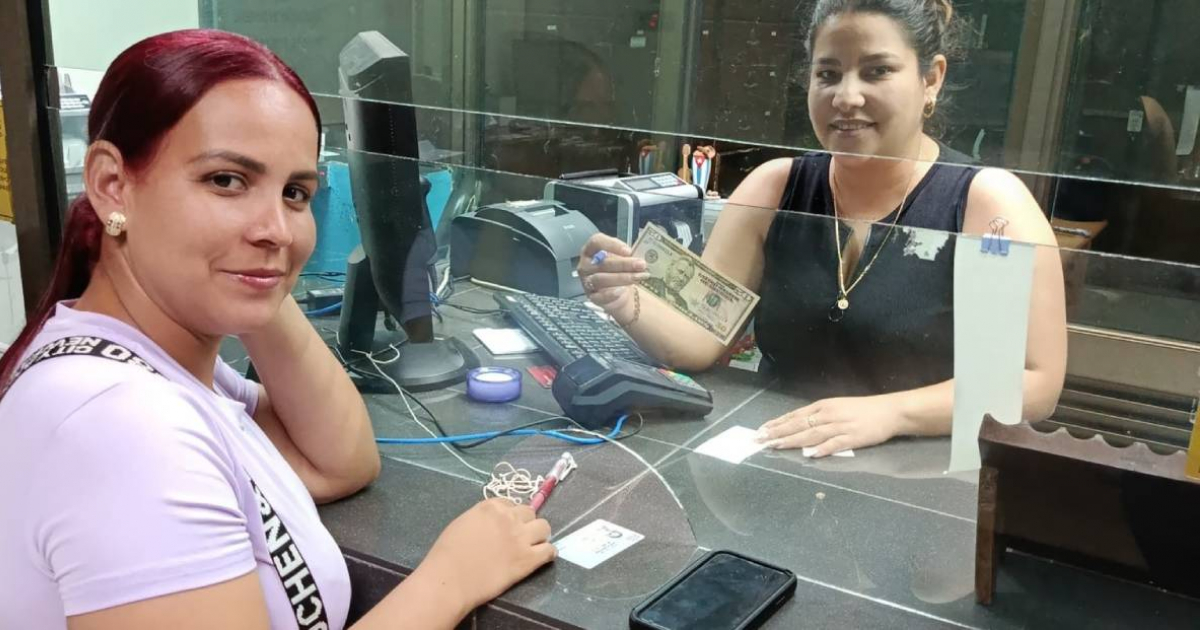
Cadeca published images on its social media this Wednesday of the first remittance operation at a branch in Guantánamo, showing a woman collecting her dollars at the counter as a symbol of the launch of the new service.
FINCIMEX has enabled the collection of remittances from abroad in dollars at CADECA offices, representing one of the most significant measures by the Cuban regime to attract foreign currency amidst the economic crisis.
The posts are a clear promotion of CADECA's new service. The photos even showcase the Classic card, an option that the regime promotes as "an opportunity to enjoy discounts" in its dollar stores.
The population has not received the service with joy, but rather with doubts due to the lack of detailed information about the process. There is distrust in the Cuban banking system, stemming from potential liquidity issues and fear of either not having cash available or not having electricity in the offices at the time of collecting the remittance.
Reactions on social media have been swift, mostly characterized by skepticism, irony, and distrust towards the new remittance system managed by Cadeca.
Some users even question the truthfulness of the announcement: “Did they have a connection? Miracle… that was just for the photo,” one person joked, while another pointed out that “Western Union has been doing it since 1871,” casting doubt on the innovative nature of the measure.
The lack of credibility in the institutions was also reflected in comments such as: “Absolute security... haha” or “Give that story to someone else,” highlighting the population's rejection of trusting the state system again.
One of the main concerns revolves around the actual availability of cash. “This is a trap: you go, and they don’t have any cash,” warned an internet user, while another was more direct: “Anyone sending money around is crazy… later they’ll say there’s no cash.”
In the same vein, several comments reference past experiences: "Let the days pass and the stories will begin about how the money can't be withdrawn" or "As long as they provide cash, there's no problem... today it's one thing, tomorrow it's another."
There were also questions about the service conditions: “For every 100 dollars, how much does the Government deliver?” a user asked, reflecting concerns about possible commissions or hidden fees.
Others, on the other hand, summed up the general sentiment with more vivid phrases: "You'll see how the hook catches fish" or "I still have the flea behind my ear," clearly alluding to the widespread distrust.
Even structural factors like power outages came to light: “If there’s electricity, sure…,” remarked another user, recalling the limitations of the Cuban context.
CiberCuba published a complete list of enabled branches from Pinar del Río to Guantánamo, so that Cubans can identify where to access the service in each province.
The government hasn't stated this explicitly, but it can be inferred that the availability of the service depends on the dollars collected each day at each branch, which means that the service may not be guaranteed for all beneficiaries at all times.
The context in which this measure arises is critical in the country. The formal remittances have dropped by 70% compared to 2019, which has pressured the Cuban government to seek new ways to attract foreign currency through official channels.
In parallel, Correos de Cuba has also resumed its international money transfer service, joining the government's strategy to expand formal mechanisms for receiving funds from abroad.
From the United States, the situation has also become complicated for senders, as a federal 1% tax on cash remittances came into effect, which could discourage sending through formal channels.
Analysts and critics point out that this whole scheme is part of a strategy by the regime to capture dollars amid the crisis, taking advantage of the desperation of Cuban families who rely on money sent from abroad to survive.
Filed under: