
Related videos:
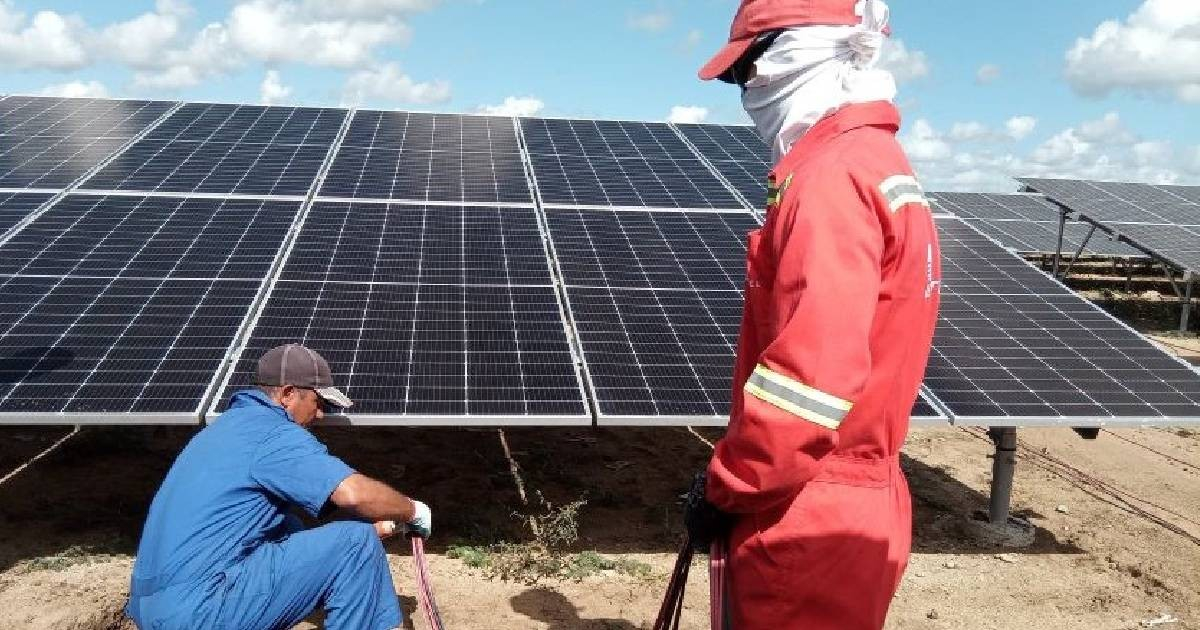
The Las Villegas Photovoltaic Solar Park, located in the municipality of Guisa, Granma, has been synchronized with the National Electric System (SEN) with a generation capacity of 5.0 megawatts (MW) and 1.0 MW of storage through batteries, as reported on Facebook by CMKX Radio Bayamo.
The facility is the second solar park of its kind to connect to the grid in the province, following the Yara PSF, which was synchronized last October, and is part of China's donation program to Cuba for 120 MW of photovoltaic capacity.
The PSF Las Villegas operates with two investors of 2.50 MW and a total of 9,048 photovoltaic panels, according to official data.
The regime presented the synchronization as an achievement, with the Electric Company of Granma expressing gratitude for "the support of all the entities involved in the transformation of the energy matrix" of the province, in a statement that omits any reference to the catastrophic electrical situation that the population is enduring.
However, despite the official propaganda, residents are aware that the new solar park will not bring any change and that blackouts will continue; they made this clear through their comments on the broadcaster's post.
"What good is it? We have been without power for over 30 hours; the more parks there are, the less electricity," said a resident of Bayamo.
"Since there are those parks in the province of Granma, and they are experiencing 30 hours of blackout," questioned a healthcare worker.
"In Jiguaní (also in Granma) there are not one, but two photovoltaic parks, and the outages last for three hours," assured an internet user.
"The problem is that there isn't enough sun," another one mocked.
"Everyone in the town knows that this current goes to military units and to Havana, not to the people. The people in Cuba live like dogs," stated a young man.
"Do you not feel ashamed? How long will all these lies continue? The blackouts are getting bigger every day, and this shows no sign of stopping," remarked another healthcare worker.
The construction of the Guisa park involved the company ATI from Santiago de Cuba, SEISA, and the Business Units of the Provincial Directorate of the Electric Company of Granma: Renewable Energy Sources, Operations Center, and the Provincial Load Dispatch
The Chinese program of 120 MW includes 15 additional facilities -13 at 5 MW and two at 10 MW- with battery storage systems for 20% of the generation, and was scheduled to be completed before April 2026.
The first phase, comprising 35 MW distributed across seven parks in five provinces, was completed on November 12 with the inauguration of the Mártires de Barbados II park in Guanajay, Artemisa, in the presence of Miguel Díaz-Canel and Chinese Ambassador Hua Xin.
The synchronization of the PSF Las Villegas takes place while Cuba is experiencing one of the worst energy crises in its history, which the regime has been unable to resolve after decades of negligence and disinvestment in the sector.
On Saturday, April 11, the availability of the National Electricity System was only 1,455 MW compared to a demand of 2,380 MW, with 964 MW affected in the early morning and a projected 1,515 MW of impact for the night peak.
Power outages reach up to 22 hours a day in some areas, and in March, there were three total collapses of the National Electric System (SEN), including one lasting 29 hours and 29 minutes on the 16th.
Cuba operates more than 54 photovoltaic solar parks that generate between 3,500 and 4,300 MWh daily, with a maximum daytime capacity of between 500 and 740 MW, but the structural deficit of the National Electric System exceeds 1,500 MW daily.
The central issue is that solar parks only generate energy during the day, and the lack of large-scale storage batteries prevents excess daytime energy from being used to meet nighttime demand, which is when the most severe power outages occur.
The share of renewable generation increased from 3% to 10% of the total in 2025, but experts warn that without the modernization of outdated thermoelectric plants—10 out of 16 units were out of service in March 2026—and without mass storage, the crisis does not have a structural solution in the short term.
The government promised to eliminate daytime blackouts by 2026 with an additional 2,000 MW of solar energy and batteries, a goal that specialists themselves have deemed unrealistic given the current conditions of the Cuban electrical system, which has been deteriorating due to 67 years of mismanagement by the dictatorship.
Filed under: