
Related videos:
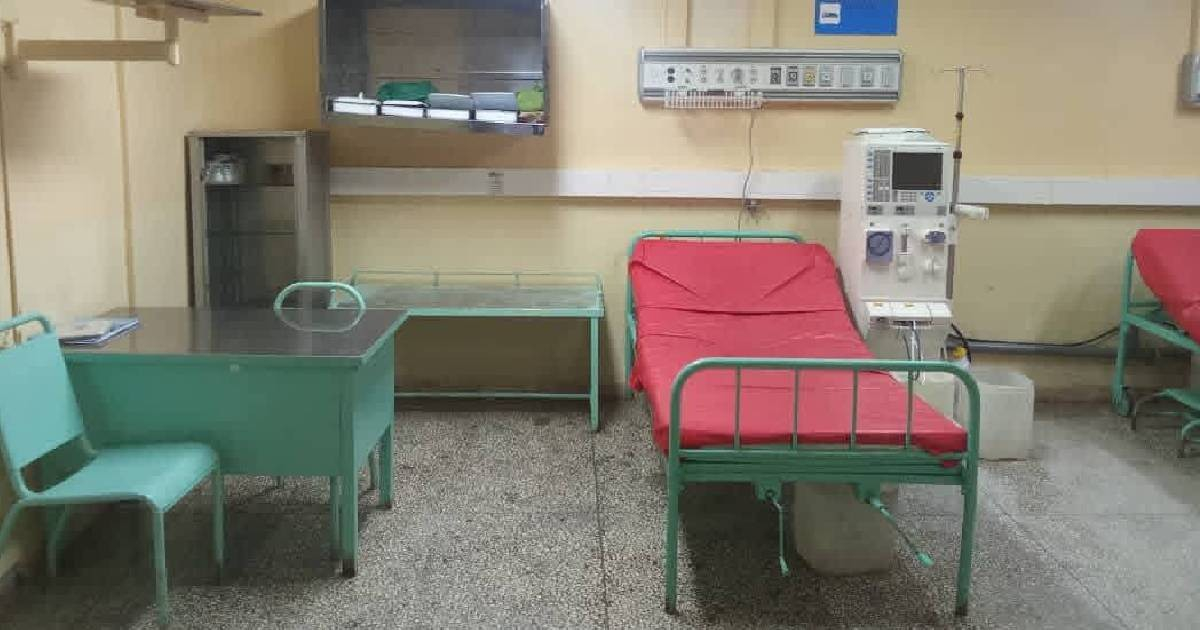
The "Arnaldo Milián Castro" Provincial Clinical Surgical Hospital in Santa Clara published an article on its social media detailing the international costs of the hemodialysis service it provides for free, an institutional response that directly contrasts with patients' complaints about outbreaks of hepatitis, mistreatment, and misallocation of resources in that same service.
The publication, titled "Lives on Dialysis: The Silent Cost of a Free Service," was also circulated by the state media "Razones de Cuba" and comes days after an anonymous patient reported to activist Alberto Arego the conditions faced by those who depend on this treatment to survive.
According to the official text, each hemodialysis session has a international cost of between 150 and 300 dollars, and the hospital uses artificial kidneys Fresenius valued between 17,000 and 22,000 dollars, with even higher prices for parts of U.S. origin affected by the embargo.
The service accommodates 144 patients in Villa Clara —141 locals and three from Caibarién— organized into five daily shifts: 71 patients on Mondays, Wednesdays, and Fridays, and 70 on Tuesdays, Thursdays, and Saturdays, the publication notes.
In 2024 there were 24,803 hemodialysis sessions at the hospital; in the first quarter of 2025, there were an additional 5,993. Dialyzers and arteriovenous lines cost between 12 and 15 dollars each, and hemodialysis catheters cost 150 dollars each, the note emphasizes.
The official statement attributes all difficulties to the U.S. embargo and celebrates the free service as a revolutionary achievement: "This service, although costly, is an act of commitment to life amidst the economic adversities in Cuba."
However, the testimony collected by Arego describes an opposing reality. "At the Arnaldo Milián Hospital in Santa Clara, the same situation will always persist: no one cares about our lives, sensitivity will never knock on our doors, broken kidneys with no one to provide an answer," denounced the anonymous patient.
The same patient revealed that an entire ward of the hospital is infected with hepatitis and that the authorities responded by closing the entrances: "They started cleaning with bleach to prevent the spread of hepatitis outbreaks. An entire ward is infected, and they have the audacity to invest in locks to close off the entrances so that no one sees the atrocities we are experiencing."
The complaints also include mistreatment when patients present grievances, neglect in the follow-up of clinical analyses, and diversion of resources towards those who have money.
"For every suggestion and concern, it feels like mistreatment, as if we had chosen to be in this situation. For the two heads of that department, there is no understanding of our reality; they justify everything, claiming that treatment is expensive worldwide and free here, but at what cost is it really free?" the patient pointed out.
This institutional response pattern—publishing cost and achievement data to counteract criticism—has been observed in other Cuban hospitals.
The hemodialysis crisis is nationwide: at the Hospital Lenin de Holguín, power outages interrupt the machines due to generator failures from age or lack of fuel; at the Hospital Juan Bruno Zayas de Santiago de Cuba, the lack of salt for disinfection plants left patients waiting for hours without treatment; and at the Hospital Celia Sánchez Manduley de Manzanillo, the shortage of sodium bicarbonate caused repeated service suspensions.
The writer Alexander Aguilar López, a hemodialysis patient in Granma, reported in March 2026 that the State no longer guarantees transportation for patients, with costs reaching up to 500 pesos per trip, and described the situation as moral decay, insensitivity, and disrespect towards patients, pointing out that "the leaders' cars continue to circulate."
Filed under: