
Related videos:
The historian and activist Alina Bárbara López Hernández published this Saturday a compelling analysis on her Facebook profile in which she questions the accuracy of the official figures from the campaign "My Signature for the Homeland," with which the Cuban regime claims to have garnered over six million endorsements in just two weeks.
The government announced the official figure —6,230,973 signatures— during the May Day event in front of the United States Embassy in Havana, where the books were symbolically handed over to Raúl Castro and Miguel Díaz-Canel. Foreign Minister Bruno Rodríguez Parrilla went so far as to claim that 81% of the Cuban population had signed, a figure that suggests virtually universal participation from all adults on the Island.
López does not question that there were voluntary signatories, but he does warn that "it is clear that there were pressures." He goes further: his analysis focuses on demonstrating that the declared figure is mathematically impossible.
"What I will emphasize is the impossibility of the enormous figure declared yesterday: 6,230,973," writes the activist. The argument is compelling: in 2002, when the regime carried out a similar campaign to declare socialism "irreversible" in the Constitution, it reported 8,188,198 signatures. The difference between both figures is just 1,957,225. "And that raises alarm bells," concludes López.
The problem is that Cuba in 2026 is not the same as in 2002. The population has dropped from over 11 million to approximately 9.7 million according to official figures from the National Office of Statistics and Information, and independent estimates place it between 8.6 and 8.8 million. Since 2021, more than one and a half million Cubans have emigrated, and in 2024 there were 128,098 recorded deaths compared to only 71,358 births.
"Since 2002, the Cuban population has alarmingly decreased, not only due to the massive exodus in recent years, which has exceeded one and a half million emigrants, but also because of the rise in mortality rates and the sustained decline in birth rates. For over five years, more people have died in our country than those born," writes the essayist.
The demographic crisis is compounded by political collapse. "The consensus that the Cuban government enjoyed in 2002 was far greater than it is now. Over the past six years, dissent has increased in Cuba; one only needs to recall all the social protests that have occurred since 2020," points out the activist, referring to mobilizations such as those on July 11, 2021, and the protests of 2024. In this context, the campaign was centrally organized by the Communist Party and presented as a spontaneous initiative from civil society, with documented pressures in workplaces, schools, and through the Committees for the Defense of the Revolution.
López also documents specific irregularities. He received testimonies from individuals who were asked to sign twice: "One of them told me she signed at home, at the request of the district delegate, and then again at her workplace, despite saying she had already done it." Three other people confessed that they wrote down false identity card numbers to invalidate their signatures.
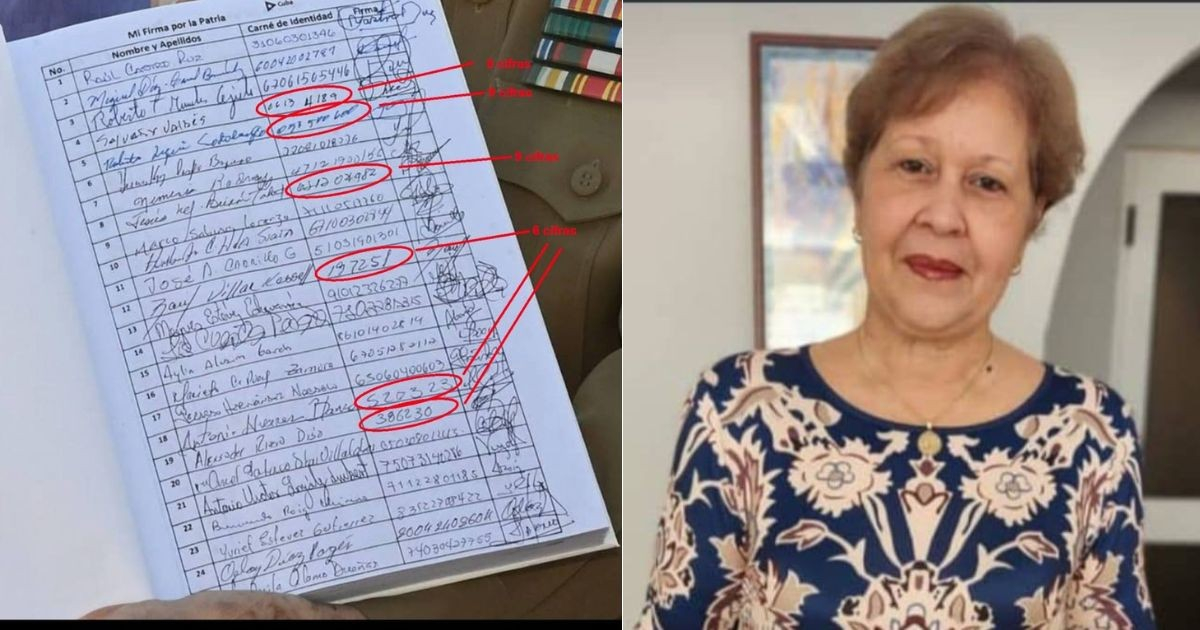
This complaint is supported visually by a photograph published on the official page "Presidencia Cuba," where Raúl Castro is opening the first guestbook. The image shows at least six ID numbers that have fewer than the required 11 digits. Among them is the one belonging to Vice President Salvador Valdés Mesa, whose number appears with only eight digits.
"The incredible thing is that one of the incomplete figures belongs to Vice President Salvador Valdés Mesa, which indicates the lack of seriousness taken in that act. If even the leaders themselves did not put in the effort, just imagine the rest of the people," concludes López.
The activist anticipates that the campaign will have political consequences similar to those of 2002, when the collection of signatures led to the declaration of the irreversibility of socialism in the Constitution: "This will have a sequel, just like it did in 2002. I don't know what they'll come up with now, although I have an idea." She promised to publish an article in the coming days with her analysis of what might be next.
Filed under: