
Related videos:
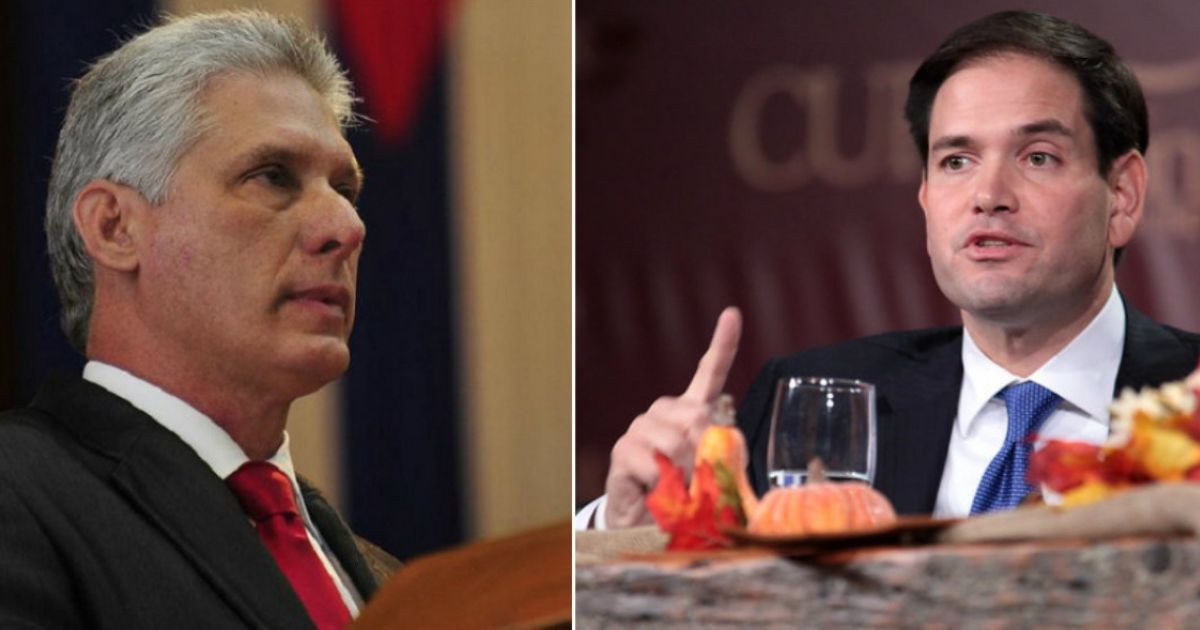
Miguel Díaz-Canel published a message on the social network X this Wednesday, directly responding to Secretary of State Marco Rubio, who publicly denied the existence of a U.S. oil embargo against Cuba last Tuesday and expressed "surprise" at what he described as a lack of knowledge regarding his own government's policy.
Rubio had stated at a press conference at the White House that "there is no oil blockade against Cuba as such", attributing the island's energy crisis to the end of free crude oil supplies from Venezuela, which were interrupted following the capture of Nicolás Maduro in early January.
Díaz-Canel responded by pointing out Executive Order 14380, signed by President Trump himself on January 29: "It is surprising that a high-ranking official of the U.S. government publicly declares that their government does not impose an energy blockade against Cuba, and that they are not aware of what is stipulated in the Executive Order of their own president."
The Cuban leader went further: "It is surprising that he has not heard his president and the White House spokesperson address the issue."
He also rejected Rubio's claim that the "alleged incompetence" of Cubans is to blame for the economic crisis: "It is equally surprising that he blames the supposed incompetence of Cubans for the difficulties the economy faces, which the U.S. government itself has aimed and continues to aim to destroy, investing substantial resources and political capital to achieve it."
The chancellor Bruno Rodríguez Parrilla had already responded to Rubio on Wednesday in similar terms, accusing him of "lying" and "contradicting the President and the Spokesperson for the White House", and labeling him the "architect of the blockade."
Executive Order 14380 declared Cuba an "unusual and extraordinary threat" to the national security of the United States and imposed secondary tariffs on any country, shipping company, or entity that supplied oil to the island, reducing Cuba's energy imports by 80% to 90%.
The situation on the ground is devastating for the population: power outages of up to 25 hours daily in more than 55% of the territory, worsened by the breakdown of the Guiteras thermoelectric plant, which raised the energy deficit to 1,750 megawatts.
Russian oil, which arrived as a partial alternative to Venezuelan supply, barely meets 10% of Cuba's energy needs, while Cuba produces around 40,000 barrels daily against a demand ranging from 90,000 to 110,000.
On May 1st, Trump signed a second executive order that expanded sanctions against the regime to sectors such as energy, defense, mining, and finance, including secondary sanctions against foreign banks that operate with sanctioned Cuban entities.
The exchange occurs at a moment of heightened tension: last Sunday, Díaz-Canel invoked the doctrine of the "War of All the People" and warned of an alleged imminent military aggression from the United States, while Rubio anticipated that "things are going to change" without specifying concrete measures, describing Cuba as "an unacceptable situation" 90 miles from U.S. shores.
Since January 2025, the Trump administration has imposed over 240 sanctions against Cuba and intercepted at least seven oil tankers intended for the island, while the Cuban economy is projected to contract by 7.2% in 2026, according to The Economist's Intelligence Unit.
Filed under: