
Related videos:
The Secretary of State Marco Rubio announced last Thursday a new package of sanctions against Cuba that included the designation on the SDN List of Ania Guillermina Lastres Morera, executive president of GAESA, and the mining company Moa Nickel S.A., among 12 officials and seven military and security entities.
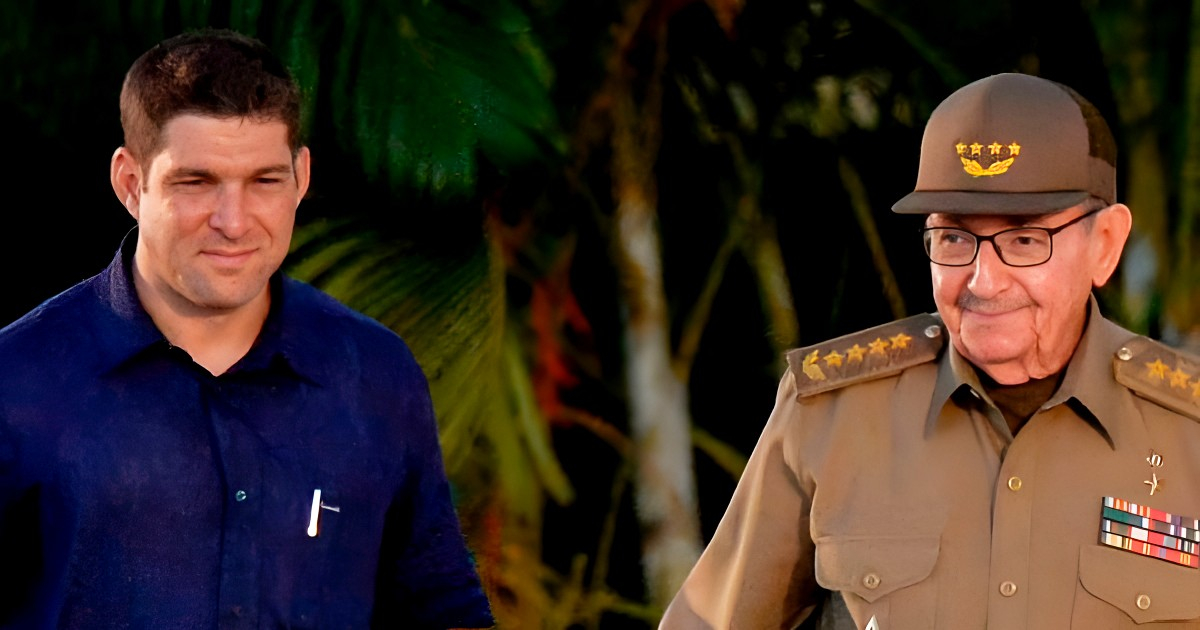
A figure, however, stood out for their absence: Raúl Guillermo Rodríguez Castro, "El Cangrejo," grandson of Raúl Castro, director of his personal security and allegedly the "heir" to the keys of the vault of the Business Administration Group S.A. (GAESA), the conglomerate that holds a significant portion of the national wealth in the hands of the regime's elite.
The omission is noteworthy for several reasons. Currently, only eight Cubans are listed on the SDN List —the most severe sanction from the Treasury Department, which involves asset freezing and financial blocking— and El Cangrejo does not appear among them, despite being the son of the late general Luis Alberto Rodríguez López-Calleja, former president of GAESA and the first Cuban individually sanctioned by Washington in 2020.
Neither Raúl Castro, Miguel Díaz-Canel, nor Alejandro Castro Espín (son of Raúl and head of the regime's intelligence services) are listed in the SDN. The three of them only face immigration restrictions under Section 7031(c), which prohibits their entry into the United States but does not freeze assets or block financial operations.
The contrast with other sanctioned regimes is hard to ignore. Russia has more than 1,500 individuals included in the SDN due to the war in Ukraine; Venezuela exceeds a hundred. Cuba, after more than six decades of dictatorship, the events of July 11, and thousands of documented arbitrary detentions, only has eight names.
Among the hypotheses to explain the exclusion of El Cangrejo, one points to its role as a active communication channel between Washington and Raúl Castro's circle. Since February 2026, advisors of Rubio have held meetings with Rodríguez Castro in Basseterre, the capital of Saint Kitts and Nevis, in encounters described as "surprisingly friendly" and focused on the "future" of Cuba.
In April, a delegation from the State Department landed in Havana on the first official U.S. flight since 2016, and a senior official held a separate meeting with El Cangrejo.
Days later, Rodríguez Castro attempted to establish direct communication with Donald Trump through a letter sent via Roberto Carlos Chamizo González, an agent of MININT, which arrived in Miami on April 18, although the attempt was unsuccessful.
This logic, however, could be reversing the model that Washington applied in Venezuela with Delcy Rodríguez. The current Venezuelan head of state
In other words, the United States initially employed maximum sanctions as a pressure mechanism and later offered to lift them as a political incentive for compliance. Trump even stated that Rodríguez was "doing a good job."
However, the process has become stalled. The Penal Forum records only 768 confirmed releases compared to the 8,616 claimed by the Venezuelan government, and Rodríguez announced the end of the Amnesty Law just two months after its enactment.
In response, Senator Rick Scott demanded this Friday that the Trump administration immediately reimpose sanctions against Rodríguez, whom he referred to as “the head of a cartel,” following the confirmation of the death of political prisoner Víctor Hugo Quero Navas.
The question that arises then is whether Washington should apply the same formula in Cuba: first include Raúl Castro, Alejandro Castro Espín, and Raúl Guillermo Rodríguez Castro on the SDN List to force them to sit down for negotiations, offering removal from the list as a real incentive for genuine transition.
In that case, the same logic applied in Venezuela would be used: increasing the personal and financial cost of the regime's resistance with the inclusion on the SDN List, and leaving open the possibility of lifting those sanctions only in the presence of verifiable progress towards a real transition, which would serve as an "incentive."
Although the Cuban opposition has already demanded that the Castro family be excluded from any transition process, the Venezuelan model suggests that SDN sanctions, if applied effectively —and accompanied by a credible demonstration of strength like the surgical operation carried out on January 3 in Caracas—, could be the lever that compels a negotiation which the regime currently has no real incentives to accept.
Rubio, while announcing the new measures, left that door open: «More sanctions against the Cuban regime will come in days and weeks».
Filed under: