
Related videos:
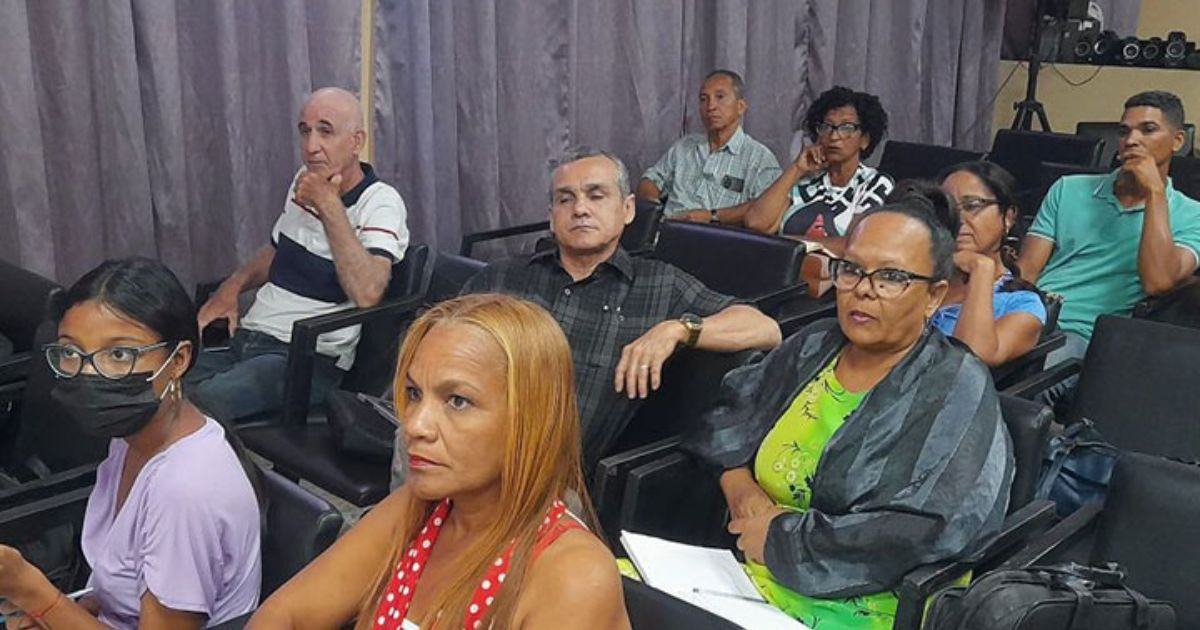
The territorial delegation of Citma in Guantánamo convened an exchange this Friday between state and private economic actors to promote "circular economy" as a key tool to improve the quality of life for Guantanamo residents and move towards an environmentally clean environment.
The event brought together entrepreneurs, small and medium-sized enterprises (SMEs), and representatives from Poligráfica, Confecciones Ámbar, Muebles Imperio, Cárnico, Education, Agriculture, and Food sectors. The stated goal was to identify support needs for business expansion, certify activities, formalize their legality, and connect with the state sector, reported the Cuban News Agency (ACN). An impeccable purpose on paper, like almost everything in Cuba.
The meeting took place in a province where, according to the data presented at the event, around 1,600 cubic meters of garbage end up in landfills and streets. This is not due to a lack of debates or strategies, but rather because the system meant to collect it has been in collapse for decades.
The circular economy is a model of production and consumption that seeks to reuse, repair, and recycle materials and products to extend their life cycle. Among the specific experiences presented at the meeting, the brothers Yoangel and Yoandri Cantillo from the community of Los Cocos stood out, as they grind around 70 pounds of plastic daily to manufacture coat racks, toothpicks, small bowls, cups, and buckets. Yoangel Cantillo noted that they could scale up production to 46 tons of reused plastic per year, with aspirations to produce slabs and blocks where plastic replaces gravel, the source reports.
However, electrical instability prevents them from milling regularly. The solution found in the exchange was for the Poligraphic, an energy-independent center, to provide them with electricity and even a space. In other words, to recycle plastic in Cuba in 2026, one must rely on a state center having its own power supply, because the national electrical grid is unreliable. Only 43% of the plan for recovering the electro-energy system was executed in the first quarter of the year, according to an evaluation by the State Council released on May 14.
Another experience presented was that of the small and medium-sized enterprise Bebidas y Alimentos Oliverfe, from Imías, which transforms bottles and nylon into caps using a small motor of its own design, and produces tomato puree, fruit vinegar, and cocoa from cocoa waste. They also mentioned tires and fabrics to make tablecloths and pillows, offcuts from the Poligráfico to create notebooks, and briquettes made from sawdust as a substitute for charcoal. Engineering scarcity elevated to public policy.
Alexander Fernández, head of environmental policy at Citma in Guantánamo, detailed financing options: bank loans, grant projects, and resources from the National Environmental Fund and international cooperation. A generous list of funding sources for a country that, according to CEPAL, will experience the largest economic contraction in Latin America in 2026, with a projected GDP drop of 6.5%.
Economist Pedro Monreal warned that in an adverse scenario, this decline could reach 15%, matching the worst year of the Special Period, when GDP shrank by 14.9% in 1993.
The Guantanamo debate occurs in the context of a government economic program presented in May 2026 with 10 general objectives, 111 specific objectives, 505 actions, and 309 indicators. A monumental bureaucratic architecture that, according to the evaluation by the State Council on May 14, managed to meet only 39.5% of the objectives for the first quarter and 41% of the planned actions. The pattern of plans without execution is as old as the dictatorship itself, and the exchange in Guantanamo is another link in that chain: while the circle of forums, strategies, and indicators continues to grow, the streets remain filled with garbage and power outages persist.
Filed under: