
Related videos:
The Cuban writer and improviser Juan Carlos García Guridi published this Thursday on his Facebook profile a sonnet titled "Cuentan" that powerfully encapsulates the historical and contemporary frustration of Cuba: a country that, in his own words, "remains in words, in promises."
The poem, consisting of 14 verses arranged in the classical sonnet form—two quatrains and two tercets—opens with a question that strikes directly at the Cuban collective consciousness: "What country is this that we have been given? / It remains in the word, in the promise; / I see a cross that pierces the soul, / who cursed it, who has betrayed it?"
What follows is not merely a denunciation of the present, but a deliberate journey through the history of broken promises that even predates the Revolution.
The speaker of García Guridi's poem outright rejects the official argument that has served as a shield for the regime for decades: “Don’t talk to me about Batista, about the past / what you’re going to say doesn’t interest me; / I prefer to talk about the world that weighs on me, / about Zayas, Grau, Prío, and Machado...”
By invoking those four presidents of the Republic prior to 1959, the lyrical subject of the poem may be alluding to a series of failures that transcend any particular regime: Alfredo Zayas governed from 1921 to 1925 amidst an economic crisis and accusations of corruption; Gerardo Machado campaigned under the slogan "water, roads, and schools" and ended up as a dictator suppressing the opposition; Ramón Grau San Martín promised "Cuban identity," and his term was marked by gang violence and political turmoil; Carlos Prío Socarrás came in with reforms, but his presidency was associated with gangsters and embezzlement.
The message is clear: Cuba's problems did not begin in 1959, nor will they end with a change of leadership; we need to build the country we owe ourselves.
The central tercet of the sonnet introduces a reference that many readers will immediately recognize: "They say that a repeated lie / becomes the truth, and that life / speaks of the sublime with the harsh." The allusion to the propaganda principle attributed to Joseph Goebbels, applied here to the Cuban political discourse of decades, requires no further explanation for those who have lived under that discourse.
The poem concludes with a statement of perplexity that also reflects a sense of detachment: "I am neither Fidel nor Raúl / and as I write, sing, and make mistakes / I don't know what kind of country this is..." With these verses, the lyrical speaker depicted by García Guridi distances himself from any identification with revolutionary power and asserts his voice as that of an ordinary citizen, bewildered by what he has inherited.
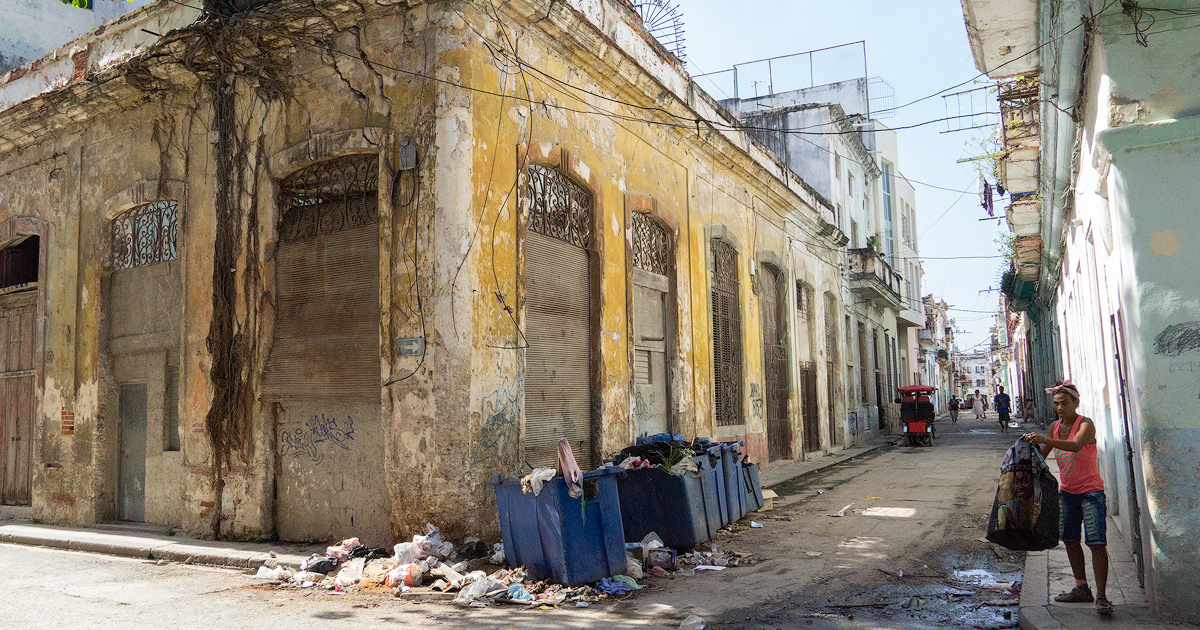
The sonnet arrives at a moment when Cuba is experiencing one of its worst energy crises: blackouts lasting over 20 hours a day in many provinces, a record electricity generation deficit of 2,153 MW recorded on May 13, and an economy in structural contraction that the government itself admitted back in December 2025 would make 2026 a "difficult" year. The image accompanying the verses is precisely of a blackout.
In April of this year, over 1,100 protests, complaints, and expressions of discontent have been recorded in the country, according to reports, and the Electric Union had forecasted blackouts since December 2025 that would affect up to 61% of the territory simultaneously: the reality has been much worse.
It is not the first time in recent days that García Guridi uses poetry to highlight the Cuban crisis. On May 29, the same poet published a humorous décima about the possibility of a U.S. military intervention — with the USS Nimitz aircraft carrier deployed in the Caribbean and Donald Trump's statements regarding Cuba — which also circulated widely on social media.
In that tenth, the tone was one of dark humor; in "Cuentan," humor gives way to gravity, and despair transforms into poetry.
García Guridi, born in Batabanó in 1968, is one of the most active cultivators and researchers of décima and popular poetry in Cuba, with over a dozen published books. The sonnet "Cuentan" represents, in fourteen verses, what millions of Cubans feel but do not always find the words to express.
Filed under: