
Related videos:
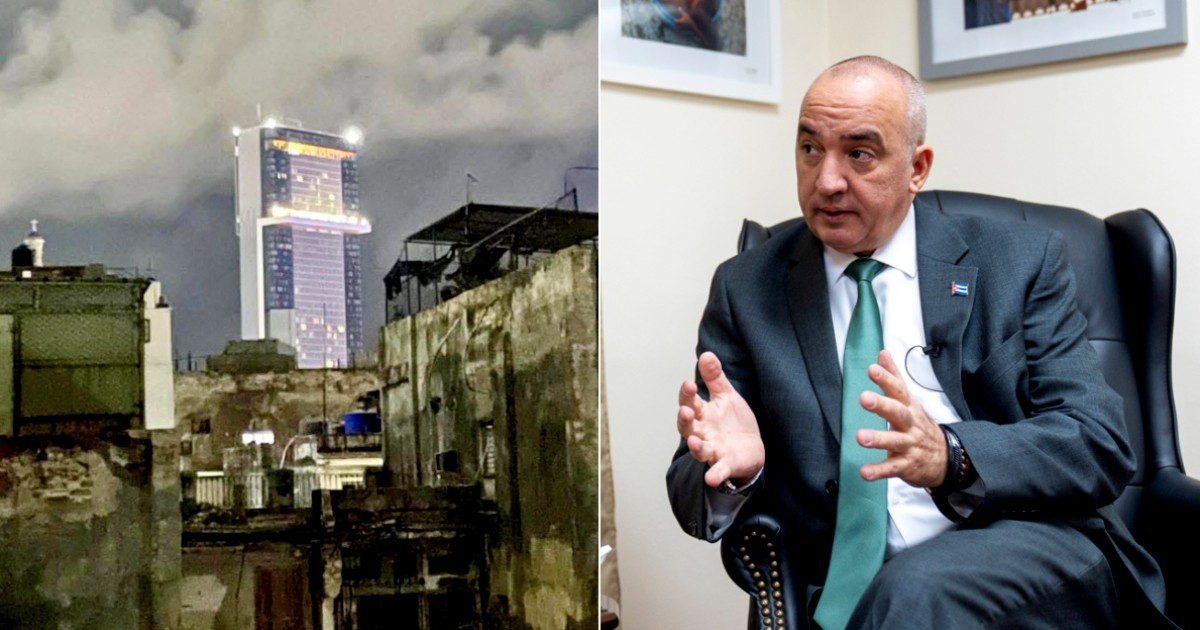
The permanent representative of the Cuban regime to the United Nations, Ernesto Soberón Guzmán, stated in an exclusive interview with the pan-Arab network Al Mayadeen that Cuba is working to build "a different reality", a system that preserves the "achievements made since 1959" and provides the best conditions for its population.
The phrase is the latest euphemism in a long chain of formulations from the official Cuban discourse —“different democracy”, “rare dictatorship”, or “people's dictatorship” — that seek to present the single-party regime as a legitimate political pathway, while in practice the repressive apparatus continues to "construct a painful reality" for tens of thousands of families.
The "different reality" described by the regime is also reflected in its economic priorities. While hospitals face shortages of medications, deteriorated medical equipment, and long waiting lists for surgeries, the State has dedicated significant resources for years to the construction of hotels and tourism projects controlled by military conglomerates.
The contrast is evident for Cubans who endure prolonged blackouts, a lack of drinking water, a public transport crisis, and an increasingly deteriorating healthcare system, despite the official discourse insisting on presenting these sectors as achievements of the so-called "revolution."
Another expression of that "different reality" is the growing gap between the ruling elite and the population. While high-ranking officials, companies connected to those in power, and privileged sectors have access to foreign currency, well-stocked stores, and better living conditions, millions of Cubans survive on insufficient wages, face uncontrolled inflation, and depend on remittances or the emigration of family members.
The official narrative speaks of social justice and equality, but daily life reveals a society marked by profound inequalities, increasing poverty, and the massive exodus of citizens who see no prospects for the future on the Island.
These "different realities" were not mentioned by Al Mayadeen because it is not a neutral outlet: Miguel Díaz-Canel himself identified it as a "natural partner" of the regime in its international communication strategy, alongside Sputnik and Cubadebate, to combat the "communication aggression" against Cuba. The interview with Soberón is, therefore, a product of that propaganda strategy.
While the diplomat speaks of building "a different reality," Prisoners Defenders documented 1,260 political prisoners in Cuba in April 2026, and the Cuban Observatory of Human Rights recorded 3,179 repressive actions and 529 arbitrary detentions just in 2025.
The Cuban Observatory of Conflicts documented more than 11,000 protests and civic actions that same year, an increase of over 25% compared to 2024. The "different reality" constructed by the regime is, in essence, the perpetuation of a system whose Constitution declares socialism "irrevocable" in its article 4.
In the interview, Soberón Guzmán described a Cuba subjected to "an economic war with severe humanitarian impact" and warned of a "real risk of military aggression" from the United States. He explained that the oil blockade imposed on January 29 drastically reduced fuel supply: "Cuba needs eight tankers per month. In five months, we received one."
However, the regime official also cited the May 1st parade as evidence of massive public support, claiming that "half a million people in Havana and more than six million across the island" took to the streets. However, the independent press described the event as a forced mobilization with low spontaneous attendance and a strong security presence.
The diplomat described the accusations from the U.S. Department of Justice against Raúl Castro regarding the shooting down of Brothers to the Rescue planes in 1996 as "slanderous," asserting that they aim to create a divide between the government and the people. The formal charges were presented on May 20 by a federal grand jury in Miami.
At the end of the interview, Soberón Guzmán appealed to the world: "All we ask is: let Cuba live. Let the Cuban people advance and build their own future." This statement aligns with Díaz-Canel's assertion in July 2024 before the National Assembly: "we will never accept the facade of democracy from the United States."
“No tell me that the blame lies with the inefficient government, the brutal government or dictatorship... What dictatorship is there in Cuba?” Díaz-Canel asked on July 12, 2021. “The dictatorship that exists to ensure that everyone is a little better off, the dictatorship we create for everyone. That is the dictatorship...”
Filed under: