
Related videos:
If someone had told me that five years after July 11, I would be coordinating a discussion about the fate of my nation, I wouldn't have believed it. Moreover, I would not have believed that after those protests, the dictatorship would remain in power for another five years, that prisoners would still be imprisoned, that they would pull out of nowhere another equally failed and absurd economic policy as the previous ones implemented, and, of course, I would not believe the idea that we would meet a new ruler from the socialist royal family.
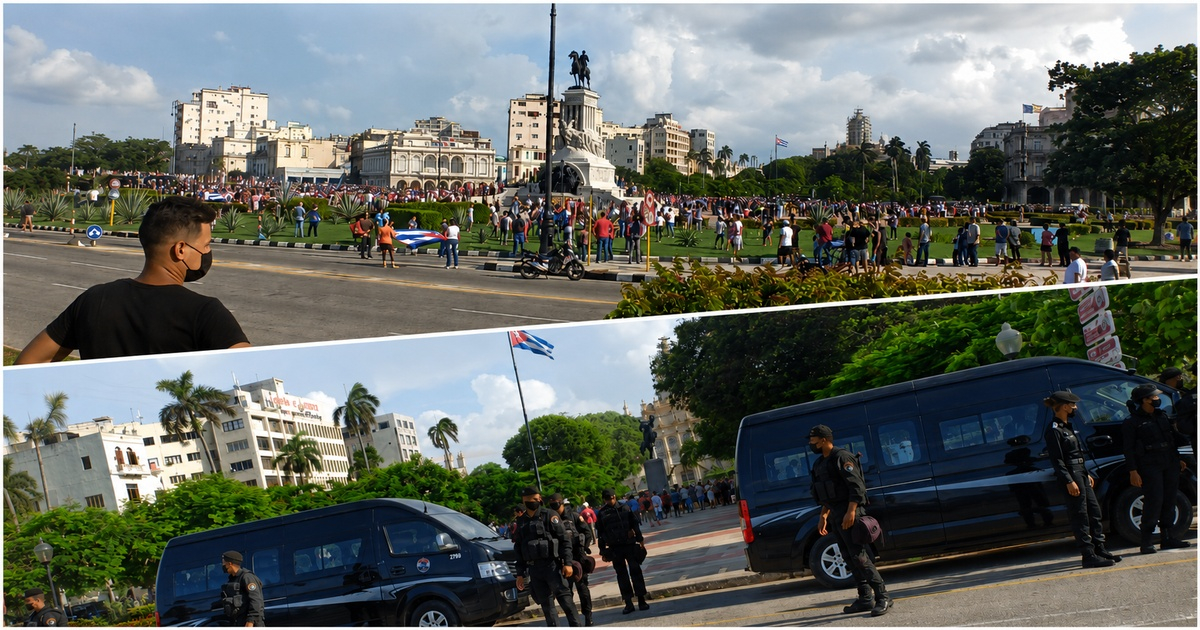
On July 11, 2021, I was just another mother standing in line at the doors of the newly opened dollar stores, whispering about the abuse that it meant to dollarize the economy. Like others, I was outraged by the double standard perpetuated by official media and suffered every time my children asked me for the most basic things and I had no way to provide them. The frustration that grew in every household was real, tangible like a mountain, but if I'm honest, no one in my closest circle thought that a demonstration of such magnitude, or even a small protest, would take place. The doctrine enforced for years, from educational institutions to media outlets, immobilizes you to such an extent that you start to believe that the power will remain intact and static, even against our will, while we can do nothing to change it.
The little we knew about the young people from the Movimiento San Isidro deeply impressed us, but we were always overwhelmed by the idea that they were exceptional beings and that in our society, filled with a culture of speaking softly, it would be impossible for others to emerge with the same courage they possessed, enough to change the system. Psychological immobility is too strong; preconceived stigmas, fears of public exposure, cruel repression, and above all, the fear of losing more freedoms than those we had relinquished years ago paralyze us.
I remember well that during those times, the only topics of conversation were about how to survive or how to escape, and we would hide at home where no one could see us to read articles from the independent press and recognize that they held the truth in their hands. The portrait of society they reflected resembled more closely the society in which I lived. The censorship from the government distanced us from the usual press, and with that process, the period began during which some of us started to detoxify ourselves. Even so, the awakening of national consciousness is slower for some than for others, and of course, more complex if you are not organized. The mobile data packages offered by ETECSA were extremely expensive, so some of us would connect occasionally, and consequently, many learned about the demonstrations due to Canel and his infamous discourse of violence and hatred.
The puppet buried his political career the day he gave the order to fight. His indifference and lack of empathy were the final blow that the people needed to understand that there are two sides: those of us who suffer under the system and those who benefit from it. In many homes, we thought that day would mark the end of the dictatorship, and when we saw it still standing, we believed that protests would multiply time and again. With the disconnection of the power grid and all means of communication, we were overwhelmed by profound uncertainties. It was impossible not to think about the demonstrators and their families. The messages flooding social media made us believe that at some point, a reconciliation would be sought, even if only as a power strategy, to display empathy where there is only neglect. However, harsh reality revealed the darkest side of dictators, with exemplary and stigmatizing lessons, reflecting a clear racial and rural bias. But repression is a double-edged sword: on one side, it immobilizes through fear, but on the other, it ignites the repressed desire to be free.
Never before had the topic of freedom been discussed so much in Cuba as it was at that moment, at least not in recent years. An important part of the nation chose the path of exile because the regime itself sought an escape route through emigration to relieve the social pressure that had preceded the protests. To think that in just 5 years, Cuba went from having over 11 million citizens to nearly 9 million should be a clear signal to the world that Cubans have lost faith in the system. The exodus is a clear response to the crisis, but also to the management. Those who believe the system is functional and are involved in a contest stay and await a blossoming because they trust that its functionality will resolve the conflict. However, those who have already lost faith in the management understand that no policy implemented will solve the problems and choose to leave the ship.
Since July 11, we are not the same. Our reality has become dehumanized, and the very party that promised social benefits has cut public spending to unimaginable levels. After feeling the disdain of the people, they decided to remove their masks of manipulation and act under the public spotlight of hatred and indifference. In just 5 years, we have faced tragedies resulting from negligence, epidemics caused by garbage invasion, total loss of electrical infrastructure, economic packages accompanied by dollarization, and an increase in military violence.
Who could believe that prosperity and respect would come hand in hand with the violent, the greedy, the indifferent? Five years after July 11, they present capitalist measures to sell the transformation and adaptation of the system to the needs of its citizens, yet justice is not mentioned. Mutating like a virus into a more powerful phase that includes social acceptance, international legitimization, and buying time is part of the strategy, because now we also sense that atmosphere of pressure we experienced in the days leading up to July 11, 2021. We are not the same, but neither are they. They offer interviews to international media to forge alliances and try to engage in dialogue with the northern neighbor that keeps them up at night; but at home, the little room remains just the same.
Anyone who thinks that changing the economy will solve Cuba's problems is not only naive but also immoral. Justice is not a secondary issue; it is the main course on this menu. Those who are unjust to one person in order to maintain their power do not hesitate to do the same to another when they pose a threat. Humanity is not negotiable, and today being human means understanding that the republic we want to build does not begin by promoting economic changes but by fostering structural changes and individual freedoms.
Filed under:
Opinion piece: Las declaraciones y opiniones expresadas en este artículo son de exclusiva responsabilidad de su autor y no representan necesariamente el punto de vista de CiberCuba.