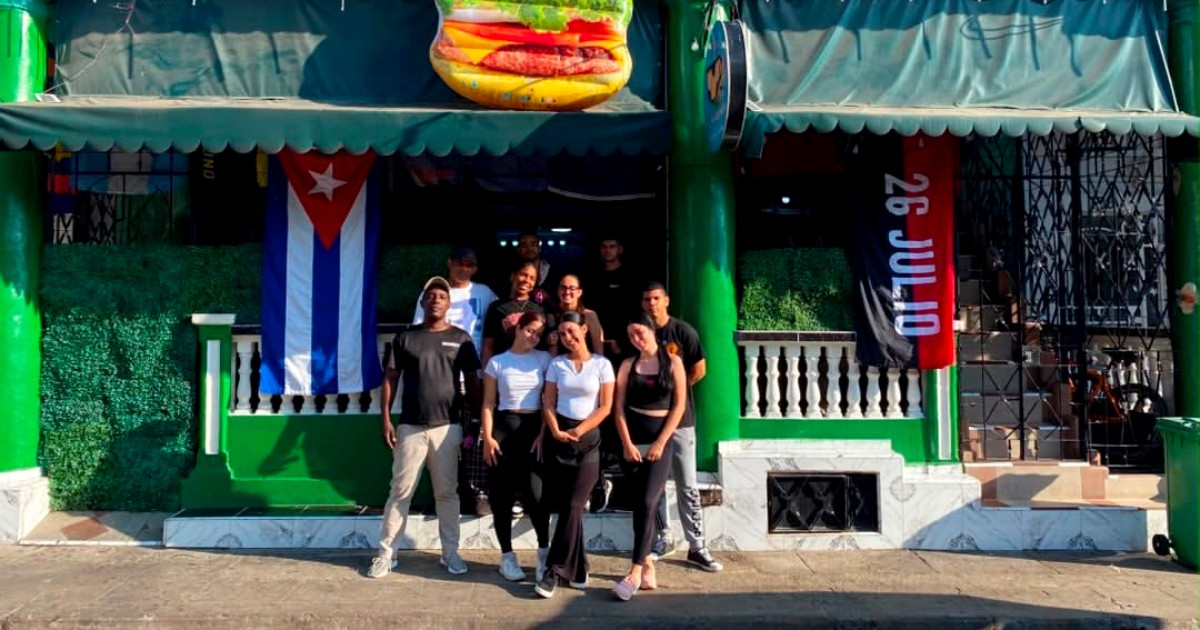
The fast food restaurant La Masía 24H, located in Pinar del Río, joined the celebrations for National Rebellion Day this Sunday with a post on its Instagram account, showcasing the Cuban flag and the flag of the 26th of July Movement on the facade of its establishment, stating it is "proud of its team and its homeland."
"Alongside the Cuban flag and the 26th of July flag, we reaffirm our respect for our history and our desire to continue providing the best service to every customer who visits us," the business wrote in its message, which garnered 91 reactions.
The gesture of La Masía 24H —a venue with 24-hour service offering hamburgers and pizza— is part of an increasingly visible pattern: that of Cuban private businesses expressing public support for the regime during politically sensitive times.
This Sunday marked the 73rd anniversary of the assault on the Moncada Barracks, an event that the regime presents as the beginning of the so-called "Cuban revolution," which is celebrated annually with political events, fairs, and mobilizations throughout the country.
In this context, private operators in Cienfuegos reopened iconic dining spaces such as Covadonga, Coppelia, and El Cairo ahead of schedule, while in Havana, agro-industrial and commercial fairs were organized with the participation of small and medium-sized enterprises and cooperatives. In Granma, an agro-commercial fair offered prices that were aligned with salaries in the framework of July 26.
The regime has managed to capitalize on these initiatives to project an image of unity between the private sector and the official political project.
The clearest precedent for this instrumentalization dates back to 2023, when the mipyme Cubamodela paid for the first commercial advertorial in Cubadebate, marking the beginning of private advertising in the official press.
Between September and October of that year, the Ideas Multimedio group received over 712,000 pesos for paid advertising by small and medium-sized enterprises.
However, the relationship between the private sector and the regime is far from idyllic.
The government approved Resolution 225/2024, which set maximum prices for basic products sold by small and medium enterprises (mipymes), and began to fine those who violated it, leading to the closure of 12 businesses in Las Tunas for breaching the price caps.
The regime itself later acknowledged that this policy had caused a shortage of chicken in small and medium-sized enterprises.
In June 2026, the regime approved 176 economic measures that include the obligation for private actors to support elements of state social assistance, such as pensions and funeral services.
Weeks later, Prime Minister Manuel Marrero Cruz publicly called on "bold entrepreneurs" to join the regime's economic project.
Analysts describe the public alignment of private businesses with the official discourse as a survival strategy in an environment where the State controls licenses, supplies, and regulations, rather than as genuine ideological support. Others link it to corrupt practices and the proliferation of frontmen for public figures of the regime.
Even so, the display of revolutionary symbols by small and medium enterprises has a real propaganda effect that the regime takes advantage of to project an image of popular support for its political agenda.
Related videos:
Filed under: