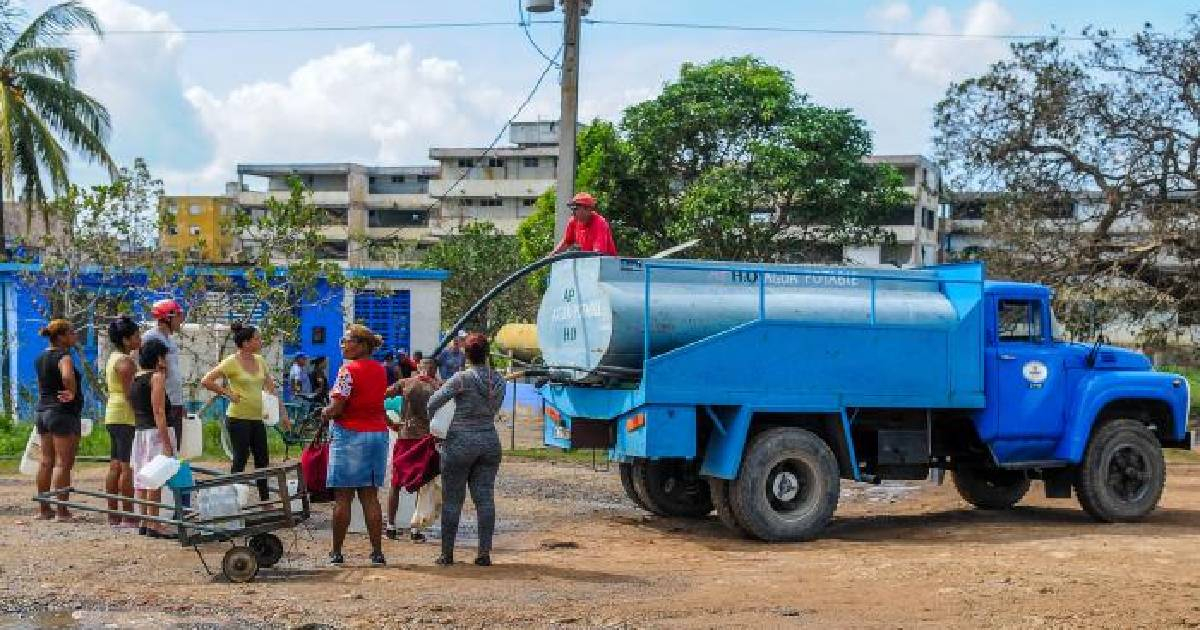
The playwright and theater director from Pinar, Irán Capote, published this Sunday on his Facebook profile a "parodic poem" about the water supply service in Cuba, which quickly became a reflection of the collective desperation of Cubans without regular access to drinking water.
Capote resorted to the metaphor of the horizon —so popular after President Miguel Díaz-Canel's erroneous quote of Eduardo Galeano— to depict the unfulfilled promise of water supply: «Aqueduct is on the horizon. And when thirst approaches two steps, Aqueduct retreats ten steps. What good is Aqueduct? To suffer from thirst…».
The post sparked an avalanche of comments in which Cubans acknowledged their own daily reality, blending laughter with bitterness.
The playwright Norge Espinosa Mendoza, a prominent figure in Cuban theater, responded sarcastically: "SEN-pre is 26!", referring to the National Electric System — as each blackout brings the water cutoff and exacerbates the water crisis —; and to the old revolutionary slogan that all days on the calendar are the 26th of July, the day of the Assault on the Moncada Barracks led by Fidel Castro in 1953.
Capote himself, faced with the avalanche of reactions, merely responded: "Everything has its philosophical explanation."
The comments from internet users painted a stark picture of the situation. One person wrote: "The aqueduct serves to keep us awake at night waiting for the precious liquid, to pay for water trucks at an unaffordable price, to carry water like animals, and for nothing else." Another noted: "The aqueduct serves to enrich two or three people who sell water trucks for 10,000 pesos, and no one puts a stop to it. They quickly understood what the socialist mafia is all about."
There were those who added the energy factor: "And suddenly... When it's your turn in the little cup of water... Paraparapan... The SEN goes down." Others simply asked, "Does the aqueduct still exist?" or confessed, "One laughs to avoid crying."
The irony of Capote reflects a supply crisis that reached alarming proportions in 2026 across the island. According to data from the National Institute of Hydraulic Resources cited in May 2026, about 2.7 million Cubans were suffering from severe difficulties accessing potable water, while several million others received the service intermittently.
The pumping system operates with only 37% of the necessary fuel, and 87% of the aqueducts depend on the National Electric System, turning each blackout into a simultaneous and unavoidable water crisis.
In Pinar del Río, Capote province, the situation is particularly serious. In Entronque de Herradura, residents have been without regular water service for over two years, paying up to thousands of pesos for a water truck. In Viñales, the shortage exceeded six continuous months in May 2026.
The informal market for water tanks has flourished in the wake of the collapse of state services: prices skyrocketed from around 3,000 or 4,000 pesos in 2025 to over 10,000 pesos in July 2026, depending on the area—figures that are unaffordable for most Cubans.
Capote, who holds a degree in Theatre Arts from the Higher Institute of Art, won the 2019 Calendario Prize for Dramaturgy and the 2025 Villanueva Prize for Criticism. In November 2022, the UNEAC of Pinar del Río prevented him from taking a teaching position for ideological reasons, an episode that marked his public relationship with the cultural institutions of the regime.
A user summed up the widespread sentiment regarding the post: "That muse of yours has a sense of the historical moment. I laugh, but no, I actually want to cry."
Related videos:
Filed under: