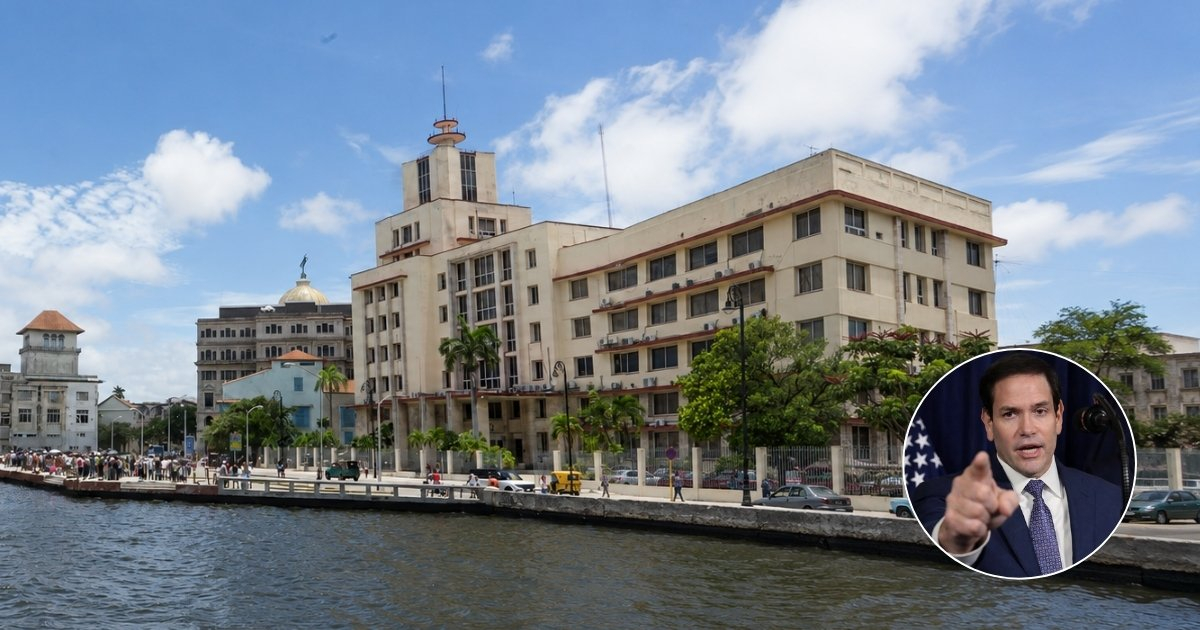
The U.S. State Department issued a direct warning this Friday to foreign companies operating with the Business Administration Group S.A. (GAESA) and labeled them as accomplices in the corruption scheme of the dictatorship.
The message was posted on the official account of the Bureau of Western Hemisphere Affairs on X, where it described the business group of the Revolutionary Armed Forces not as an isolated company, but as a much broader structure.
GAESA is not just a company. It is a vast corrupt network that controls hotels, stores, real estate, transportation, finance, and more of the regime, says the text.
The publication directly targeted foreign investors for partnering with a state-owned company to operate on the island.
«Foreign companies wishing to invest in Cuba must partner with a Cuban state-owned company, which makes them accomplices in the dictatorship's corruption scheme. This is why the Trump Administration has imposed secondary sanctions on all companies doing business with GAESA.»
The tweet included a network diagram that illustrates the interconnections between entities of the conglomerate, including Transgaviota and FINCIMEX, two of the most active subsidiaries of the group in the transportation and finance sectors.
The warning comes a day after the U.S. imposed new sanctions on five Cuban entities and eight individuals linked to arms acquisition and military cooperation, including GAESA subsidiaries such as Tecnoimport and Tecnotex, as well as the Minister of the FAR Álvaro López Miera and the Chief of Staff Roberto Legra Sotolongo.
The offensive against GAESA officially began in May 2026, when the U.S. sanctioned the conglomerate under Executive Order 14404 and granted a deadline for foreign companies and financial institutions until June 5 to sever ties without consequences.
Once that deadline has passed, any transactions with GAESA or its subsidiaries expose third parties to measures from the Office of Foreign Assets Control (OFAC), which include asset freezing under U.S. jurisdiction, prohibition of transactions with individuals or entities in the U.S., and loss of access to the North American financial system.
Since then, the rounds of appointments have not stopped. On June 4, the U.S. sanctioned the Ministry of the Revolutionary Armed Forces and other military entities.
On July 23, it expanded the sanctions against the conglomerate, adding nine entities and two high-ranking officials.
The strategy behind this offensive, as revealed this Friday by Marco Rubio in a interview with Axios, is one of "maximum pressure" against the Cuban government and aims to close down, one by one, each mechanism that the regime uses to evade sanctions.
Related videos:
Filed under: