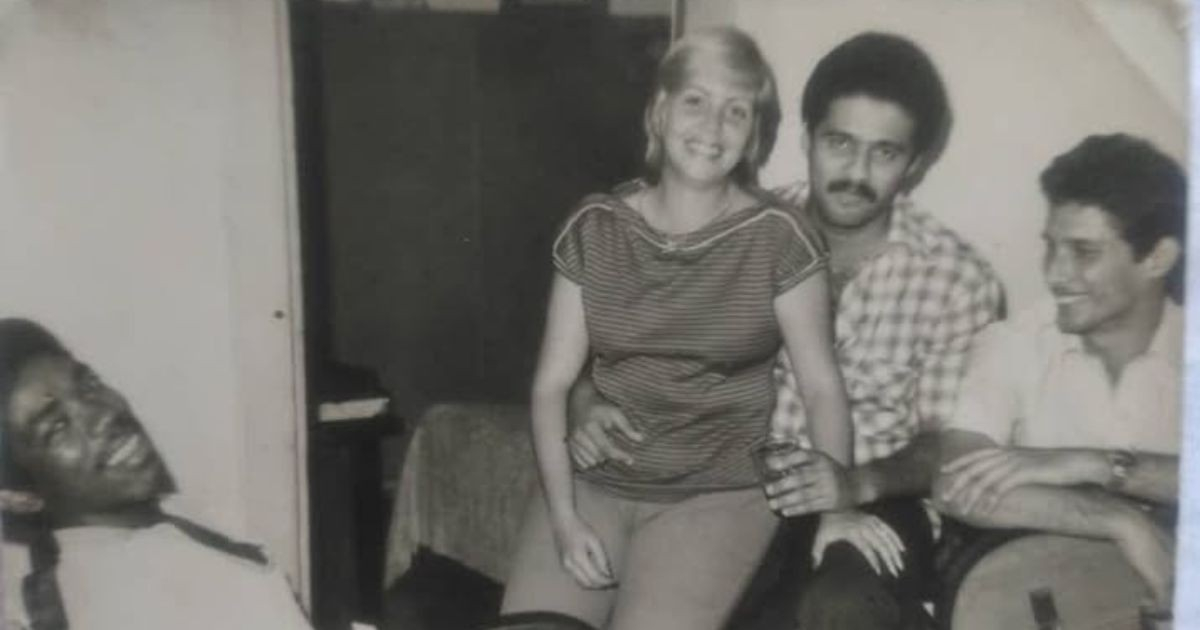
A Cuban identified as Violeta Pérez published on Facebook a lengthy personal testimony addressed to Miguel Díaz-Canel, whom she met in her youth in Santa Clara, articulating in an intimate and accusatory tone the transformation of a humble young man into the leader who, according to her, has plunged Cuba into misery.
The text, written in the second person with the tone of someone settling scores with a lost friend, traverses decades of shared history: from anecdotes of students at the Central University "Marta Abreu" of Las Villas (UCLV) to government decisions that, in the author's view, shattered the hopes of millions of Cubans.
"What a shame, Díaz-Canel... instead of promoting modernity, you arrived with the slogan of continuity, and while at first we thought it was the continuation of Raúl and his openness, we soon realized that your continuity was a regression to the darkest era of Fidelism," Pérez writes in one of the most striking passages of the publication.
The author recalls a young Díaz-Canel who inspired sympathy: modest, riding his bicycle as the provincial secretary of the Communist Party of Cuba (PCC) in Villa Clara, and showing up at work centers early in the morning for inspections. "The people loved you," she tells him directly.
This contrast between the past and the present is the axis of the narrative. Pérez describes the period from 2012 to 2018 under Raúl Castro as a time of relative openness—private work, the sale of homes and cars, internet access, travel abroad—which generated the expectation that Díaz-Canel would deepen it upon taking office in 2018.
What followed was quite the opposite. From that same year, the government began to restrict self-employed workers (TCP), limiting them to a single license per person. The author disdainfully cites a phrase attributed to the then-minister of the Ministry of Labor and Social Security: "the self-employed individual is a figure to address the unemployment problem; he must carry out the work with his hands, Cuba is not prepared to have rich people."
Meanwhile, Pérez points out that Luis Alberto Rodríguez López-Calleja, son-in-law of Raúl Castro, controlled more than 70% of the country's economy through the business conglomerate of the Armed Forces (GAESA), with an explicit ban on the self-employed (TCP) working in its facilities.
The breaking point came with the announcement of the Tarea Ordenamiento, which took effect on January 1, 2021, eliminated the convertible Cuban peso, and triggered a historic three-digit inflation, with prices skyrocketing between five and 13 times. "Your Tarea Ordenamiento was the dumbest thing you could have done, and it produced the results that were already known," Pérez writes bluntly.
Later came the protests of July 11, 2021, which began in San Antonio de los Baños and spread to over forty cities. The regime's response, in addition to violent repression, included hundreds of arrests, and there are currently more than 300 political prisoners from that date, according to independent organizations.
The author intensely describes the country's deterioration and confronts her former friend: "It's too late, Diaz-Canel! You don't have time, people no longer want improvements, dialogue, or band-aids; they want freedom and since everything will continue to be terrible, tomorrow, or next month, or in December, they will come for you... because, in addition, the emigrants are united like never before against misgovernment and you are isolated internationally."
"You could have been the ruler who went down in history as the one who opened Cuba, unleashed its productive forces, and made the country great [...] but you chose to turn back, opting for the continuation of Fidelism," the author concludes, before closing with a personal statement: "From friends, we are now enemies because I have lost loved ones and have seen many tears because of you... and I never turn the other cheek."
The post generated dozens of reactions. Several internet users shared their own memories of a young Díaz-Canel. "People reveal themselves when they gain power. That's where the metamorphosis occurs," one wrote. Another pointed out that "between the lines, one can read the heart of someone disappointed by the life expectations that any Cuban had since his youth."
Another internet user captured the discredit and mockery directed at the leader by saying that "between the 'lemon base and the walk of utopia', he is the king of memes." Someone else remarked: "The only thing he has achieved is that he will be remembered as one of the worst presidents in the world."
The testimony circulates in a context of historical rejection of the leader: a national survey from April 2026 gave him an average score of 1.11 out of 5, with 93.7% of participants rating him the lowest possible.
Related videos:
Filed under: