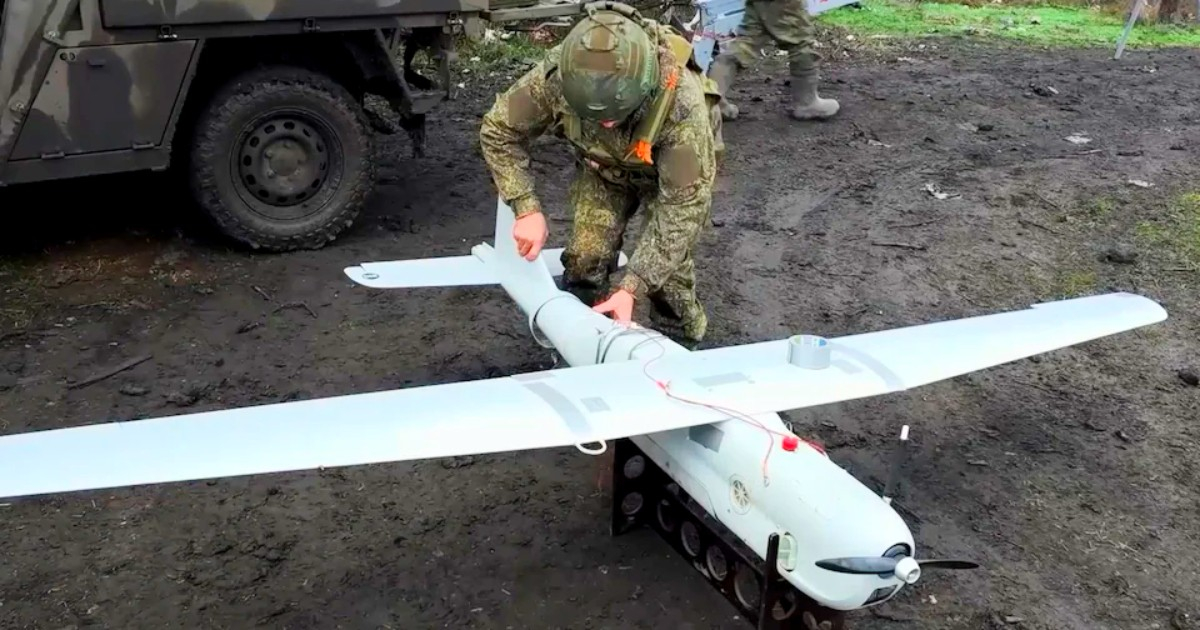
A report by the British newspaper The Telegraph revealed this Monday that Russia has established at least 10 secret bases equipped with launch platforms for its advanced long-range suicide drones, located along the Russian border with Belarus and Ukraine, capable of reaching NATO territory.
According to research by the British media, based on leaked documents and satellite images, analysts identified at least 59 new launch ramps —mechanical guide rails for the takeoff of fixed-wing drones— distributed in those border areas. Seven of the 10 sites have already been used in recent bombings against Kiev, according to tracking data from open sources.
What turns these sites into a direct threat to the Atlantic alliance is the range of the new Russian models. Moscow has rapidly modernized its version of the Iranian drone Shahed, developing the Geran-4 and Geran-5 variants, which are capable of reaching targets nearly 1,000 kilometers away and flying at speeds sufficient to evade air defense systems, according to leaked Ukrainian government documents online. Each device can carry a payload of 90 kilograms.
With this range, it would be possible to reach Warsaw, the capital of Poland, from the identified bases. About 20 of the newly installed ramps have an extended length, indicating their capacity to launch these long-range models. At least one of the bases has storage capacity for more than 1,000 drones simultaneously.
The Ukrainian military intelligence agency GUR also warned that Russia is equipping the Geran drones with air-to-air missiles to target the aircraft protecting Kyiv, representing a qualitative leap in the use of these autonomous systems.
Mike Monnik, executive director and founder of DroneSec, the intelligence firm specialized in drones that analyzed the satellite images, stated that the Kremlin has "significantly expanded" its network with the aim of "attacking Ukraine and keeping NATO states at risk of such attacks".
Monnik added that "this expansion of launch sites shows how Russia has increased its capacity to launch a greater number of drones while simultaneously using technology to make the types of drones employed harder to intercept."
The bases are supplied by several Russian ammunition factories, including the special economic zone of Alabuga in Tatarstan, a large-scale production campus. Some facilities have been converted from military bases and civil airports, while others were established directly in rural areas.
European and American intelligence officials believe that Russia is considering carrying out an armed provocation on Polish soil, missile or drone attacks against critical infrastructure, or false flag actions attributed to Ukraine.
This assessment comes weeks after U.S. intelligence warned that Putin might authorize hybrid operations and cyberattacks against allied territory to test the cohesion of the alliance, and just days after a Russian Kh-101 missile struck Polish soil at the end of July, leaving a 10-meter crater in an agricultural field 94 kilometers from the Ukrainian border.
NATO, which is experiencing internal tensions over the distribution of defense burdens between the United States and Europe, responded firmly.
A representative of the alliance stated to the Telegraph that they are "prepared to defend every inch of allied territory" and added: "Drones have fundamentally changed the nature of modern warfare and have become a decisive factor on the battlefield. We are rapidly expanding our capacity to produce, operate, and neutralize drones at scale."
Related videos:
Filed under: