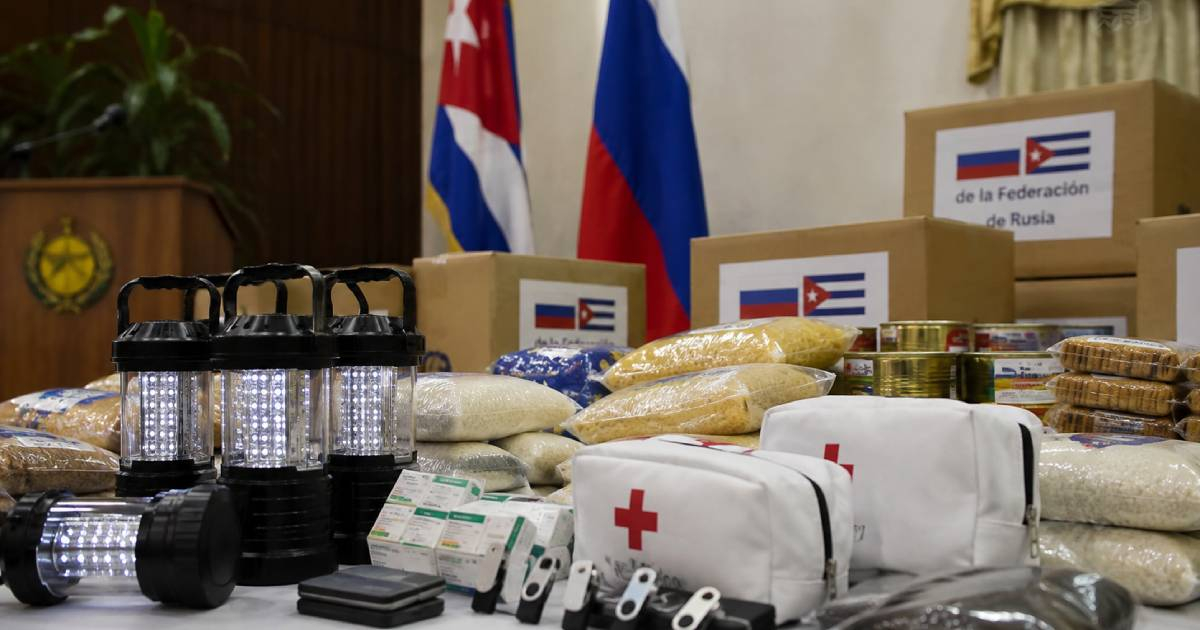
A delegation from the Russian Civic Chamber delivered a humanitarian donation in Havana consisting of food, sweets, portable flashlights, USB drives, and first aid kits, at a time when the Cuban population is facing a deep shortage of basic products and prolonged power outages.
The aid was delivered during a meeting with executives from the Cuban Institute of Friendship with the Peoples (ICAP), according to the state media Prensa Latina, which cited the Russkiy Mir.ru channel.
The visit of the Russian delegation took place within the context of activities organized by the Cuban regime to commemorate the centenary of the birth of dictator Fidel Castro, celebrated on August 13.
Among the items sent, the presence of portable lanterns is particularly significant in today's Cuba. The country is experiencing a severe energy crisis, with generation deficits that have exceeded 2,000 MW and power outages that in some areas can last for much of the day.
In that scenario, an object as basic as a flashlight has become a daily resource for many families to cope with nights in the dark.
Nikita Anisimov, a member of the Russian Civic Chamber and the Public Council of Rossotrudnichestvo—the Russian federal agency for humanitarian cooperation abroad—assured during the meeting that Moscow will continue its support for Havana.
"Russia stands in solidarity with Cuba and will continue to support it in all international forums where NGOs from its country participate," he stated.
On the Cuban side, the first vice president of ICAP, Noemí Rabasa, expressed gratitude for the donation and acknowledged the serious hardships currently faced by the population.
Rabasa admitted that Cubans "lack basic products such as medicines, fuel, and food."
The recognition is noteworthy amid an economic crisis that has rapidly deteriorated living conditions on the island. While the regime frequently blames the situation on U.S. sanctions, economists and critics also point to the burden of decades of inefficiency, a lack of structural reforms, and management mistakes.
The ICAP itself, host of the ceremony, was sanctioned by the U.S. Department of the Treasury last June under Executive Order 14404, as it was deemed an agency of the Cuban government.
Russia continues its aid shipments to Cuba
The delivery adds to other donations from Russia in 2026, at a time when Havana increasingly relies on the support of its allies to address shortages in essential sectors.
Just four days earlier, the arrival of three ambulances donated by Russia was announced, intended for medical services in Havana, Matanzas, and Santiago de Cuba.
In April, Moscow also provided a donation of medications, while in the first months of the year, shipments of fuel and crude oil were announced to try to alleviate the severe energy crisis on the island.
Cooperation goes beyond humanitarian aid. Within the framework of the Russian-Cuban intergovernmental commission held between March and April, both governments discussed investment projects totaling over 1 billion dollars in sectors such as energy, transportation, and industry.
The successive donations reflect the close political and economic relationship that Havana maintains with Moscow, but they also reveal the extent of Cuba's internal needs.
The paradox is hard to ignore: while Cuban authorities present these shipments as a show of international solidarity, the very composition of the donations depicts a crisis in which food, medicine, and fuel are scarce, and even a flashlight can become a necessary item for enduring long hours without electricity.
Related videos:
Filed under: