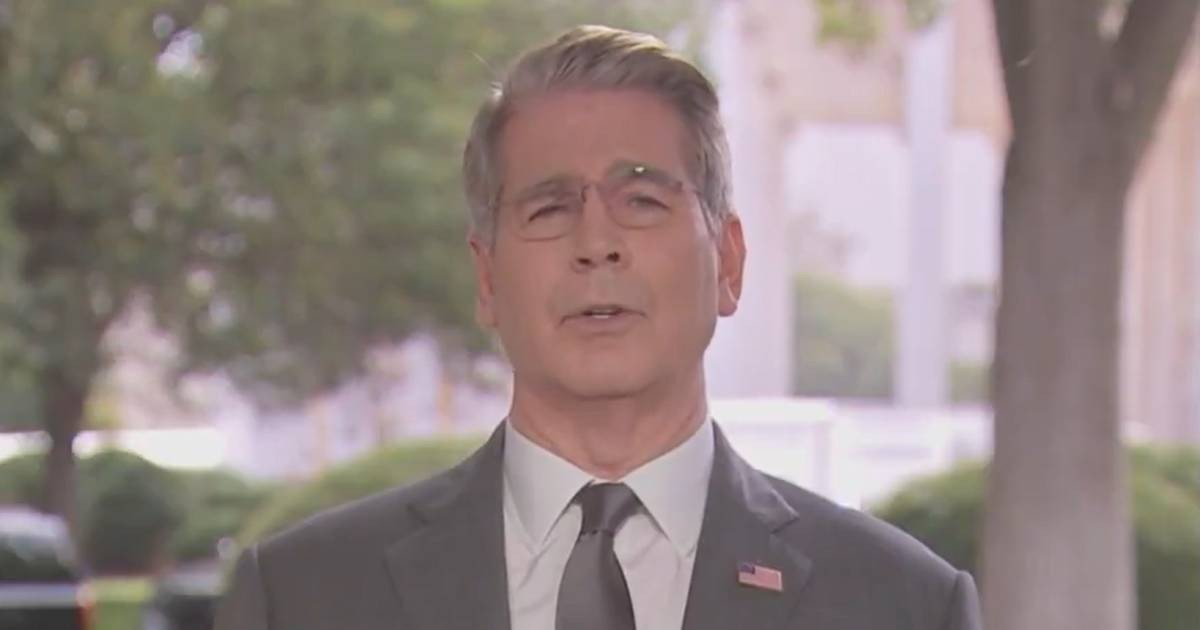
The U.S. Treasury Secretary, Scott Bessent, assured this Thursday that Washington's economic pressure strategy against the Cuban regime "is working right now," while defending in an interview with CNBC the model that the Donald Trump administration intends to apply against Iran.
“It worked in Venezuela once we imposed the blockade. It is working in Cuba right now, and it will work in Iran, and we are going to bring this regime down,” Bessent stated during the interview, according to a snippet shared by Clash Report on X.
The official described the strategy against Tehran as a "two-front strategy," based on combining a naval blockade with a new offensive of economic sanctions.
“‘We have the blockade, and we will have the most severe sanctions in history,’ Bessent told CNBC, as reported by Reuters. The secretary announced that he will hold a press conference on Monday to explain the details of the measures.”
The statements come amid the conflict with Iran and the tensions surrounding the Strait of Hormuz, a crucial artery for global oil trade.
Bessent also stated that markets might be misinterpreting the consequences of the U.S. strategy. In his view, a policy of maximum economic pressure could decrease the likelihood of a new large-scale military offensive.
The Treasury Secretary also directed part of his message to China, one of the main buyers of Iranian oil, and expressed his confidence that Beijing has incentives to cooperate with Washington with the aim of reopening the Strait of Hormuz and reducing energy prices.
According to Reuters, China buys more than 80% of the oil that Iran exports by sea, based on 2025 data from the analysis firm Kpler.
"It is time for our allies and the rest of the world to make a decision," Bessent stated.
The message reinforces the warning issued a day earlier by President Donald Trump, who threatened economic consequences for any country that provides "any type of lifeline to Iran."
When asked specifically about the possibility of taking measures against China for its dealings with Tehran, Bessent refrained from revealing any decisions and noted that many of those conversations should remain private.
However, he insisted that Beijing also has a lot at stake in the energy crisis. "We are confident that everyone wants the Strait of Hormuz to reopen and energy prices to decrease," he stated.
The mention of Cuba is particularly relevant because Bessent has repeatedly used the island as a reference to explain the economic pressure strategy of the Trump administration.
Just a few days earlier, during an interview with Newsmax, the Treasury Secretary had acknowledged that “Cuba has endured for a long time” under economic pressure, in response to questions about how long a regime subjected to sanctions can withstand.
On that occasion, he compared the Cuban case with Venezuela. "Venezuela lasted a long time. Venezuela collapsed immediately when we imposed the blockade," he stated.
Now, by stating in CNBC that the strategy "is working in Cuba," Bessent raises the tone and directly presents the situation on the island as evidence that Washington believes its maximum pressure policy is weakening the regime.
Words are not an isolated fact either. In March, during an interview with Fox Business, Bessent predicted a “slow-motion regime change in Cuba”, in a regional scenario transformed following Nicolás Maduro's capture by U.S. forces.
In May, he warned that the sanctions could "rise or fall" depending on the behavior of the Cuban government, a policy he described as "carrot and stick." In July, he hardened his rhetoric again and described Havana, along with Moscow and Caracas, as "a hellish landscape of deprivation".
The Trump administration's maximum pressure policy against Cuba has intensified in 2026, with more than 240 sanctions imposed and measures specifically aimed at funding sources and economic structures linked to the military apparatus.
One of the most significant steps was the Executive Order 14404, signed on May 1, which formally blocked the military conglomerate GAESA and its subsidiaries and introduced secondary sanctions against foreign companies that engage in significant transactions with sanctioned Cuban entities.
The U.S. offensive coincides, however, with a deep economic and energy crisis that directly impacts the Cuban population, which is enduring extensive blackouts, shortages of fuel, food, and medicine, as well as a significant deterioration of public services.
The Cuban regime has systematically rejected the statements from Washington regarding a potential collapse or political change. In March, Deputy Minister of Foreign Affairs Carlos Fernández de Cossío asserted that a regime change was "off the table."
Bessent's new words indicate that Washington has a very different perspective: the Trump administration now views Cuba not only as a target of its maximum pressure policy but also as an example it publicly uses to argue that this strategy is yielding results and can be replicated against other adversaries such as Iran.
Related videos:
Filed under: