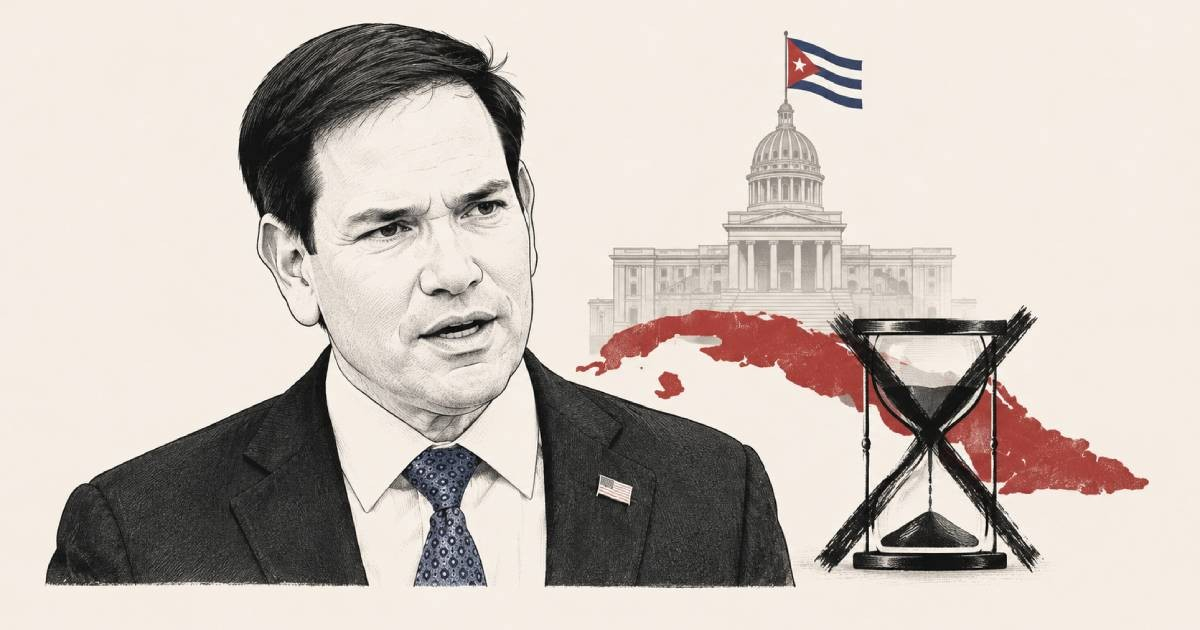
The Secretary of State Marco Rubio described this Friday the maximum pressure strategy of the Trump administration against the Cuban regime with a phrase that sums up its philosophy: "What we are trying to teach them is that there are no escape valves," he stated in an exclusive interview with Axios.
Since January 2026, Washington has taken more than two dozen separate actions against Havana, including sanctions against at least 40 entities —ranging from foreign companies operating on the island to state-owned conglomerates in fuel, banking, and mining— and economic or visa restrictions against at least 38 individuals.
"Every time they create a new mechanism to try to untangle the knot, we tighten it," Rubio stated. "Of course, they cannot expect this to go away. This is not going to disappear in the next two and a half years."
The diplomat pointed out that Cuba is experiencing a situation without historical precedent: for the first time, the island simultaneously lacks an external sponsor and faces American indifference.
"They will not secure a sponsor in the next two and a half years, so that is the dynamic that has changed. It has put them in a very difficult position," he stated.
The most decisive blow came with the capture of Nicolás Maduro by U.S. forces on January 3, 2026. Venezuela supplied up to 100,000 barrels of oil daily to Cuba, and the island resold about half of that volume in the global market as a source of foreign currency. Both flows were suddenly disrupted.
The effects on the Cuban economy are tangible. The fuel exports from the U.S. to Cuba surged to 96 million dollars in the first six months of the year —more than half of that just in June— according to the U.S.-Cuba Trade and Economic Council. Its president, John Kavulich, was emphatic: "Trump and Rubio have initiated the most effective sanctions program against a target country than any of their predecessors. We've been at this since 1994 and have never seen anything like it."
In parallel, foreign companies are leaving the island due to the threat of secondary sanctions, while American fuel distributors are filling that gap.
Rubio interpreted the historic announcement by Prime Minister Manuel Marrero Cruz —who on Tuesday opened the door to the largest expansion of the private sector since the 1959 Revolution— as a tactical maneuver, not a genuine change: Cuba "is playing for time by pretending to reform while seeking ways to evade sanctions."
"My level of confidence is that when this administration ends, at a minimum, Cuba will be on an irreversible trajectory towards a different future," concluded the Secretary of State.
The interview also revealed that Rubio is in talks with Raúl Guillermo Rodríguez Castro, the grandson of the historic leader Raúl Castro, regarding a potential political transition on the island.
However, the viability of that channel raises questions even within the administration. “When Raúl is no longer here, what is its status? Who protects it?” asked an anonymous U.S. official cited by Axios.
This Thursday, the administration imposed a new round of sanctions against Cuban entities and officials, and Rubio hinted that there will be more. "One of the things we have lost in U.S. foreign policy and geopolitics is the concept of patience and persistence," he reflected.
Related videos:
Filed under: