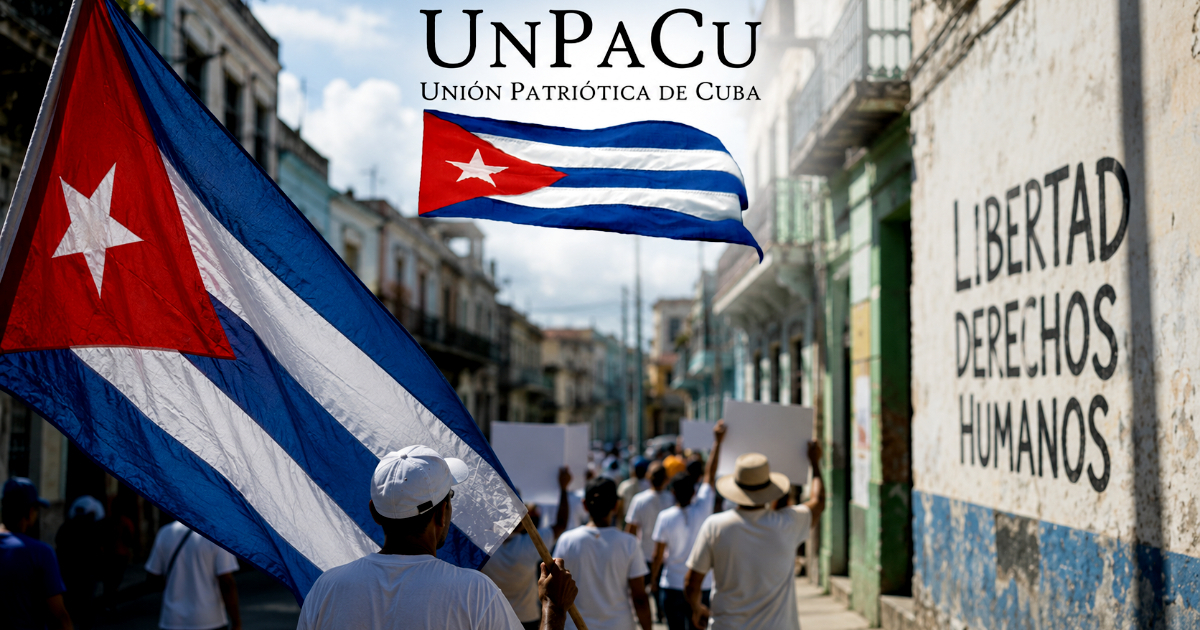
The Patriotic Union of Cuba (UNPACU) marked 15 years since its founding this Monday, a journey characterized by peaceful protests, assistance to vulnerable individuals, and the systematic persecution of its members by the Cuban regime.
Founded on August 24, 2011, under the leadership of José Daniel Ferrer García, the organization was created just a few months after the opposition leader was released from prison, where he had spent eight years for his involvement in the Varela Project and his subsequent conviction during the Black Spring of 2003.
Ferrer, one of the political prisoners from the Group of 75, refused to leave Cuba after his release and decided to continue his opposition activities from Santiago de Cuba. Shortly after, he promoted the creation of UNPACU, which began with a small structure in the eastern part of the country and later expanded its presence to other provinces.
This Monday, on the occasion of the anniversary, the opposition leader reflected on that journey in an article published by CiberCuba and recalled both the civic and humanitarian actions carried out by the organization as well as the significant human cost of confronting the regime for three decades.
From a small group to taking the protest to the streets
One of the characteristics that distinguished UNPACU from its early years was its commitment to bring political opposition into the public sphere.
Their activists organized flash marches and demonstrations, created graffiti, distributed leaflets and printed materials, and handed out thousands of DVDs with content about democracy, human rights, and the Cuban reality, at a time when internet access on the island was still extremely limited.
The authorities' response was virtually immediate.
As Ferrer recalled in his anniversary article, just four days after the founding of UNPACU, on August 28, 2011, forces from the Ministry of the Interior (MININT) violently stormed a home on Paquito Borrero Street in Palma Soriano, where dozens of opponents were gathered.
The agents used tear gas and forcibly removed the activists. According to Ferrer’s account, 27 people were arrested and around ten remained incarcerated, becoming the first political prisoners linked to the emerging organization.
Far from being limited to Santiago de Cuba, Palma Soriano, and Palmarito de Cauto, UNPACU later expanded its structures to the central and western regions of the country.
Alliances within the Cuban opposition
Another aspect of his trajectory has been the pursuit of cooperation with other opposition groups and exile organizations.
UNPACU maintained a close relationship with the Ladies in White and its activists participated for years in joint actions and campaigns such as Everyone Marches.
In 2017, the organization also joined Cuba Decide, the initiative led by Rosa María Payá that promotes holding a binding process for Cubans to democratically decide the political future of the country.
Ferrer also participated in 2021 in the creation of the Council for Democratic Transition in Cuba, envisioned as a plural platform to bring together organizations and civil society actors around a peaceful transition to democracy.
That search for coordination has continued since the exile and banishment of its leader, José Daniel Ferrer.
In March 2026, Ferrer and UNPACU joined the Liberation Agreement, an initiative promoted by the Assembly of the Cuban Resistance and Pasos de Cambio that brings together organizations and opposition leaders from both inside and outside the island around a roadmap to promote political change and a democratic transition in Cuba.
Ferrer has made the promotion of this initiative one of the focal points of his international activities during 2026, seeking political support for a transition and for the demands for freedom of political prisoners and respect for fundamental rights.
The adherence to that agreement reinforced a line that UNPACU has maintained throughout its journey: to seek common ground among opposition organizations with different strategies and sensitivities around shared goals for a democratic transition.
Currently, UNPACU maintains cooperative ties with opposition and exile organizations such as the Cuban American National Foundation (FNCA), the Ladies in White, Cuba Decide, the Cuban Democratic Directorate, and other groups.
The other side of UNPACU: food, medicines, and aid to the most vulnerable
The activities of UNPACU were not limited to political protests. Particularly in eastern Cuba, the organization has developed over the years initiatives to provide food, medicine, and assistance to the elderly, the sick, people with disabilities, and families in extreme poverty.
After the devastating impact of Hurricane Sandy on eastern Cuba in 2012, UNPACU established a humanitarian partnership with the Cuban American National Foundation to assist those affected and people in need.
According to Ferrer, the activists have also repaired homes, cleaned houses of abandoned elderly people, parks, streets, and coastal areas, and provided assistance to families affected by hurricanes and other disasters.
That humanitarian dimension also ended up becoming a point of confrontation with State Security.
Images of numerous Cubans gathering at the UNPACU headquarters in the Altamira neighborhood of Santiago de Cuba to receive food or assistance gained particular notoriety between 2020 and 2021.
The authorities then established a strong device around the headquarters that hindered or prevented access for activists and citizens.
In March 2021, Ferrer and other members of UNPACU began a hunger strike to demand an end to the crackdown. The protest garnered dozens of participants and received international attention.
11J changed the history of Ferrer and UNPACU
The historic anti-government protests of July 11, 2021, marked another turning point for the organization.
That day, as thousands of Cubans took to the streets in dozens of locations across the country, Ferrer left his home in Santiago de Cuba with one of his sons with the intention of joining the protests.
He was arrested before achieving it.
The authorities later revoked a previous sentence and sent him to Mar Verde prison in Santiago de Cuba, where he remained for years.
His imprisonment was accompanied by repeated complaints from family members and human rights organizations regarding isolation, restrictions on communications and visits, mistreatment, and deterioration of his health.
Ferrer also held several hunger strikes during his time in prison.
He was released in January 2025, although he was arrested again months later. Finally, in October of that year, he left Cuba for the United States with part of his family, beginning a new phase of his political activity from exile.
More than 200 activists have been imprisoned, according to Ferrer
The cost of these 15 years has been particularly high for the members of UNPACU.
Ferrer asserts that more than 200 members and activists linked to the organization have been imprisoned by the regime since 2011 and that UNPACU continues to have members incarcerated.
In his anniversary report, the founder notably remembered four members associated with the organization who died after enduring imprisonment: Wilman Villar Mendoza, Hamell Santiago Más Hernández, Pablo Moya Delá, and Manuel de Jesús Guillén Esplugas.
Villar Mendoza died in January 2012 after a prolonged hunger strike while incarcerated. Más Hernández passed away in 2017 while being held at Combinado del Este. Moya Delá died in 2021 after being released from prison in a delicate state of health, and Guillén Esplugas died in prison in 2024.
UNPACU and human rights organizations have reported arrests, home raids, confiscations, surveillance, interrogations, assaults, and prison sentences against members of the organization over the years.
Surviving the prison and exile of its founder
Ferrer’s departure to the United States marked an unprecedented phase for UNPACU. For the first time since its establishment, its founder and primary figure is conducting his political activities outside of Cuba.
However, the organization keeps activists within the island while Ferrer attempts from exile to strengthen cooperation among different sectors of the opposition, maintain attention on political prisoners, and promote actions aimed at a democratic change in Cuba.
Fifteen years after that August 24, 2011, the history of UNPACU also reflects a significant part of the evolution of the Cuban opposition during this period: small groups of activists confronting a powerful repressive apparatus, protests in the streets, attempts to build national structures, periods of growth and decline, alliances, imprisonment, and exile.
But the organization has managed to survive.
What began 15 years ago with a small group of opposition members in eastern Cuba remains active despite the imprisonment of many members, the targeting of its structures, and the exile of its main leader.
UNPACU reaches this anniversary under very different circumstances than in 2011, but maintaining the demands that gave rise to the organization: freedom, democracy, respect for human rights, and a political transition in Cuba.
Related videos:
Filed under: