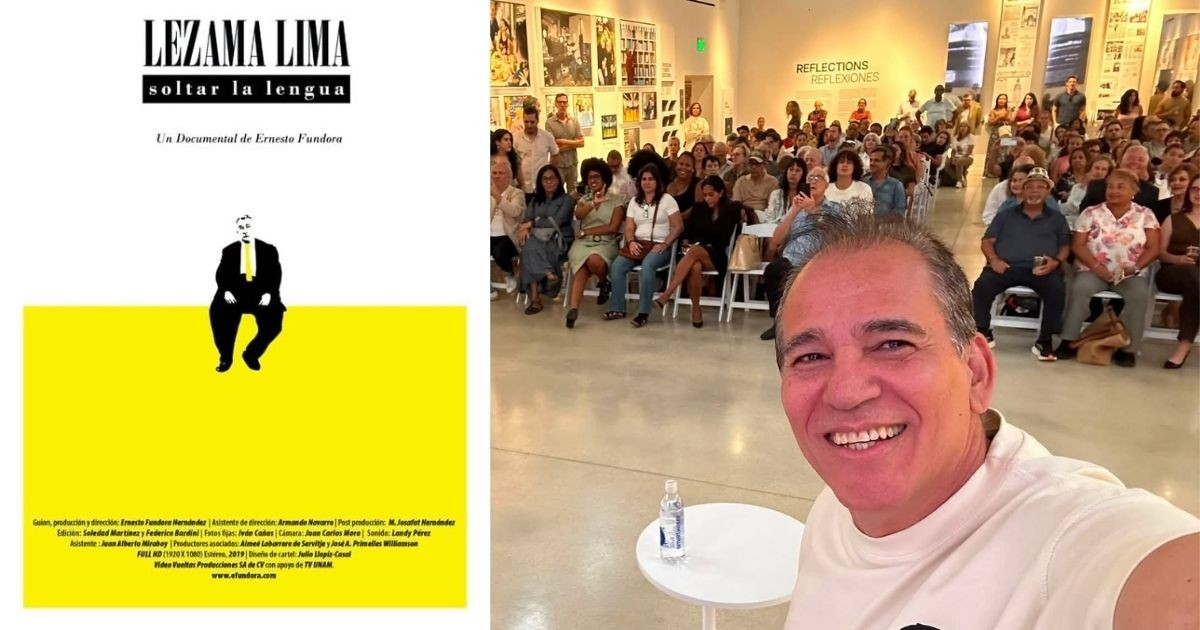
The Coral Gables Museum in Florida will showcase the biographical documentary "Lezama Lima: Letting the Tongue Loose", by Cuban filmmaker Ernesto Fundora Hernández, on September 9 at 6:30 PM, in commemoration of the 50th anniversary of the death of poet and novelist José Lezama Lima and the 60th anniversary of the publication of Paradiso, as reported by the institution's page and the filmmaker on his social media.
The screening is the second part of the series "Persecuted: Artists Censored by Communist Cuba," which the museum presents as a journey through two eras of Cuban cultural history marked by state persecution of dissenting art. The Cuban writer and literary critic José Prats Sariol will participate as a special guest, and the documentary will feature English subtitles.
According to the description of the Coral Gables Museum, the film "offers a portrait of the Cuban poet, novelist, and essayist José Lezama Lima, one of the most influential figures in 20th-century Latin American literature and an important literary voice associated with the Latin American boom." Through interviews with writers, artists, academics, friends, and former students, the documentary "explores Lezama's life, literary vision, and lasting legacy," preserving firsthand accounts from those who knew him personally.
The film was produced between 2018 and 2019 by Video Vueltas Producciones SA de CV with the support of TV UNAM, and features interviews recorded in Miami, Havana, and other locations. Among those interviewed are cultural figures from the island such as Cintio Vitier, Fina García Marruz, César López, Anton Arrufat, and Silvio Rodríguez.
The screening takes place in a year of dual commemoration. Paradiso, published in Cuba in 1966, is described by the museum as “an ambitious novel, partially autobiographical, that intertwines family memory, Cuban history, mythology, philosophy, and an innovative poetic language to create one of the most singular literary works in the region.” However, the novel was withdrawn from Havana bookstores shortly after its publication when the cultural bureaucracy of the regime deemed it “pornographic” due to its sexual content and homosexual references, particularly in Chapter VIII.
Lezama's homosexuality clashed with the cultural and moral policies of the Cuban regime, which during the sixties and seventies repressed homosexuals through mechanisms such as the Military Units for Production Assistance (UMAP) and, later, the cultural exclusion policies of the so-called Gray Five-Year Period. His homosexuality, Catholicism, defense of literary autonomy, and stance during the Padilla case contributed to the writer's gradual marginalization within Cuba. In his final years, the authorities denied him permission to travel abroad, and Lezama died in Havana on August 9, 1976.
The series "Persecuted" traces a connection between the censorship of the 1960s and the repression experienced by visual artist Luis Manuel Otero Alcántara, co-founder of the San Isidro Movement, who was arrested in July 2021 and sentenced to five years in prison. The first part of the series was the screening of the documentary "Luis Manuel Otero Alcántara: We Are Connected" on August 5th —the anniversary of El Maleconazo of 1994—, with Otero Alcántara himself present at the museum.
Fundora, based in Mexico City, is a graduate of the Instituto Superior de Arte (ISA) in Havana and the Escuela Internacional de Cine y Televisión (EICTV) in San Antonio de los Baños. Since founding Video Vueltas Producciones in 1996, he has directed over 90 music videos for artists such as Celia Cruz, Willy Chirino, and Carlos Varela, as well as a dozen documentaries. The journey to bring these stories to the public has not been easy: last May, he was physically attacked by militants of the Mexican Communist Party during a screening of «Estamos conectados» in Coyoacán, where the assailants shouted insults like «¡Malditos gusanos!».
Regarding the Cuban reality documented in his work, the filmmaker has been emphatic: "We are kidnapped by a group of satanists. The Cuban nation is kidnapped by a group of satanists.", he stated in a recent interview.
Related videos:
Filed under: