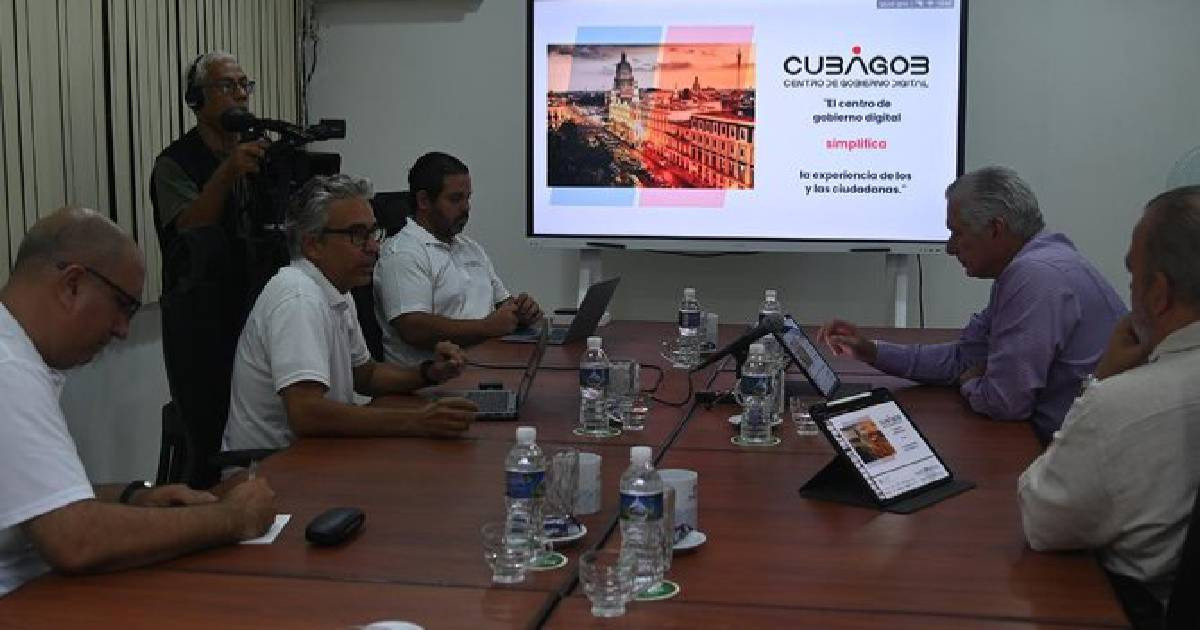
The leader Miguel Díaz-Canel visited the Digital Government Center in the Havana municipality of Playa this Saturday to celebrate the first anniversary of the Sovereignty Platform, the official tool for digitizing public procedures in a country where power outages, the slowest internet in Latin America, and the collapse of telecommunications make this objective unfeasible for most Cubans.
Along with Prime Minister Manuel Marrero Cruz, the head of state received a report from the director of the Digital Government Center, Wilfredo González Vidal, who presented the results of the platform established by Decree 125 in July 2025. This includes over 43,000 verified digital identities, nearly 24,000 passport applications for individuals over 18, and almost 40,000 civil status registrations, as detailed in a report from the Presidency portal.
González Vidal himself acknowledged that these figures "are still insufficient" and that the population needs greater knowledge and trust in the tool.
Among the available services are 12 procedures related to the civil registry, five concerning citizen identity and changes in electoral location, the adult passport, and social services from the Ministry of Labor.
Díaz-Canel stated that "as people notice that procedures are resolved more quickly and they achieve results through the use of this platform, greater trust will be gained."
The government also presented two ongoing projects, one aimed at facilitating citizen participation around the 176 economic and social transformations approved in June, and another for publishing job offers in the state and private sectors.
The official discourse clashes directly with the reality of the country. In August, the state-owned and sole Telecommunications Company of Cuba (Etecsa) accumulated three serious failures in less than a month: a breakdown that interrupted mobile phone service nationwide on the third of that month, a fiber optic cut that affected the Nauta payment system, and a false seismic alert sent to users in nine provinces on August 18.
Regarding this last fact, the state monopoly took four days to acknowledge it as a "technical-human error, caused by our specialists who were conducting tests on the telecommunications network."
The Cubans are voicing their anger against Etecsa on social media over each failure. Indignation grew after the company raised its internet fees in May 2025, increasing service costs by 13 times with prices in dollars: 4 GB for 10 dollars, 8 GB for 20, and 16 GB for 35. Despite collecting 24.8 million dollars in just 46 days, the quality did not improve.
The average internet speed in Cuba is only 7.21 Mbps, the lowest in Latin America, with drops below two Mbps in several provinces during power outages.
The company itself admitted that its backup batteries cannot support the network for more than 24 hours without electricity, which takes 47.5% of mobile radio bases and 56.5% of the cabinets out of service during outages.
They are joined byat least seven total collapses of the electrical system so far this year, while numerous localities often remain in the dark for over 20 hours a day due to the energy collapse that the island is experiencing.
Additionally, less than four percent of transactions in Cuba are digital, while the Central Bank had to lift the limit of 5,000 pesos for cash transactions in July, which is an implicit acknowledgment of the failure of the forced banking system introduced three years ago.
The comedian Ulises Toirac summed up the contradiction with irony in July, in a direct challenge to Etecsa: "With all the money you've collected after the rate hike to straighten out those who were stealing from you, why don't you put batteries in your towers?".
Related videos:
Filed under: