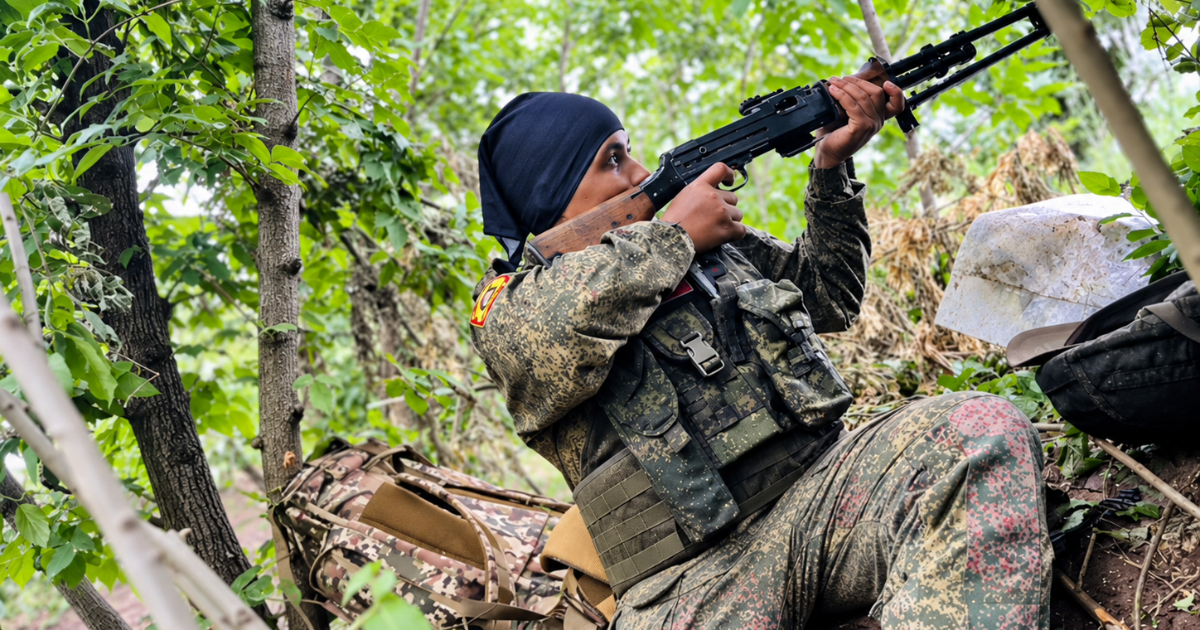
About two weeks of training and then, the front. That is one of the patterns identified by Amnesty International among foreigners recruited by Russia to fight in Ukraine, including Cuban citizens.
In its new report Russia: Trafficking of Foreign Nationals to Fight in Ukraine, the organization devotes a chapter to the lack of preparation of these fighters and reaches a particularly harsh conclusion: the minimal training suggests that their recruitment is driven by the interest in increasing the number of personnel available on the frontline, with little to no concern for their readiness for combat or effective integration into the units.
Amnesty considers that this pattern indicates both a military strategy of imposing dominance through numerical superiority and an "apparent disregard for human life".
The gathered testimonies describe "extremely short" training periods, usually lasting about two weeks, before being deployed to combat zones. Some recruits lacked military experience, reported a lack of equipment, and were barely able to communicate with their Russian commanders.
Cubans with only a few weeks of preparation
Two Cubans interviewed by Amnesty are part of the documented pattern.
"Enrique," who had worked in construction in Russia, agreed to sign a military contract, also drawn by the possibility of obtaining a Russian passport. He received about 20 days of training at a camp located, according to his testimony, in the occupied region of Lugansk.
Later, he was moved to the front. When he finally entered the combat zone in an armored vehicle, it was almost immediately attacked by drones, and the occupants had to disperse.
The Cuban also stated that he had been told he would have a support role and not that he would be sent directly to the front lines.
«Ruben», another Cuban interviewed by the organization, had signed a contract while serving a sentence in Russia and was facing the possibility of being deported to Cuba.
Two weeks after signing numerous documents in Russian, he received military identification and was transferred to a training camp alongside former prisoners of various nationalities. He later ended up on the front lines, was injured and hospitalized twice, and was captured in January 2026.
Amnesty found similar situations among other nationalities. A citizen of Sri Lanka spent 14 days training without understanding much of what was happening because the instruction was in Russian. He was sent to the front and captured less than two weeks later.
A Brazilian IT professional, who claims to have traveled thinking he would have a job in his field, spent three weeks in a training center where he did not understand the language before being sent to fight. Another recruit, from Somalia and with no military experience, stated that he received "almost no proper training" and ended up near the front even without a weapon.
A pattern already observed among Cubans
Amnesty's findings now provide an independent assessment of a phenomenon that CiberCuba has documented for years among the citizens of the Island who have joined the Russian forces.
In July 2024, CiberCuba reported on the case of Denis Frank Pacheco Rubio, who, according to his wife's testimony, traveled to Russia believing he would work in occupied cities, received about 15 days of military training, and ended up sent to the front, where he died.
Another case was that of Lester Mora Pichardo, who traveled to Russia in 2023 as part of a group of Cubans. Before his death, he managed to showcase from the trenches the difficulties of understanding commands and communicating in Russian.
He was injured in his first confrontation, was hospitalized and later returned to the front, where he died after a drone attack.
A subsequent investigation by CiberCuba, based on a Ukrainian dossier with information about 1,028 citizens from the Island, allowed for the observation of the phenomenon on a much larger scale and documented numerous cases of Cubans integrated into the Moscow army, including the dead, missing, and prisoners.
"Four months to die"
The extremely brief preparation periods now described by Amnesty take on greater significance when compared to the data on the survival of foreign fighters previously released by Ukraine.
In January 2026, CiberCuba analyzed statistics from the Ukrainian project I Want to Live, according to which 42% of the foreign fighters studied who fought for Russia died within the first four months after signing their contracts, with the highest casualty rate occurring during the second month.
The data comes from an official Ukrainian source and has not been verified by Amnesty, so it does not alone establish that the lack of training is the cause of these deaths. However, it describes a scenario consistent with what the human rights organization is now finding: foreigners rapidly sent to combat zones despite their limited preparation.
CiberCuba also documented extreme cases among older Cubans. Lázaro Aramis, aged 55, died approximately a month after signing his contract, while Luis Ángel, who joined at 50, also did not survive a month before passing away.
From "cannon fodder" to the so-called "meat assaults"
The use of troops with limited training to sustain a war of attrition is not a hypothesis that has emerged solely from the testimonies of foreigners.
Western military analysts have described certain Russian tactics using terms such as meat attacks: successive assaults by small infantry groups where Moscow accepts high levels of casualties to maintain pressure, locate enemy positions, and wear down Ukrainian defenses.
The Royal United Services Institute (RUSI) has used that expression when analyzing the Russian strategy and its ability to sustain offensive operations despite losses, relying on various personnel sources.
This does not allow us to conclude that all Cubans or recruited foreigners are specifically sent to carry out that type of assaults. Amnesty also does not use the concept nor does it claim to have demonstrated that the interviewed Cubans are part of units assigned to those operations.
What is clear is that the limited training of foreigners before sending them to the front seems to reflect an intention to increase troop numbers, with little concern for their military capability and preparedness.
Not all Cubans describe the same experience
There are also testimonies that contradict the idea that Cubans are systematically used as "cannon fodder."
A Cuban fighter who wrote a letter featured by CiberCuba, with several years of service in the Russian forces, rejected that characterization and asserted that he received the same treatment as Russian soldiers.
The difference is significant: there is not enough evidence to assert that all Cubans follow the same path or that they are deliberately sent to die.
The new report from Amnesty points to something more specific and documentable: among the foreigners they investigated, there is a pattern of extremely short training, communication difficulties, and rapid deployment in combat zones, even among individuals without prior military experience.
For Cubans, these findings add an independent piece to the stories of men who traveled to Russia lured by salaries, jobs, or the possibility of obtaining citizenship, only to find themselves shortly afterward in the trenches of Ukraine.
Amnesty now articulates what several of these cases have been suggesting: for the Russian military machinery, rapidly increasing the number of men available at the front may outweigh ensuring that they are actually prepared to survive and fight.
Related videos:
Filed under: