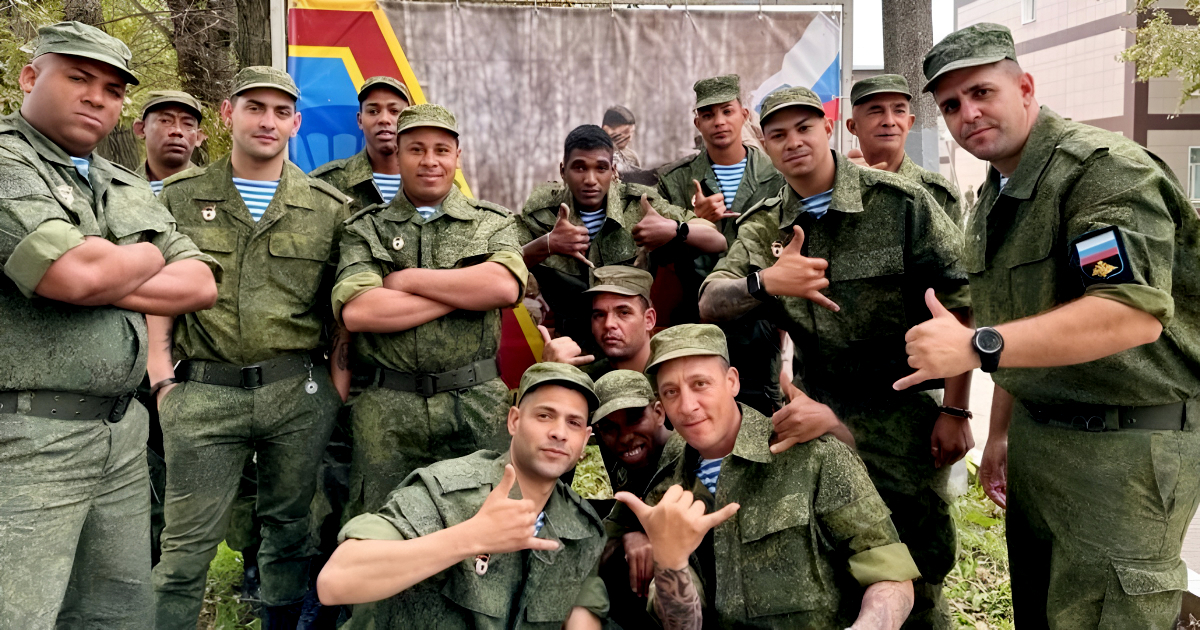
Amnesty International concluded that Russia has recruited thousands of foreign nationals to fight in Ukraine through practices that, in many cases, may constitute human trafficking.
The research includes direct testimonies from Cuban citizens who ended up in the Russian Armed Forces.
The report, published in September under the title Russia: Trafficking of Foreign Nationals to Fight in Ukraine, is based, among other sources, on six visits made between 2024 and 2026 to two prisoner of war camps in Ukraine.
Amnesty interviewed 15 foreigners there from Brazil, Colombia, Cuba, Egypt, Sierra Leone, Sri Lanka, Somalia, and South Africa. Only three claimed to have knowingly signed a military contract aware that they would be sent to a warzone. Seven said they had been promised civilian jobs, while others described circumstances that raise doubts about the voluntary nature of their enlistment.
The document also cites official Ukrainian data indicating that, until April 2026, 28,391 foreigners from 136 countries had been identified as participating in hostilities as members of the Russian Armed Forces. Amnesty clarifies that it could not independently verify that figure.
Two Cubans in the Amnesty report
One of the testimonies belongs to "Ruben," a fictitious name used to protect his identity.
The Cuban recounted that he arrived in Moscow with his wife in 2021 and worked in construction until he was arrested for possession of drugs and sentenced to six years in prison.
In 2025, while serving his sentence and facing the prospect of being deported to Cuba upon his release from prison, he received an offer, along with other foreigners, to join the Russian Army.
According to his account, they promised him a Russian passport, a bonus of 800,000 rubles —about 10,000 dollars— and a monthly salary of 400,000 rubles, around 5,000 dollars.
"I signed the contract because I didn't want to be deported back to Cuba", he stated to Amnesty.
Three other Cuban prisoners accepted the same proposal. Ruben hoped to obtain Russian citizenship, subsequently help his wife acquire it, and take his children, who remained in Cuba, to Russia.
Amnesty highlights the extent to which he was worried about returning to the Island: “going to war seemed like a better option. After being sent to the front at the end of 2025, he was injured and hospitalized twice before being taken prisoner in January 2026.
The second case is that of "Enrique," another Cuban who was aware he was signing a contract with the Russian Armed Forces, but he claims that he was deceived about the tasks he would perform.
He had traveled to Russia to work in construction and wanted to settle in the country. A colleague suggested joining the Army to later obtain Russian citizenship.
After signing the contract and receiving about 20 days of training, he was deployed to the combat zone. According to his account, the vehicle he was traveling in was attacked by drones almost upon arrival.
«I was told I would be in a support role, not that I would be on the front lines», he explained.
Deceptions, withheld passports, and rapid deployment to the front
The Cuban cases are part of a broader pattern documented by Amnesty: false offers of civilian jobs, contracts written in Russian that foreigners did not understand, promises of high salaries and citizenship, confiscation of passports and phones, movement restrictions, and threats against those who tried to leave the service.
Training periods were often only two weeks, even for individuals without military experience and with significant difficulties in communicating in Russian.
Amnesty International believes that fraud, coercion, and the exploitation of economic, migratory, or legal vulnerability among recruits may meet international standards for classifying these cases as human trafficking. The organization warns that certain forms of control and restriction described should be investigated for possible indicators of slavery.
The report primarily holds Russia responsible. It asserts that official agencies, including the Ministry of Defense and the Migration Directorate of the Ministry of the Interior, could be directly involved in some of these practices.
However, Amnesty does not establish in this investigation that the Cuban regime is involved in recruitment networks.
The suspicions regarding Havana's role
This last aspect has been addressed by other research. Since 2023, numerous testimonies have emerged from Cubans recruited for Russian forces, while Havana officially maintains that Cuba is not part of the war and denies any state involvement.
An investigation by CiberCuba based on a Ukrainian database of 1,028 Cuban citizens found patterns of recruitment into Russian forces, contracts, travel routes, and economic and migratory incentives.
The analysis also detected a temporal correlation between periods of intense recruitment, the increase in air connections between Cuba and Russia, and the strengthening of relations between both governments.
These elements do not independently prove an operation directed from Havana, but they have fueled doubts about how such a large-scale recruitment could have developed without the knowledge, tolerance, or complicity of the Cuban authorities.
The regime announced in September 2023 the arrest of 17 individuals linked to an alleged human trafficking network for warfare, but subsequently provided little public information about the judicial outcomes of that investigation.
The accusations later escalated to the international level. The United States included the recruitment of Cubans for Russia in its Trafficking in Persons Report and stated that Cuban officials had facilitated this process, an accusation that was rejected by Havana.
Washington also brought the issue to the United Nations during the discussion on the embargo against Cuba, using it among its arguments to question the international actions of the Cuban regime and urging other governments not to support the resolution promoted by Havana.
From Cuban civil society, complaints have also been raised. Organizations and activists have called for international investigations and presented to European interlocutors the potential responsibilities of Cuba in the recruitment of citizens for the forces of one of the regime's main military and political allies.
Not everyone can simply be considered "mercenaries."
The Amnesty report now introduces a key element in that debate: having ended up fighting for Russia does not necessarily mean that all foreigners arrived in the war voluntarily.
The organization requests that those who have been recruited through deception, coercion, or abuse of vulnerability be identified as potential victims of trafficking.
It also recommends that Ukraine individually assess foreign prisoners in that situation and, when legally appropriate, explore avenues for their release and voluntary return.
For the Cuban case, the report provides new independent evidence to a file that has been open for more than three years. Amnesty does not hold Havana responsible for organizing recruitment, but confirms through its own testimonies that Cuban citizens ended up on the front lines within a Russian system that exhibits characteristics of human trafficking.
The investigation raises again a question that the Cuban regime has not clarified: how an operation capable of incorporating numerous citizens from the Island into the army of one of its main allies could remain undetected or effectively stopped by the Cuban authorities for years without being detected.
Related videos:
Filed under: