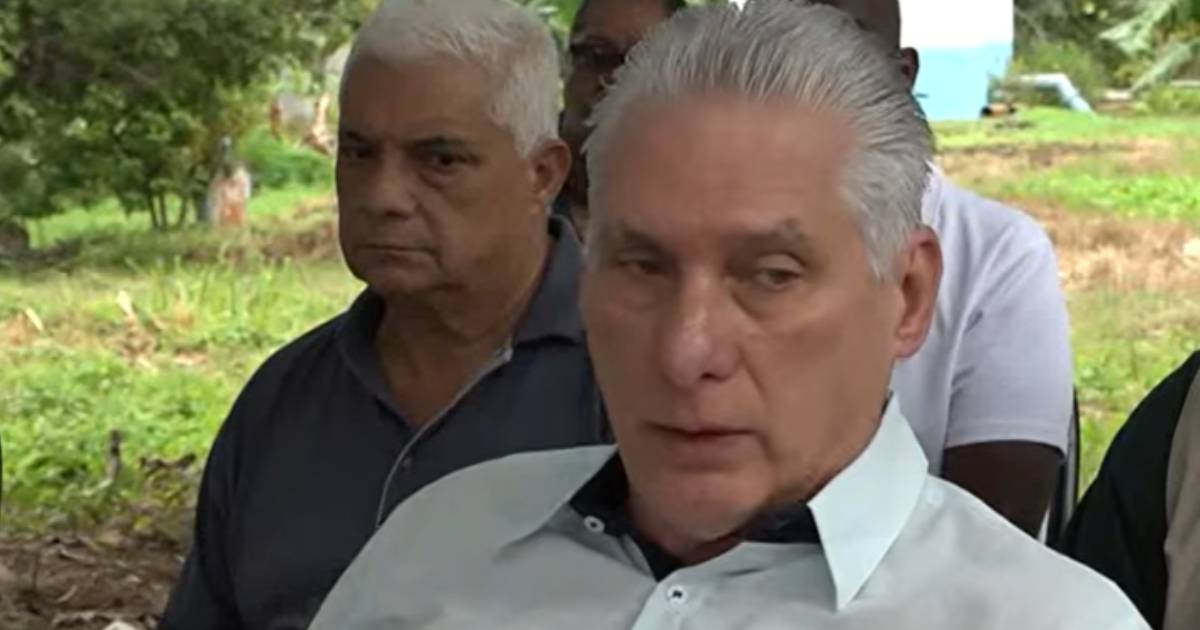
Miguel Díaz-Canel visited the Cosculluela water supply facility in Boyeros on Tuesday, where the government is working to restore an installation that has been in operation for over six decades amid the serious water crisis affecting Havana.
The visit comes as the deadline set by the ruler approaches to begin showing results of his strategy: late September, after months of blackouts, breakdowns, leaks, and pumping failures that have left hundreds of thousands of Havana residents with irregular service or without water for days.
According to the official source Canal Caribe, Cosculluela is the second most important source in the western system of the capital. Its 10 wells provide more than 33% of the water primarily destined for Playa and Marianao.
The facility has been in operation for over 60 years without a comprehensive renovation, a fact that highlights the deterioration of an infrastructure essential for the city's supply.
During the tour, officials reported on leak repairs, replacement of internal networks, road recovery, and efforts to automate pumping.
An electric line is also installed from a battery of generators to try to protect the wells from the constant issues of the National Electric System.
According to the specialists quoted by Canal Caribe, "by the end of September, we should be seeing improvements in electricity."
Executives also stated that around 11 pumping units have been recovered and acknowledged that another major issue continues to be in the distribution networks.
The program also includes the installation of photovoltaic systems to reduce the dependence on the deteriorating national electrical system, which currently supports a large part of the water pumping in the capital.
More than half a million residents of Havana affected
The intervention in Cosculluela comes after months of worsening the crisis.
In April, around 200,000 people were experiencing issues with the water supply in Havana. By May, the figure had risen to 376,055, and by July, specialists from Aguas de La Habana acknowledged that more than half a million residents were affected.
The situation has been especially critical in Boyeros itself. In January, more than 40,000 people were affected after the supply sources were nearly depleted.
In July, elderly residents of Santiago de las Vegas had to carry buckets from a water truck to their homes, an image that reflected the daily consequences of the crisis.
And just four days before Díaz-Canel's visit, a resident of Boyeros reported a possible water contamination, amidst reports of fevers, diarrhea, and rashes, as well as the presence of sewage on public streets.
The complaints are not limited to Boyeros. In July, residents of San Miguel del Padrón reported being without water for up to a month, while successive breakdowns have left extensive areas of the capital without service.
Díaz-Canel promised results by the end of September
The water crisis is closely linked to power outages. Approximately 87% of the water supply system in Havana relies on electricity for pumping.
On September 3, Díaz-Canel acknowledged that the government could not guarantee the electricity necessary for stable water pumping.
Two days later, he set the end of September as the first test of his plan to alleviate the crisis: by then, he assured, results should begin to be seen in two or three of the main supply systems.
The official schedule includes consolidating other sources during October and incorporating solutions based on renewable energies before the end of the year.
However, the government has not publicly disclosed how much the program will cost, nor has it established concrete indicators regarding how many residents of Havana will need to restore their service, how many hours of supply will be guaranteed, or what additional volume of water will need to reach households.
Díaz-Canel urged on Tuesday to keep the population informed about the progress of the work.
As September draws to a close, Cosculluela's rehabilitation thus becomes one of the milestones outlined by the governor himself, while hundreds of thousands of Havana residents continue to hope that the repairs will finally result in water in their homes.
Related videos:
Filed under: