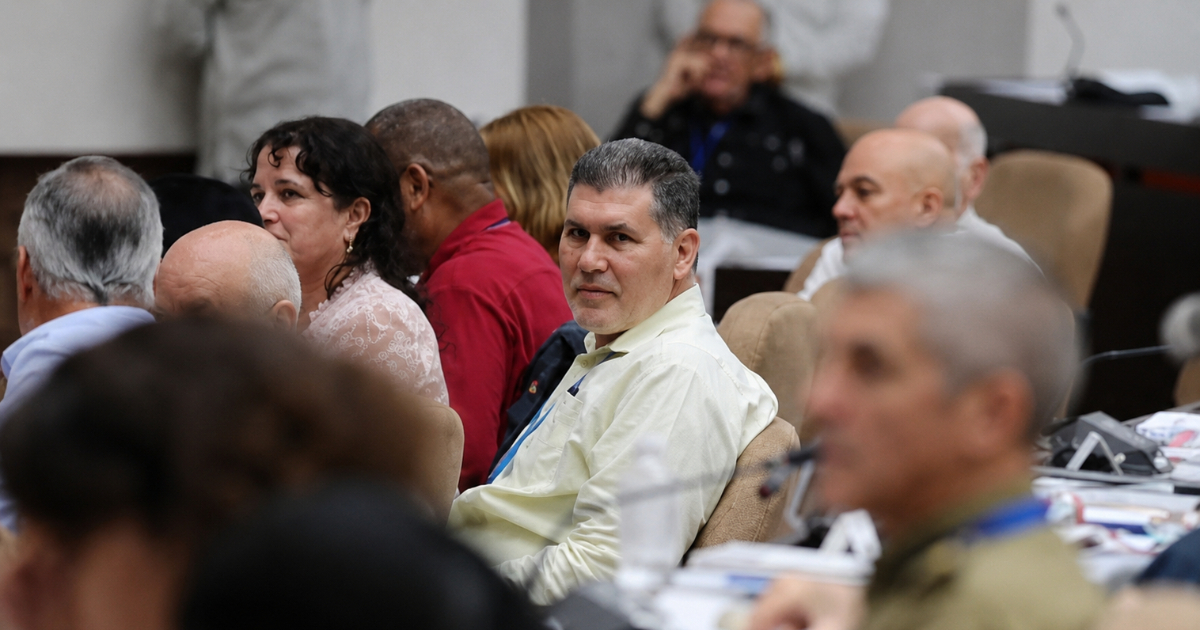
The Cuban regime seems to be promoting Óscar Pérez-Oliva Fraga as a potential successor within its power structure, as revealed this Friday by The New York Times, at a time when the administration of Donald Trump is seeking to identify figures capable of taking on governmental responsibilities in a potential transition scenario on the island.
The statement from the American newspaper takes on particular importance due to the rapid rise that Pérez-Oliva has experienced in recent months and the increasing public exposure he has received within Cuba.
According to the Times, Pérez-Oliva, the great-nephew of the dictator Fidel Castro, has recently appeared more frequently on state television and in government statements, and even granted an unusual interview to international media.
The newspaper interprets these signals as indications that the Cuban government would be backing him as a potential successor.
But there is a fundamental obstacle to any attempt to present him as a figure capable of leading a negotiated transition with Washington.
The New York Times states that Pérez-Oliva would be “almost certainly unacceptable for the United States.”
Pérez-Oliva's prominence has not gone unnoticed.
CiberCuba has closely followed its rapid rise within the governmental structure over the past few months, as well as the signs pointing to a carefully crafted political promotion.
His recent trajectory has particularly attracted attention because it combines family ties with the historical elite of Castroism, experience in the economic apparatus, and a public image that the regime has attempted to project as more technical and innovative than that of much of the old guard.
Its growing visibility had raised questions about whether the regime was attempting to build around it a figure capable of representing renewal without breaking away from the system.
The new information from Times takes that hypothesis a step further by directly stating that the Cuban government "seems to be supporting" Pérez-Oliva as a potential successor.
The rise of Pérez-Oliva also occurs at a particularly delicate moment for the Cuban political succession.
Raúl Castro maintains significant political influence despite not formally holding the presidency, while Miguel Díaz-Canel leads a structure facing a deep economic, energy, and social crisis.
This is compounded by the growing pressure from the United States and the regime's own need to ensure the continuity of the system when the historical generation that built and controlled its main institutions finally disappears.
In that context, a relatively young figure, with government experience and family ties to the Castros, could provide the regime with an attractive combination: generational renewal without breaking the historical continuity of power.
But precisely that continuity could pose a problem for Washington.
The investigation by the New York Times reveals that the Trump administration is seeking something different.
Washington is said to have asked its intelligence agencies to identify current or former officials of the Cuban regime who could become pragmatic interlocutors and assume positions of power if U.S. pressure leads to a reconfiguration of the leadership.
The model that some officials have in mind is that of Delcy Rodríguez in Venezuela.
After the capture of Nicolás Maduro in January, Rodríguez assumed the role of interim president and was regarded by U.S. officials as a pragmatic figure capable of keeping the state apparatus functioning while collaborating with Washington.
Trump would be looking in Cuba for someone capable of performing a similar role. However, the candidate that he is apparently trying to position in Havana may not be the one desired by Washington.
The Times does not explain the specific reasons why Pérez-Oliva would be deemed unacceptable to the United States, nor does it identify the officials who support that assessment.
The information is part of a investigation primarily based on current and former U.S. officials, and individuals knowledgeable about intelligence assessments, whose identities were not revealed.
The situation raises a much deeper question than just a simple dispute over a name.
Havana and Washington may be simultaneously seeking a figure for the post-current leadership scenario, but with very different criteria.
For the Cuban regime, the primary objective would be to preserve the continuity of the system and prevent any succession from leading to a loss of political control.
For the United States, according to the scenario described by the Times, the priority would be to find someone within the existing structures who is pragmatic enough to accept profound transformations and work with Washington.
In that American search, other surprising names have emerged.
The Times states that the Trump administration may be open to Raúl Guillermo Rodríguez Castro, known as "El Cangrejo," the grandson of Raúl Castro, while the current Minister of the Interior, Lázaro Alberto Álvarez Casas, could also be deemed acceptable by U.S. officials.
The question is whether this succession project can succeed in a scenario where the United States intends to have a decisive influence on the course of any transition.
Related videos:
Filed under: