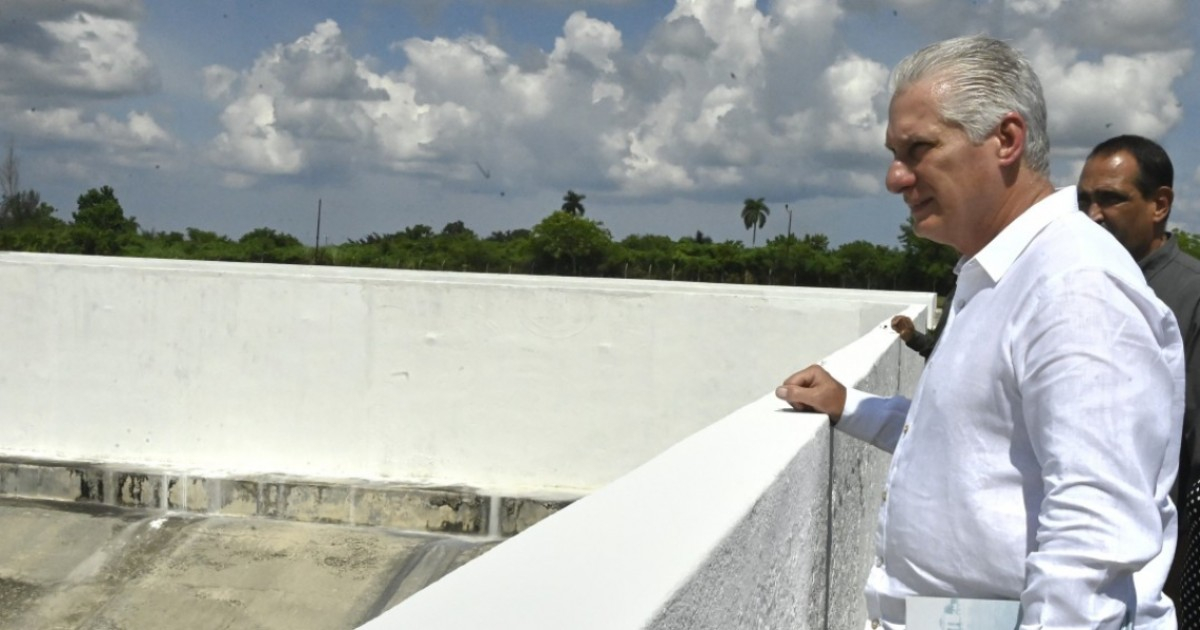
While Miguel Díaz-Canel toured the Main Tank "El Gato" in the Cotorro municipality of Havana on Tuesday, stating that the Integrated Water Supply Program in Havana "has been progressing" and that "results are already being seen", hundreds of thousands of residents continued to live without running water in their homes.
The ruler also expressed that as the works progress in the capital, the experience will need to be expanded to other provinces in order to reverse the water deficit.
That same morning, Aguas de La Habana announced a water outage in areas of six municipalities —Plaza de la Revolución, Cerro, Diez de Octubre, Boyeros, Centro Habana, and Habana Vieja— between 6:00 a.m. and 8:00 p.m., due to electrical work in Cuenca Sur and maintenance of the 78-inch pipeline.
La contradicción entre el optimismo oficial y la realidad cotidiana de los habaneros quedó expuesta con claridad: Díaz-Canel alababa los supuestos logros en las infraestructuras hidráulicas, mientras la propia empresa estatal reconocía que unas 282.000 personas todavía sufrían déficit de agua.
The General Director of Aguas de La Habana, Yosvani Rubí Bazail, provided figures that the regime presents as progress: "We started with a peak impact affecting around 577,000 people, and today we are down to about 282,000." According to his data, 296,000 residents of the capital have exited the affected group since the program began, with 14,500 doing so in the last week.
The official admitted, however, that there is a water shortage in all the municipalities of the province, and that the improvement will be gradual.
But these numbers coexist with a national reality that contradicts the triumphant narrative. The regime itself acknowledged last week that 2.7 million Cubans have water service that is totally or partially affected on a national scale, practically the same figure as in May. The UN Office for the Coordination of Humanitarian Affairs (OCHA) estimated in September that the water crisis affected about 3.5 million people in Cuba.
In September, Díaz-Canel promised that by the end of that month improvements would be seen in two or three supply systems in Havana and that in October other sources would be consolidated. Current data confirms that the national figure did not change.
The crisis has structural roots that no presidential tenure can obscure. The dependence on the electric system further exacerbates the water crisis: according to the National Institute of Hydraulic Resources, 87% of the Cuban population served by the water and sanitation system relies on the National Electric System.
Furthermore, losses due to leaks exceed 40% of the water pumped before reaching households, and some main pipelines have been in operation for 60 to 70 years without comprehensive rehabilitation.
The 78-inch pipeline of Cuenca Sur —the same one that prompted the shutdown this Tuesday— previously experienced a serious breakdown in August that left six municipalities without water, with three leaks detected.
The health consequences are alarming. The Ministry of Public Health admitted at the end of September to a simultaneous increase in dengue, diarrhea, hepatitis, and respiratory infections. The authorities specifically linked diarrheal diseases and hepatitis to sanitation and water treatment issues, while prolonged storage of water may encourage the proliferation of the mosquito that transmits dengue.
The long-term solution proposed by the regime —to install 200 megawatts of solar photovoltaic energy to make water pumping independent from the electrical grid— is not expected to be implemented until the first months of 2027, so its effects will depend on adherence to the announced timeline.
Related videos:
Filed under: