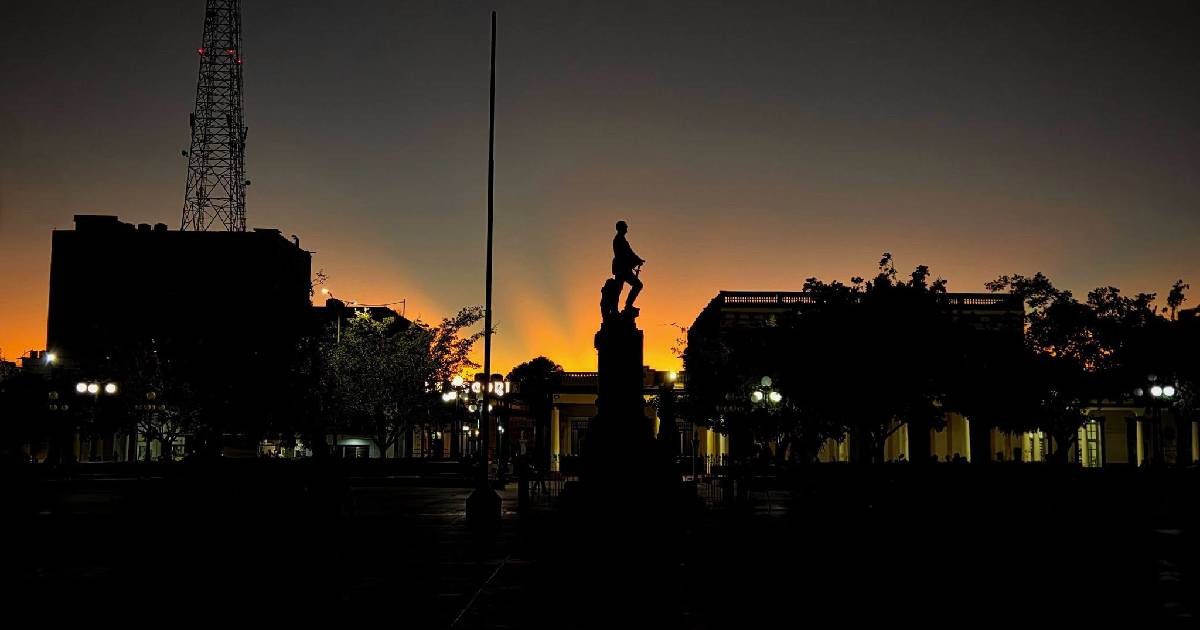
The writer from Holguín, José Poveda Cruz, published a satirical chronicle on Facebook titled "Requiem for the Rotation of the Circuits", in which he ironically bids farewell to the electric load-shedding system that the Electric Company of Holguín had suspended, while accumulating 25 consecutive hours without power.
The text arrives after the provincial electric company announced the formal suspension of circuit rotation in the capital city, citing the "complex situation of the National Electro-Energy System." The measure only exempted the circuits that supply the area of the Lenin Hospital, the largest hospital center in the province.
Poveda Cruz describes the suspended scheme with a clarity that exposes its absurdity: "The invention consisted of going without power for twelve or thirteen hours in order to enjoy three hours of electricity afterwards. Three glorious hours, barely enough to charge the phone, cook something, do a load of laundry, and check that we still belong to civilization."
The writer devotes an entire paragraph to dissecting the language with which the regime wraps its failures: "Rotation of the circuits: an elegant, almost musical expression, emerging from that national factory of euphemisms where a blackout becomes an 'affection', scarcity turns into 'difficulty', and disaster is just an opportunity to refine administrative vocabulary. If tomorrow they were to cut off water for five years, they would surely announce a program of intermittent hydration."
The irony does not conceal the portrait of a daily and exhausting crisis. "We have been without electricity for twenty-five hours now, and no one knows when it will come back or how long this miracle will last. Food spoils, the heat feels like a landlord, and one wonders how long a person can survive under such an experiment before the word life starts to seem like an exaggeration," he writes.
The human portrait it draws is equally bleak: "People speak in hushed tones, walk with hunched shoulders, and have that look of someone who has just received bad news, even if it’s the same news as yesterday. […] We are a laboratory of human resistance where wise decision-makers test their formulas, and the population provides the experimental material for free. With one difference: the researchers usually have access to electricity."
The reaction on social media to the electric company's announcement was equally ironic. "What rotation?" asked one user, encapsulating the sentiment of those who have never experienced any regular alternation. Another forewarned the outcome with bitterness: "When the SEN completely collapses, which won't be long, the NTV will say that we are a fortunate country because we have the moon at night and the sun during the day."
The numbers support that skepticism. By dawn on Saturday, the availability of the National Electro-Energy System was just 758 MW against a demand of 2,250 MW. In Holguín, the satisfied demand stood at only 50 MW, and some circuits had been without service for over 39 hours, with one even exceeding 43 hours. On that same day, neighbors in Santa Rita, in Jiguaní (Granma), took to the streets shouting "We want electricity!" in front of a police patrol that was unable to disperse them.
The electrical collapse brings along the water crisis: 87% of the population supplied by the Cuban water system depends on electricity for water supply. The regime itself admitted that 2.7 million Cubans are suffering from water supply issues. Poveda Cruz knows this reality firsthand: at the beginning of October he recounted 28 days without water in his home and the unequal competition between neighbors with and without suction pumps.
The crisis has structural causes that have accumulated over the years. The Antonio Guiteras thermoelectric power plant, the largest in the country, has recorded at least 17 unscheduled interruptions so far in 2026. On October 16, a fire took unit 1 of the Ernesto Guevara de la Serna thermoelectric plant in Mayabeque out of service, and on the same day the Felton thermoelectric plant in Mayarí also went offline. Cuba has experienced eight total disconnections from the SEN this year.
Poveda Cruz closes his text with the same mix of humor and despair that permeates it from beginning to end: "Thank goodness that the rotation of the planets still exists and that no official has announced a reorganization of the Earth's movement. [...] Although, upon closer inspection, we have been living in the dark for so long that the Sun seems like a freelance service."
Related videos:
Filed under: