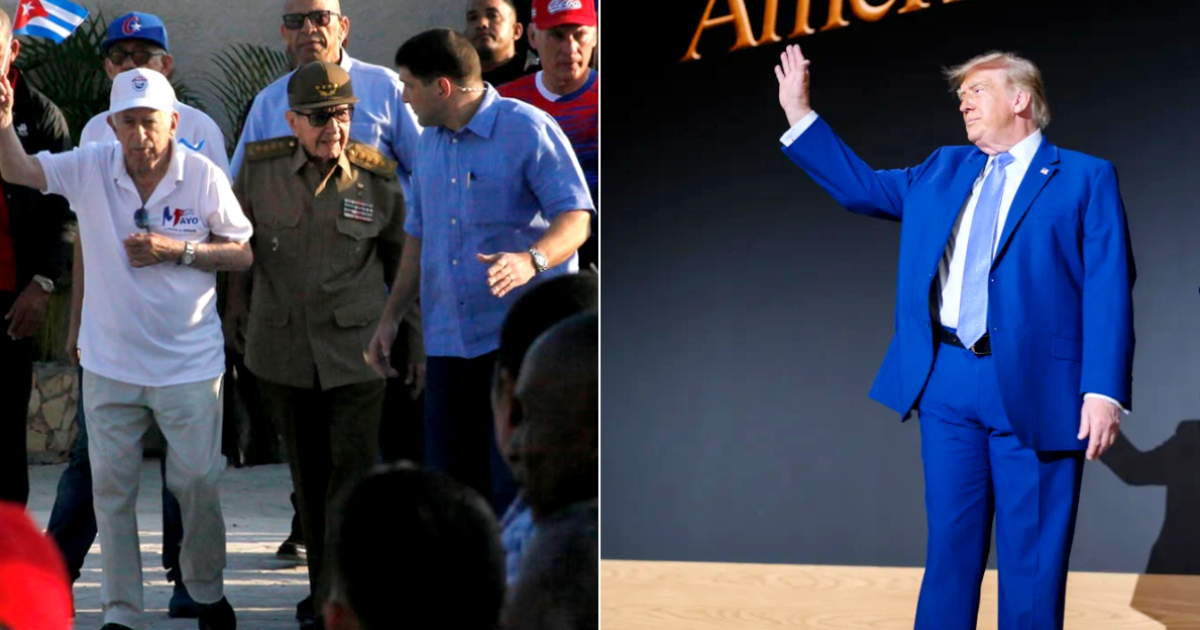
The new arrest warrant against Raúl Castro, announced on Monday by Florida's Attorney General James Uthmeier, is based on a concrete judicial foundation: the alleged involvement of the former leader in the conspiracy that led to the shooting down of two planes from Hermanos al Rescate in 1996.
However, his public presentation, just fifteen days before the U.S. legislative elections on November 3, also raises a political question: can this accusation turn into a campaign tool for the Republicans, amid increasing criticism of Donald Trump from sectors of the Cuban exile community?
The order, signed on October 16 by Judge Ariana Fajardo Orshan, complements the federal charges filed in May related to the same case. Uthmeier announced it at Florida International University (FIU) in Miami, in front of the families of the four victims of the attack.
The upcoming election does not demonstrate that the procedure has partisan motives. The investigation began months prior and is based on actions attributed to Cuban spies operating in Florida. Nevertheless, a judicial initiative may have legitimate foundations while also providing political benefits to those publicly presenting it.
Cuban Americans support the pressure on Cuba, but question other policies of Trump
The support of Cuban-Americans for Trump remains substantial, although polls reveal significant disagreements with decisions made by his administration.
A survey commissioned by the Miami Herald from Bendixen & Amandi International and The Tarrance Group, conducted in April among 800 Cubans and Cuban Americans in South Florida, revealed that 67% supported the president's policy towards Cuba. However, only 46% approved of direct negotiations with the communist regime, while 79% supported a U.S. military intervention on the Island.
The discrepancies were greater in immigration matters. According to the same survey, 68% opposed the increase in deportations of undocumented Cubans without a criminal record, while 81% supported the existence of legal immigration pathways for their fellow citizens.
The difference is revealing: a significant part of the community supports the pressure measures against Havana but rejects the idea that Washington's immigration policies harm Cubans who sought refuge in the United States.
In the national context, the decline in Trump's popularity among Hispanics is even more pronounced. A survey by Pew Research Center published on October 16 indicates his approval rating among registered Latino voters is at 24%, down from 38% in February 2025. Among Latinos who voted for him in 2024, support dropped from 93% to 57%.
These latest figures are national and do not specifically represent Cuban Americans, whose relationship with the Republican Party has its own distinct characteristics.
Deportations and promises regarding Cuba fuel disillusionment
The discomfort is not limited to the surveys. A report by NPR gathered by CiberCuba in early October documented the disappointment of Cuban Americans in Miami regarding the immigration raids and deportations driven by the Trump administration.
The operations of the Immigration and Customs Enforcement (ICE) have reached neighborhoods with a strong Cuban presence, including Little Havana. The controversy has even drawn the attention of Republican leaders like María Elvira Salazar, who has questioned the treatment of immigrants without criminal records.
An analysis published by CiberCuba on October 14 highlighted the warning from researcher Guillermo Grenier, associated with the Cuba Poll at FIU: the disillusionment of Cuban American Republican voters could manifest through abstention, which does not necessarily translate into support for the Democratic Party.
The deportations are accompanied by frustration over the expectations set after the capture of Nicolás Maduro in Venezuela on January 3. The operation fueled hope among certain exile groups for a similar action against the Cuban leadership, encouraged by subsequent warnings from Trump and Marco Rubio.
However, the months that have passed without intervention, along with information about U.S. negotiations with Raúl Guillermo Rodríguez Castro, known as 'El Cangrejo', have generated distrust among those who oppose any agreement that would allow the regime to continue.
A report by Florida Bulldog, published on October 15 and reviewed by CiberCuba, documented this shift in sentiment among Miami radio stations that have traditionally supported Trump.
Among the collected interventions, there are former Republican supporters who are questioning the promises regarding Cuba, criticizing the deportations, and announcing their intention not to participate in the elections. These are individual testimonies, not a statistical measurement, but they indicate that criticisms have also reached media spaces that have historically aligned with the president.
The approach to Putin adds another contradiction
Another point of controversy is Trump's policy towards Russia. While Washington tightens the energy blockade on Cuba and demands changes from its leaders, the U.S. president announced a oil agreement with Vladimir Putin to facilitate the marketing of Russian diesel.
The decision sparked criticism due to its potential economic benefits for Moscow while the war against Ukraine continues.
Among the Cuban voices questioning the agreement is the boxer Yordenis Ugás, who accused Trump of financially benefiting Russia while the Kremlin continues its military offensive against the Ukrainians.
The criticism has an additional dimension for the debate on Cuba: Russia is one of Havana's main international allies. The energy rapprochement between Washington and Moscow contrasts with U.S. pressure on the Cuban regime and may raise doubts about the consistency of both policies.
There are no surveys that measure how much this issue influences the electoral preferences of Cuban Americans. The statements from Ugás and other public reactions document specific criticisms, but they do not authorize presenting them as a majority position of the exile community.
A court order under electoral suspicion
Skepticism also appears among the readers of CiberCuba. In the posts regarding the new arrest warrant, numerous comments question whether Castro, 95 years old and residing in Cuba, will actually be detained.
On the profile of Facebook for this outlet, some describe the announcement as a "circus" or "theater," explicitly linking it to the midterm elections. Others express frustration with Trump regarding his promises about Cuba and his immigration policy, while some support judicial persecution or call for more decisive measures.
Although these reactions do not represent a representative sample of the electorate, they reflect disbelief and fatigue among some commentators regarding announcements they perceive as political gestures without practical consequences.
The presentation of the order in Miami, with extensive media coverage and statements from state and federal authorities, brings Cuba policy back to the forefront of public debate in South Florida.
During the press conference, Uthmeier stated that «there cannot be a future for Cuba that includes the Castros». The official statement from the Florida Department of Law Enforcement also highlighted the cooperation between state and federal authorities to pursue accountability for the downing of Brothers to the Rescue.
The case has its own legal consequences. As it involves a state accusation, a potential presidential pardon for federal offenses would not terminate the proceedings in Florida. Although Castro remains in Cuba and his arrest seems unlikely under the current circumstances, the new order adds another avenue to seek accountability for the deaths of four individuals.
The victims' families have been seeking justice for three decades. This demand and the grounds of the investigation do not vanish due to the upcoming elections. There is also no public evidence that the date of the announcement was chosen for electoral reasons.
But the judicial value of the measure does not exclude its potential political exploitation. The order allows Republicans to showcase a specific action against a historical figure of the Cuban regime at a time when certain sectors of the exile community are questioning the results of the pressure on Havana and the consequences of other Trump policies.
The question is whether this display of firmness will help regain the trust of the disenchanted or if it will be seen as just another announcement with no immediate results.
For now, the order against Raúl Castro has a documented judicial basis. Its potential electoral use remains a hypothesis, although the timing of its presentation and the reactions it has provoked provide reasons to examine it.
Related videos:
Filed under: