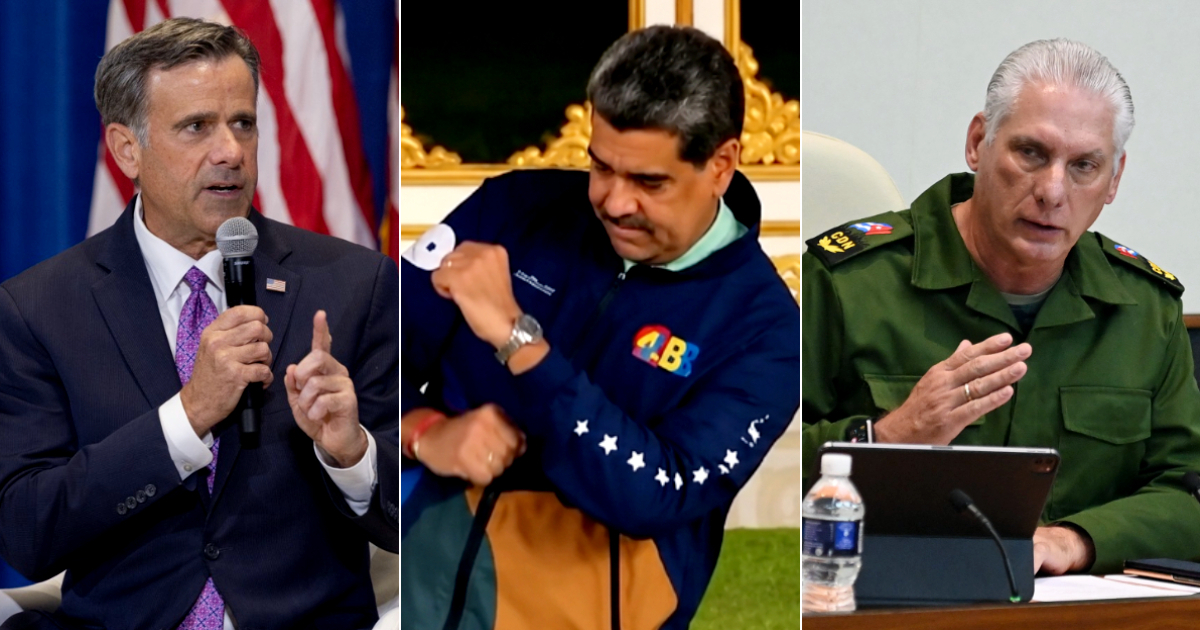
The director of the Central Intelligence Agency (CIA) of the United States, John Ratcliffe, has claimed the decisive role of his agency in the military operation that led to the capture of Nicolás Maduro, a precedent that becomes particularly relevant following Washington's call for Cubans to secretly cooperate with U.S. intelligence services.
A report published on Friday by The Atlantic, written by Shane Harris, describes Ratcliffe's increasing role in national security decisions under Donald Trump and his commitment to reviving covert operations as one of the key tools of the CIA.
The article recalls that during a speech delivered in June, Ratcliffe stated that, "thanks to the CIA," U.S. special forces were able to locate and capture Maduro in less than four minutes after landing at Venezuela's largest military complex.
It was not just an institutional claim. According to investigations by Reuters and The New York Times, the CIA had deployed a small covert team in Venezuela since August 2025 and had a source within the Chavista government that helped track Maduro's movements and determine his location.
The information obtained, supplemented with aerial surveillance and a thorough monitoring of the leader's routines, was crucial for the operation on January 3, which culminated in his capture along with Cilia Flores.
Reuters also identified Ratcliffe as a member, along with Marco Rubio, Pete Hegseth, and Stephen Miller, of the small group of senior officials who prepared for months the U.S. strategy towards Venezuela.
According to The Atlantic, the director has restored a central role for the CIA in advising the president and has promoted covert and paramilitary operations, whose leaders are among the most active sectors of the agency.
Ratcliffe used Maduro's capture to warn Havana
The Venezuelan precedent is not a mere comparison between scenarios. Ratcliffe himself used it as a warning during his visit to Cuba on May 14th, when he met with senior officials of the regime's security apparatus.
According to revealed by Axios, citing a CIA official, Ratcliffe urged his Cuban counterparts to draw lessons from the U.S. operation that overthrew Maduro.
Among the participants in that meeting were the Minister of Interior, Lázaro Alberto Álvarez Casas; the head of Cuban intelligence; and Raúl Guillermo Rodríguez Castro, "El Cangrejo," the grandson of Raúl Castro and a figure linked to confidential contacts with Washington.
The director conveyed that the United States was willing to negotiate economic and security issues, but conditioned any understanding on fundamental changes in Cuba.
A CIA official then warned that the opportunity to reach an agreement would not remain open indefinitely and that Trump would seek other avenues to enforce his demands if the talks failed.
From the dialogue reserved for the public appeal of the CIA
Five months later, the agency led by Ratcliffe has openly begun to seek collaboration from Cuban citizens, in a campaign promoted since Friday by Secretary of State Marco Rubio and subsequently supported by U.S. Southern Command.
The CIA published a message in Spanish directed at those who wish to promote political change on the island, inviting them to establish a "discreet partnership" with its intelligence services.
The agency also disseminated a guide for confidential contact and requested information from potential collaborators regarding their job positions and their level of access to sensitive data.
The commander of SOUTHCOM, General Francis L. Donovan, amplified the CIA's message and , while the State Department also publicly supported the campaign.
The offensive unfolds after months of discussions between Washington and representatives of the Cuban regime, who have reiterated their refusal to negotiate changes to the political system, the leading role of the Communist Party, or the holding of multiparty elections.
The U.S. government has also explored the possibility of identifying interlocutors within the Cuban power structure itself, partially following the Venezuelan model, where Delcy Rodríguez assumed the interim presidency after Maduro's capture.
Trump has not ruled out a similar operation in Cuba. In an interview with Axios in June, he responded, “Possibly. It’s possible” when asked if a potential U.S. action against the island could unfold similarly to what occurred in Venezuela.
The combination of diplomatic pressure, internal contacts, intelligence operations, and military option planning keeps various alternatives open for Washington, without any public confirmation of a decision to intervene militarily.
The prominence that Ratcliffe has gained in the Trump administration, now described by The Atlantic, places the CIA director at the center of that strategy.
The same agency whose intelligence helped make the capture of Maduro possible is now seeking collaborators within a Cuban regime that its director has already personally warned about the consequences of ignoring the Venezuelan precedent.
Related videos:
Filed under: