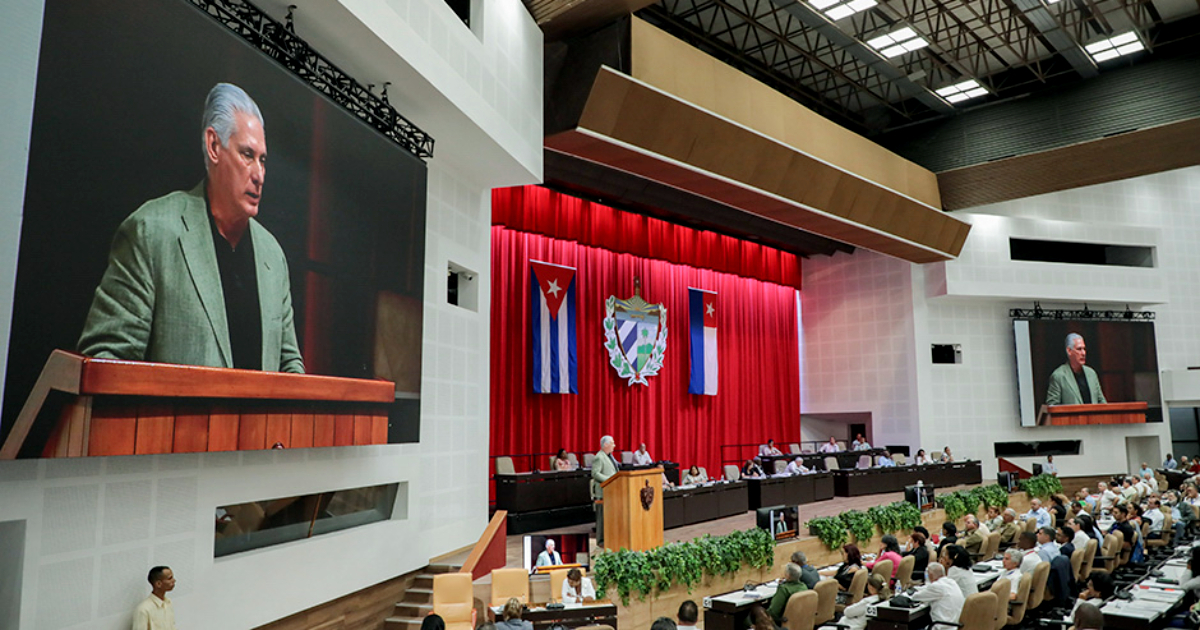
The Cuban ruler Miguel Díaz-Canel announced that 171 of the 176 economic and social transformations approved in June already have their legal foundations completed and that the government has approved 215 regulations to support their implementation.
However, an academic study warns that the announced opening does not, by itself, guarantee the rights and legal security that businesses and investors need.
The figures were presented by the leader on November 2, during a meeting with executives of state-owned companies. Díaz-Canel acknowledged that five measures are still pending, which he described as the most controversial, without specifying which ones they are or when they will be ready.
The balance represents progress compared to the situation in August, when much of the reform was still awaiting regulatory development. However, it raises a fundamental question: Is it enough to pass new laws and regulations to transform an economy that has been under state control for decades?
That is precisely the question addressed by Sofía Lagos in the essay "Cuba's Recent Economic Reforms: Legal Opening or Legislative Illusion?", published on August 27 in Horizonte Cubano, an academic project of Columbia University.
His analysis distinguishes between allowing new economic activities and establishing a legal system capable of protecting them against administrative decisions, contractual breaches, or changes in government policy.
An opening that does not guarantee rights
Lagos acknowledges that the 176 measures include significant modifications to the previous system.
Among them, the possibility of creating private banks and currency exchange houses, expanding foreign investments in non-state enterprises, removing certain restrictions on labor hiring, and allowing greater private participation in foreign trade stands out.
These are changes that, if fully implemented, would expand the opportunities for action for Cuban entrepreneurs and foreign investors.
But the author warns that removing a prohibition does not equate to establishing a right that can be effectively enforced before authorities and courts.
An investor needs to know not only if they can open a business, but also if they will retain their license, if they will be able to enforce a contract, convert their profits into foreign currency, or appeal an administrative decision that harms their interests.
According to Lagos, the package approved in June did not provide sufficient answers to those issues.
The study indicates, for instance, that authorizations for certain foreign investments still depend on the discretionary decisions of the authorities, while the reforms do not establish general guarantees regarding the conditions for suspending or revoking licenses.
The problem is significant: a company may receive authorization to operate and yet remain exposed to regulatory uncertainty that hinders financing and long-term investments.
The obstacle of legal certainty
Another central criticism from Lagos pertains to the lack of sufficiently independent and predictable mechanisms for resolving trade disputes.
The researcher questions the guarantees of independence of the Cuban judicial system and recalls that the country is not a part of the Convention on the Settlement of Investment Disputes between States and Nationals of Other States (ICSID), one of the main international mechanisms used in disputes between investors and States.
Although Cuba has bilateral investment treaties and other arbitration mechanisms, the author believes that the fundamental issue remains the ability to effectively enforce contractual obligations.
It also points out that the authorization of private financial institutions does not automatically resolve the shortage of foreign currency nor does it ensure that profits earned in Cuban pesos can be converted and transferred abroad.
These difficulties are compounded by the risks associated with U.S. sanctions, especially when operations involve entities linked to the military conglomerate GAESA.
These are obstacles that particularly affect industrial, energy, and infrastructure projects, whose investors need to commit large amounts of capital for years before recovering their money.
More rules, but better guarantees?
The balance now presented by Díaz-Canel requires an update of part of Lagos' diagnosis.
When she published her research in August, the author questioned the slow progress of the legislative development of the 176 measures. Two months later, the government claims to have approved 215 provisions and completed the legal foundations for almost the entire package.
That advancement modifies and updates the regulatory situation, but it does not automatically address the substantive objections of the study.
The number of provisions approved does not allow us to determine on its own whether the new rights have effective protection, whether the discretionary powers of the administration have been reduced, or whether there are reliable procedures in place to resolve disputes.
To determine this, it is necessary to examine the content of the regulations, their practical application, and the guarantees they offer to those who decide to invest or develop private activities.
In his essay, Lagos argues that reforms operate less as a general liberalization and more as an expansion of authorized exceptions within a system that retains state control over fundamental economic decisions.
This interpretation contrasts with the government's presentation of the 176 measures as a transformative process capable of unleashing productive forces and modernizing business operations.
The difference between both perspectives does not lie in denying that changes exist, but in determining how far they go and what specific rights they establish.
The challenge of turning reforms into results
Legal doubts are compounded by the economic objections raised by other specialists.
In August, the Cuban economist Pedro Monreal warned that the 176 measures lacked a specific axis for macroeconomic stabilization, despite the serious monetary and productive imbalances in the country.
Their critique and that of Lagos examine different dimensions of the same program: one questions its macroeconomic foundations; the other, the necessary legal guarantees for new opportunities to translate into sustainable investments and activities.
For the regime, the approval of hundreds of regulations represents a step forward in the implementation of reforms. However, for investors, the value of these provisions will also depend on the stability of the rules, the security of contracts, and the ability to exercise their rights in relation to state institutions.
The study by Lagos thus outlines a distinction that the figures announced by Díaz-Canel have not yet clarified: one thing is to legally expand the authorized economic activities, and another is to ensure that those who develop them can operate with autonomy, predictability, and effective legal protection.
Related videos:
Filed under: