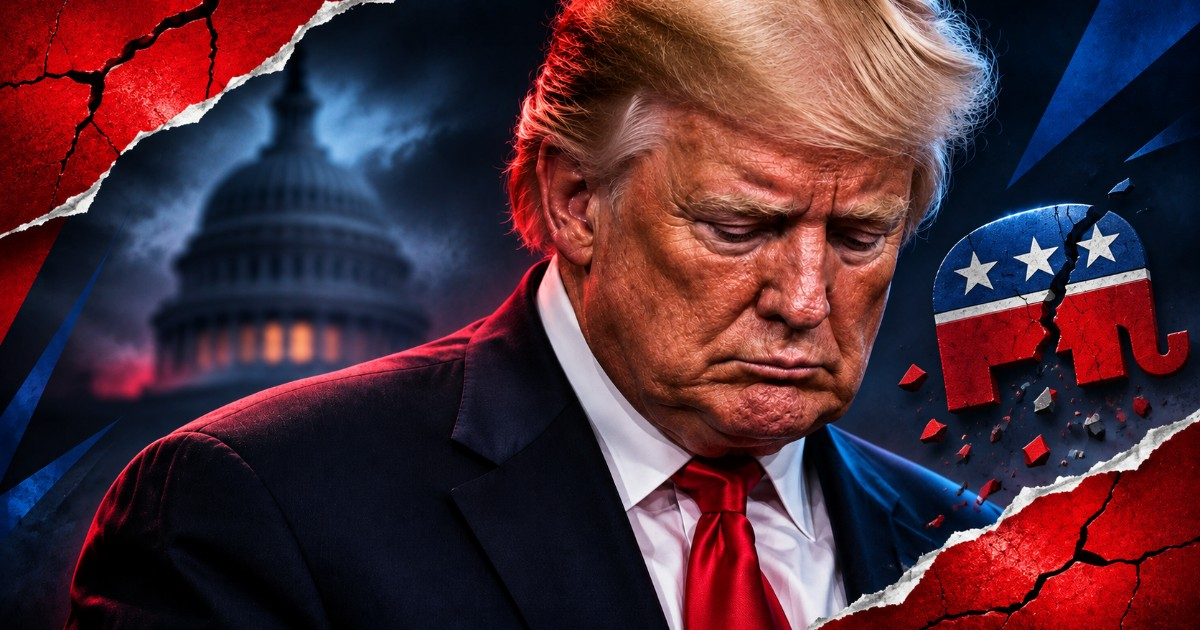
The discontent within the Republican Party erupted after the legislative elections this Tuesday in the United States, with leaders, strategists, and allies of the White House directly blaming President Donald Trump for the defeat that allowed the Democrats to regain control of Congress.
According to a report by BBC News published this Wednesday, the initial surprise over the election results has turned into anger among Republican sectors, who are questioning the president's decisions, his political priorities, and the lack of attention to economic issues affecting American families.
“The responsibility is yours. It is no one else's. It is a total and absolute rejection of President Trump”, stated Bill Miller, a prominent Republican lobbyist from Texas.
“This is a major disaster. No one saw it coming,” added Miller, who believed that the results reflect a direct rejection of the presidential administration.
Reproaches arose after the Democrats achieved victories in traditionally Republican states like Texas, Kansas, and South Carolina, a series of outcomes that exceeded the expectations of leaders from both parties.
Gregg Peppin, a Republican strategist from Minnesota, also questioned the direction of the administration and attributed part of the defeat to the unpopularity of its decisions.
“It was one mistake after another”, Peppin stated. “Clearly, in many states, people did not like the president's policies.”
The BBC interviewed a dozen members of the Republican Party, campaign officials, and individuals connected to the White House. Several spoke on the condition of anonymity to express their disagreements with Trump's electoral strategy.
One of the administration's allies stated that the war against Iran, tariffs, and the government's immigration measures contributed to creating a "perfect storm" that ultimately harmed the Republican candidates.
"There is a palpable frustration within the party regarding how events have unfolded," said that source, who described the anger towards Trump as "extremely high."
Among the criticisms, there is also the perception that the president devoted too much attention to personal projects and construction works in Washington, while voters expressed concerns about rising prices, particularly for gasoline.
In the months leading up to the elections, Trump promoted various renovation projects in the U.S. capital, including the construction of a ballroom in the White House, a helipad, and a memorial arch near Arlington National Cemetery.
Some Republicans interviewed by the BBC believed that these initiatives contributed to conveying an image of disconnection between the president's priorities and the economic concerns of the citizens.
The Republican convention held in September in Dallas also caused discomfort among party leaders, who expected greater visibility for their legislative candidates.
However, Trump captured a significant amount of attention during the event and surprised many with his remarks about Ken Paxton, the Republican Senate candidate from Texas, questioning his appearance and charisma while announcing his endorsement.
Robin Armstrong, a member of the Texas Republican National Committee, stated that those remarks did not aid the campaign.
"Obviously, that never helps," Armstrong stated. "You can't stop what President Trump says. We just have to accept it."
Paxton ended up losing the election to the Democrat James Talarico, whose campaign was praised even by some Republicans interviewed after the elections.
One of them questioned the mobilization capability of the Republican candidacy and stated that Talarico had run a "really good and smart" campaign.
The criticisms, however, were not unanimous. Other members of the party defended Trump's work and considered it unfair to attribute all the responsibility for the losses to him.
Krish Mathrani, president of the Michigan Republican Youth Committee, argued that the president should balance his presidential duties with the election campaign and highlighted his ability to mobilize supporters.
"It is the president. He is not going to spend all his time campaigning 24 hours a day, 7 days a week," he stated.
Some allies of the White House also pointed out that the party put forward weak candidates in key states and reminded that historically, midterm elections tend to disadvantage the party in power.
After the loss of Congress became known, Trump posted a message on his social media Truth Social where he tried to distance himself from the outcome.
“I was not on the ballot, and had I been, we would have won by a landslide!”, the president wrote.
Later, in interviews with The New York Times and Fox News, he asserted that he would accept the results and acknowledged feeling "a bit surprised," although he remembered that ruling parties often lose ground in legislative elections.
The outcome also reopened discussions within the Republican Party about its future after Trump and the need to present a different agenda in preparation for the 2028 presidential elections.
Steve Scheffler, a member of the Republican National Committee in Iowa, stated that the party has potential candidates for the upcoming elections, including Vice President JD Vance, Secretary of State Marco Rubio, and Senator Ted Cruz.
Peppin was more straightforward in demanding a political renewal within his party.
“I sincerely hope that we have put the Trump era behind us and that we will have new actors, new themes, and a new approach in the future,” stated the Republican strategist.
However, the criticism against the leader did not begin with Tuesday's defeat.
On October 18, Cuban exiled doctor Manuel Guerra, who identifies as a Republican, predicted that his party could lose the House of Representatives and possibly the Senate, and blamed Trump for the broken promises and decisions of his administration.
"Being a Republican does not mean being a subordinate of Donald Trump. The principles of a party must take precedence over the ego of any president," Guerra stated on that occasion.
The doctor questioned the administration's economic, immigration, and foreign policies, warning that loyalty to conservative values should not be confused with personal obedience to the leader.
Also, several Republican lawmakers had publicly distanced themselves from Trump over his agreement to import Russian diesel, a decision they criticized for providing revenue to Moscow while the war against Ukraine continued.
Among those who expressed their disagreement were Senators John Kennedy and Lisa Murkowski, as well as Representatives Michael McCaul, Brian Fitzpatrick, and Don Bacon.
Rejection also came from former Vice President Mike Pence, who demanded that Trump rescind the energy agreement with Russia and reinstate sanctions against Vladimir Putin's government.
On the eve of the elections, polls were already showing difficulties for the Republican candidates, particularly due to the cost of living, rising fuel prices, and the unpopularity of the war with Iran.
Before the vote, Trump had warned that if the Democrats regained Congress, he would resort to his veto power to block opposition initiatives and force negotiations, a strategy he described by saying he would become the "Mr. Veto."
Related videos:
Filed under: