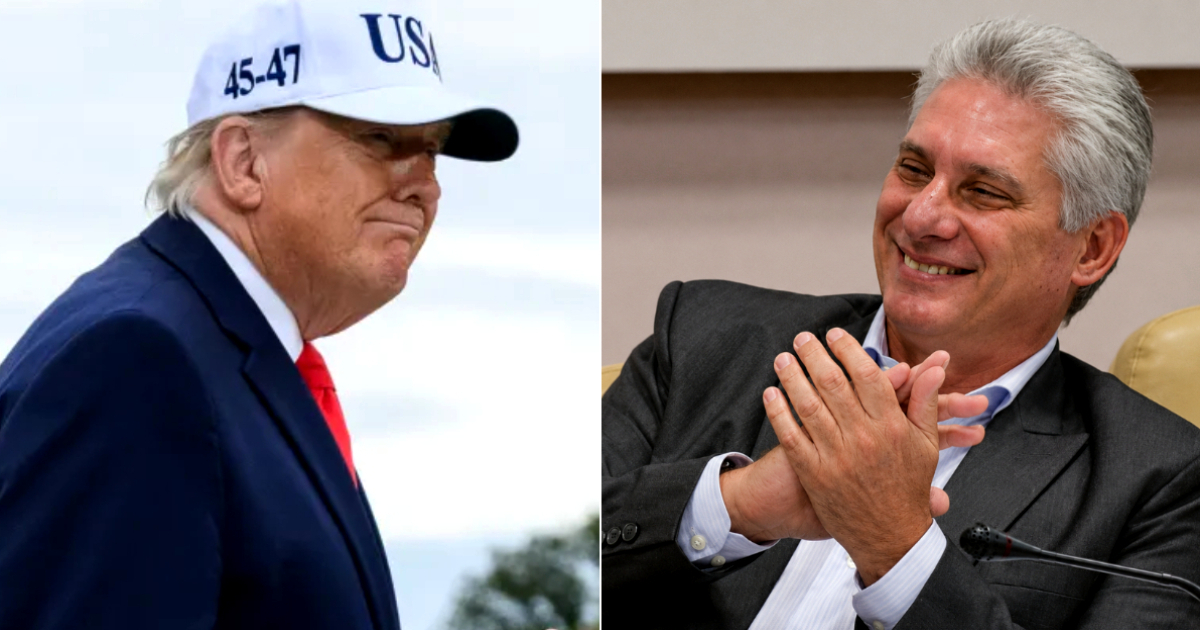
The Republican defeat in the legislative elections on November 3 has provided the propaganda of the Cuban regime with a new argument to bolster its resistance strategy: Donald Trump is now a "lame duck," a weakened president who is losing political influence and the ability to impose his agenda.
Thus presents Razones de Cuba, a platform linked to State Security, in an article signed by Javier López, interpreting the electoral setback in the United States as a sign of reduced effectiveness of the pressure on Havana.
More political and media noise, less strategic effectiveness, the author states, convinced that Trump could escalate his sanctions and threats without achieving significant political results.
The conclusion aligns with the regime's expectations: Washington is weakening, time is running in favor of Havana, and holding out remains the best bet.
The problem is that López confuses the loss of political influence with a supposed strategic incapacity that the facts do not support.
A "lame duck" that can still bite
It is true that Trump faces greater obstacles after losing both chambers of Congress. The Democrats will be able to oversee his decisions, block legislative initiatives, and raise the political cost of any potential military operations.
But the president retains broad executive powers regarding sanctions, national security, and foreign policy.
In fact, just two days after the elections, Washington announced new sanctions against eight entities and two individuals connected to the Cuban regime, as well as designating five vessels as blocked property.
The article from Razones de Cuba also downplays a fundamental dimension: the new U.S. hemispheric strategy, the military preparations examined during 2026, and the precedent of the operation that ended with the capture of Nicolás Maduro in Venezuela.
None of this means that Trump has decided to intervene militarily in Cuba, nor does it guarantee that he will achieve his objectives. But presenting his actions as mere propaganda gestures intended to mask his weakness is a biased and poorly supported interpretation.
From "psychological warfare" to the comfort of the "crippled duck"
The speech recalls the one used months ago by the propagandist Ana Hurtado, who described psychological warfare the reports from CBS News regarding U.S. military preparations related to Cuba.
Now, Razones de Cuba turns to a seemingly more sophisticated explanation to project a similar calm: Trump may continue to exert pressure, but his actions would become increasingly ineffective.
It is not coincidence that this message appears on a platform that, as stated in its own institutional presentation, was founded in 2010 by decision of the Cuban leadership and used testimonies from undercover agents of State Security in its early productions.
Your article reflects an editorial line committed to defending the Cuban political system. It provides a perspective on current events particularly advantageous for those who hope to endure the current U.S. president.
Resistance comes at a cost that propaganda overlooks
The Chancellor Bruno Rodríguez Parrilla has openly defended the strategy of resisting until Washington changes its policy.
The Democratic victory seems to reinforce that expectation. However, the regime risks interpreting Trump's electoral weakening as a guarantee of survival, ignoring that he still has more than two years left in his term.
The Cuban-American historian Michael J. Bustamante recently warned that waiting may be a strategy for the regime, but the costs continue to accumulate for the population.
And there lies the significant oversight of the official analysis: while the leadership calculates how much time it can endure, millions of Cubans face blackouts, shortages, inflation, and the deterioration of their living conditions.
U.S. sanctions have economic consequences, but they also do not absolve the regime of its responsibilities for decades of failed policies, stagnation, and the absence of substantial political reforms.
There is, furthermore, a revealing paradox: Cuban propaganda celebrates Trump's weakening as a consequence of competitive elections, while it defends a system where citizens cannot freely contest power against the Communist Party.
Trump has a constitutional exit date from the White House. In contrast, the Cuban leaders continue to bet on resisting without offering the population a democratic alternative to decide their future.
Havana can trust that Trump will fail, but it has no guarantees that waiting for his failure will resolve anything.
If in two years the regime manages to survive politically, but Cuba continues to sink into poverty and emigration, who will have really won that battle of resistance?
Related videos:
Filed under: