The Cuban regime is preparing to allow private banks, private currency exchange houses, and new forms of financial investment, but the Communist Party is not willing to relinquish political control over those transformations.
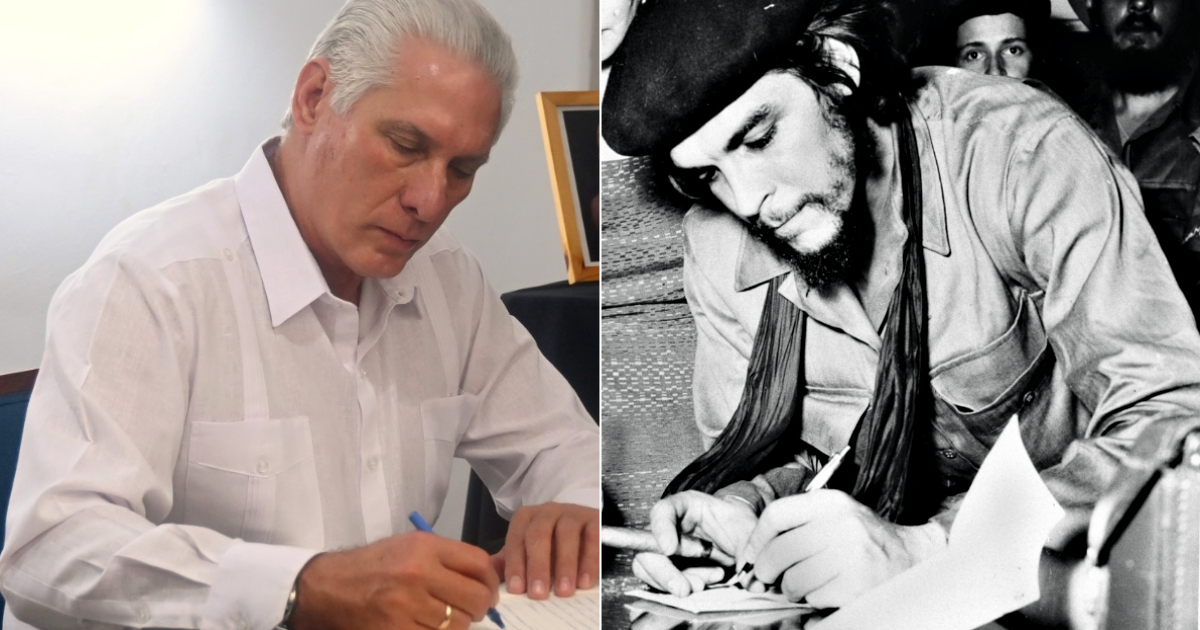
This was clearly demonstrated in a recent speech by Miguel Díaz-Canel to banking workers, where the leader emphasized the guiding role of the PCC and even invoked Che Guevara and his ideal of the "new man."
The meeting, reported by Granma on November 4th, concluded a visit by the Secretariat of the Central Committee of the Party to the Central Bank of Cuba and three state commercial banks: Metropolitano, Popular de Ahorro, and BANDEC.
Díaz-Canel explained that one of his objectives was to "affirm the guiding role of the Party and strengthen the political and ideological leadership" of the institutions visited.
The statement is particularly significant coming at a time when the government has just approved reforms that introduce tools characteristic of a market economy, which have been rejected or severely restricted by the regime for decades.
The contradiction is evident: there is an intention to modernize the financial system through capitalist mechanisms, but without changing the subordination of economic institutions to communist political power.
The capitalism that the regime refuses to call capitalism
The 176 economic transformations announced in June include the authorization of private banks, private exchange houses, new foreign investment opportunities, joint-stock companies, and greater freedom for private entrepreneurs to expand their businesses.
However, the authorities have accompanied these announcements with a discourse aimed at assuring that nothing essential will change in the political system.
The Prime Minister Manuel Marrero Cruz summarized that position with a phrase that CiberCuba examined in June: «doing what is necessary to preserve the essential».
The formula acknowledged the need for deep transformations but set its limit from the outset: to preserve socialism and the political structures of the so-called "revolution."
Díaz-Canel has repeatedly insisted on this idea. In July, during an interview with RT, he was explicit: “The transformations will also be under control, under the direction of the Communist Party of Cuba.”
A month later, in statements to the Brazilian newspaper Folha de S.Paulo, he acknowledged that expanding the private sector was a concession.
"Expanding the private sector is not an ideal of socialism. It is a concession", he stated, although he assured that the PCC would ensure that these measures did not lead to a capitalist restoration.
The regime needs these mechanisms to attempt to reactivate production and attract investments, but acknowledging them as a correction to its traditional model would call into question decades of decisions justified precisely in the name of socialism.
That is why the reforms are presented as a revolutionary continuity rather than a revision of principles.
The "new man" of Che, now on the bench of the 21st century
The invocation of Ernesto 'Che' Guevara adds a historical dimension to that contradiction.
Díaz-Canel maintained that the banking system should also be a space for building the "new man" that Che demanded, whose concepts, he recalled, matured during his time as president of the National Bank of Cuba.
The reference deserves attention because Guevara was not just a political symbol. He also directly participated in the construction of the Cuban socialist economic model and advocated for a vision of business management that is very different from what the government is currently trying to promote.
Che advocated for a centrally planned economy, with companies subject to state financial management and with moral incentives prioritized over material stimuli as a principle of social transformation.
In his 1964 essay On the Budget Financing System, he questioned the predominance of material interest as the driving force of economic activity and advocated for an organization aimed at developing socialist consciousness.
He did not reject the use of monetary instruments altogether, but he was wary that individual profit would become the main incentive for economic functioning.
Sixty years later, the regime turns to private banks, individual investors, and market mechanisms to try to overcome a crisis that the state model has failed to resolve.
The paradox takes on a familiar nuance when recalling the statements of Aleida Guevara, daughter of Che, who, in an interview published by Cubadebate in October 2020, referred to self-employment as a “small cancer within our society.”
Aleida then asserted that her father "would never understand. No way," because entrepreneurs were starting to think only about their pockets. Her words were cited by CiberCuba in August 2026, precisely when Díaz-Canel was expanding the economic spaces allocated to that sector.
The irony is hard to overlook: the small "cancer" denounced by Che's daughter not only has permission to sell products and import goods; now the regime is ready to allow it to even open banks.
And all of this, according to Díaz-Canel, is inspired by the "new man" envisioned by his father.
More economic autonomy, but under political oversight
The contradiction is not limited to the banking sector.
Days before his visit to financial institutions, Díaz-Canel had urged the leaders of state-owned enterprises to achieve greater autonomy and productivity, while explicitly reminding them that they remained subject to political oversight.
«You are leaders of the Revolution, you are leaders of the Party», he warned them during a meeting about the reforms.
The message is now being reiterated in banking: more efficiency, new investment opportunities, and greater participation from economic actors, but under the ideological guidance of the PCC.
It is important to distinguish between the financial supervision typically exercised by a central bank and the political direction of banking institutions. The former aims to ensure solvency and compliance with regulations; the latter introduces partisan criteria into decisions that also require professional autonomy.
The statements made in November were addressed to state banks and do not constitute a specific directive aimed at future private banks. However, they are part of a broader policy defined by Díaz-Canel himself: economic transformations will be under the direction of the Communist Party.
The regime envisions an expansion of entrepreneurial initiatives, but not a corresponding political opening. The Constitution retains the PCC as the supreme leading force of society and the state, without allowing other organizations to compete for its place in government.
The historical legitimacy of the regime is based on the so-called "revolution" and the promise of building socialism. Openly abandoning that project would necessitate a review of the ideological foundations with which the Party justifies its monopoly on power.
Díaz-Canel's address to banking workers succinctly summarizes a transformation filled with tensions: the government needs market instruments to make the economy work, but insists that its limits and objectives remain defined by the PCC.
The banking sector may open up to private capital, and businesses could have greater autonomy. However, what the regime does not consider subjecting to competition is the political authority that decides how far these freedoms can extend.
The "new man" of Che reappears, therefore, in the official discourse to accompany reforms that allow for private profit and market relationships, while the Communist Party reserves the final say on the fate of the Cuban economy.
Related videos:
Filed under: