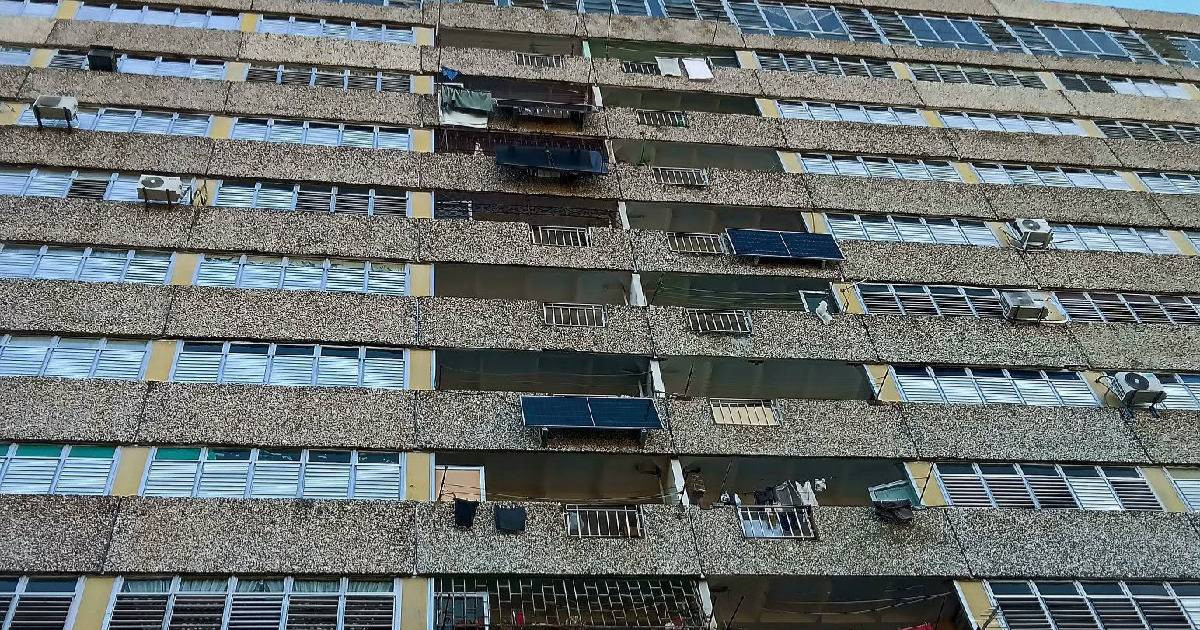
A photograph of several solar panels installed on the façade of a 12-story building in the Sandino neighborhood of Santa Clara sparked a debate on social media about survival during power outages and the state's responsibility.
The image was shared this Friday by the user Leonel Alfaro Pérez in the group Facebook "Santa Clara in Snapshots", for whom the snapshot is a symbol of "the ingenuity of Cubans."
The reactions revealed opposing positions between those who emphasized the residents' ability to seek alternatives and those who rejected portraying that adaptation as a source of pride.
"Misery cannot be normalized," wrote one of the commenters. Another questioned the celebration of the so-called "Cuban ingenuity" and argued that installing solar panels to provide electricity to homes is not an achievement, but rather a desperate response to basic needs that, in his view, the government has failed to guarantee for decades.
"How long are we going to romanticize misery and call what is purely survival resistance?" asked the user, who also pointed out that while some can buy panels, thousands of families continue to be without electricity and alternatives.
Other comments echoed this rejection. "I don't see what there is to be proud of or to celebrate; it's shameful to have to live like this in the 21st century," expressed one person. Another pointed out that citizens are forced to seek options to survive the blackouts and expressed the hope that everyone could access a similar solution.
The cost of the equipment was also part of the discussion. A commentator joked about the price of photovoltaic systems.
The available references place the cost of an individual panel between 990 and 1,000 dollars, while a complete residential kit ranges from 2,750 to 5,200 dollars. This latter price is equivalent to between 29 and 54 years of the full salary of a state worker who earns an average monthly wage of 7,354 pesos, which is about eight dollars at the informal exchange rate.
The economic disparity limits access to this equipment for those without remittances or income in foreign currency, while other families remain vulnerable to power outages without the means to install their own alternatives.
In July, more than 100 families from one of the 12-story buildings in the Sandino neighborhood went over 112 consecutive hours without electricity or water, as the pumping relies on electric turbines. Residents had to carry buckets of water up the stairs and lost food.
In September, the Government proposed to "regulate" private installations of solar panels on roofs and balconies, a proposal that also faced criticism.
The activist Lara Crofs summarized that rejection with the phrase "Cuba needs less control over those who survive."
Related videos:
Filed under: