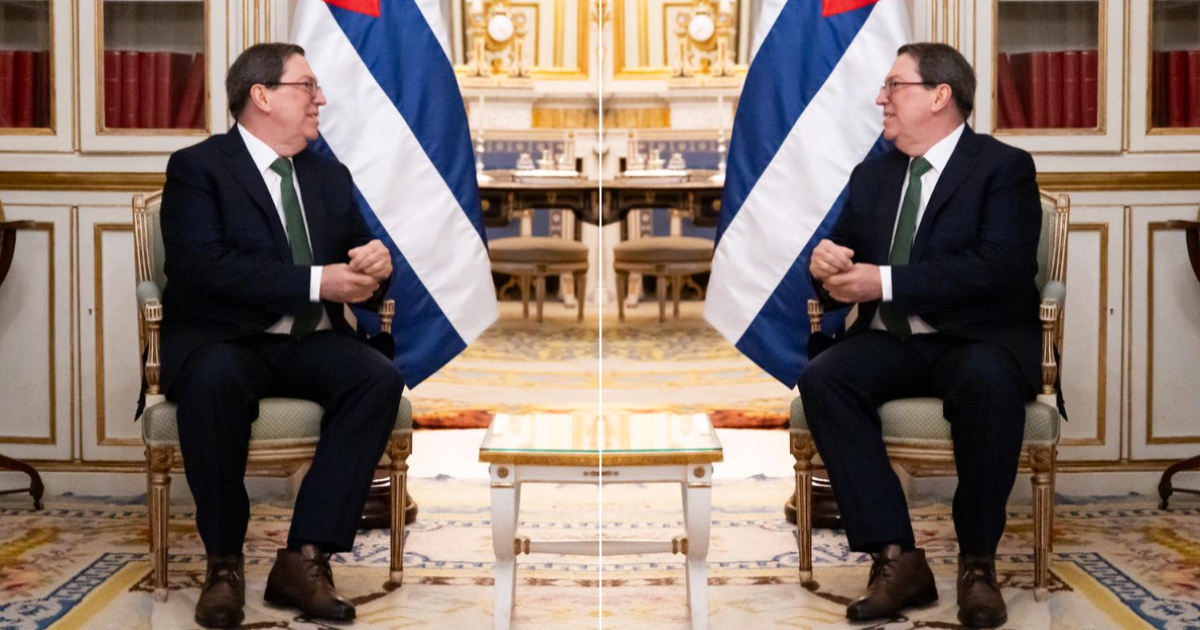
The Cuban Foreign Minister Bruno Rodríguez Parrilla made a stop in Madrid this Monday and met with the staff of the Cuban Embassy in Spain upon his return from a tour of China and Vietnam, as announced on his X account.
The visit did not include any public meetings with the Spanish Minister of Foreign Affairs, José Manuel Albares, or with any other official from the Spanish government.
In his post, Rodríguez described the situation in Cuba as "difficult" and attributed the country's problems to the "tightening of the blockade, the energy blockade, and secondary sanctions," a common argument by the regime to evade its responsibility for the structural crisis the island has faced after more than six decades of dictatorship. According to the foreign minister himself, they also "assessed the results achieved and the existing challenges" during the meeting.
The Madrid stop concludes a tour that took Rodríguez Parrilla first to Beijing from November 10 to 13, and then to Hanoi on November 13 and 14, as a special envoy of the Communist Party and the Cuban Government.
In the Chinese capital, he met with Chancellor Wang Yi, who stated that China would continue its support for Cuba "regardless of how circumstances evolve," as well as with officials from the cooperation agency and the international department of the Chinese Communist Party.
In Vietnam, he was received by the General Secretary of the Communist Party and President Tô Lâm, as well as by Foreign Minister Lê Hoài Trung.
None of the two visits resulted in publicly announced financial, energy, or debt relief agreements, highlighting the real limits of a diplomacy that accumulates statements of support without translating them into material commitments that alleviate the Cuban crisis. Furthermore, it was the second time in 2026 that Rodríguez took that same route; the first trip occurred in February.
The contrast with the Western diplomatic environment is pronounced. Just days before this stop, the foreign ministers of the G7 gathered in Paris demanded from Havana "meaningful and substantial" reforms, including a multiparty system, freedom of the press, and the release of political prisoners.
Rodríguez Parrilla responded from Beijing, accusing the group of reiterating “false arguments manufactured by Washington” and described U.S. policy toward Cuba as “genocidal.”
The visit to Madrid comes just ten days after the XXX Ibero-American Summit, where the head of MINREX led the Cuban delegation in place of Miguel Díaz-Canel.
The final statement of that forum, consisting of 20 points, did not expressly mention the U.S. embargo against Cuba, a symbolic setback for Havana. Meanwhile, 18 Cuban exile organizations in Spain publicly rejected the regime's presence at the summit.
The profile of Rodríguez Parrilla's visits to Spain has been declining.
In February, he was received by Minister Albares — the most concrete outcome was a commitment to humanitarian aid channeled through the UN and Spanish cooperation — but on that occasion, Cuban activists confronted him in Madrid with shouts of "Miserable!", "Murderer!", and "We want a free Cuba!". This time, the meeting was limited to an internal gathering with diplomatic staff, without a public agenda.
The Trump administration, with Marco Rubio at the forefront of U.S. diplomacy, has implemented, since January 2026, a maximum pressure strategy that includes sanctions against more than 40 entities, restrictions on 38 individuals, and Executive Order 14404, signed on May 1, which expanded measures against the GAESA military conglomerate, leaders of the Armed Forces, and the nickel sector.
In November, Washington imposed sanctions on oil tankers and shipping companies linked to Cuban oil. In the face of this blockade, the regime's diplomacy seeks support in Beijing, Hanoi, and Moscow, but returns to Havana empty-handed in terms of concrete commitments, albeit with supplies from Gran Vía.
Related videos:
Filed under: