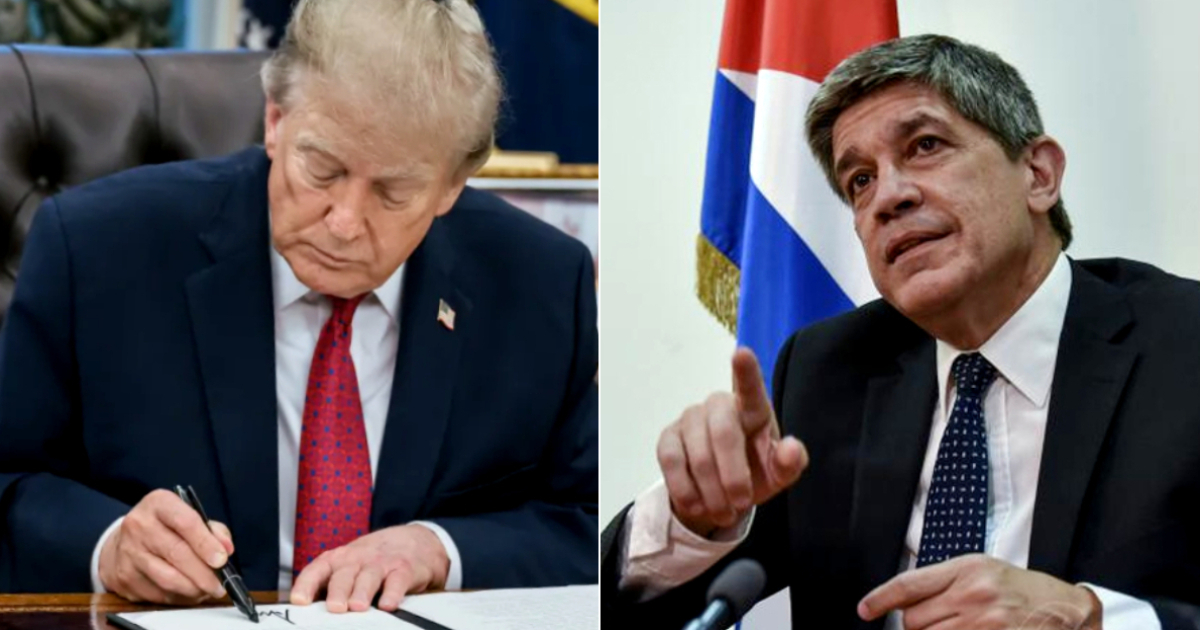
The Cuban Deputy Minister of Foreign Affairs, Carlos Fernández de Cossío, has decided to delve into political theory.
In a post on Facebook, he did not limit himself to his litany of condemning U.S. sanctions against Cuba, but also provided an analysis of the very nature of the U.S. government system, which he attributed to institutionalized lying, corruption, and the impunity of its leaders.
“Assume that he has the ability to lie shamelessly without any political cost and that the truth is an inconvenient detail that is better left unacknowledged. That is the nature of his system of government,” the diplomat wrote.
The reflection is particularly interesting because of its author. Fernández de Cossío represents a state where the Communist Party is constitutionally enshrined as the leading force of society, socialism has been declared irrevocable, and citizens lack the ability to replace the ruling party through free and competitive elections.
In other words, the diplomat has chosen to examine the structural flaws of a foreign political system while maintaining a compliant silence about the characteristics of the one he has been defending for decades. This is a striking omission from someone who has just ventured into the realm of political science.
Because, when it comes to studying the nature of political systems, the Cuban case presents extraordinary interest: a revolution turned into a perpetual source of legitimacy, a party identified with the nation, an ideology elevated to an intangible constitutional principle, and a repressive apparatus tasked with preserving the monopoly of power.
The Revolution as perpetual legitimacy
The Cuban regime built its legitimacy on the revolutionary triumph of 1959, a historical event that ultimately became a permanent justification for the right to govern.
The so-called "revolution" ceased to be merely a historical process and became an almost sacred entity, placed above the institutions and the changing will of the citizens. Its leaders proclaimed themselves interpreters of its principles and their designated successors inherited that authority without subjecting it to any real political competition.
From that ideological construction arose one of the most effective operations of Castroism: to equate the homeland with the Revolution, the Revolution with socialism, and socialism with the Communist Party. Questioning the latter could thus be framed not as a legitimate disagreement, but as a threat to the nation.
The 2019 Constitution ultimately enshrined this conception of power in legal terms. Its Article 3 proclaims that sovereignty resides untransferably in the people, but Article 4 declares socialism irrevocable —authorizing the use of arms to defend it— and Article 5 recognizes the PCC as the sole party and the leading force of society and the State.
The political contradiction is profound: the people are declared sovereign, yet they are prevented from freely deciding on a fundamental issue—the possibility of replacing the political system and the party that monopolizes its leadership.
A constitution that entrenches an ideology and the supremacy of a single party does not guarantee democratic pluralism, no matter how much it proclaims popular sovereignty.
Repression as a mechanism for preserving power
The concentration of power requires tools to preserve its limits. In Cuba, this function corresponds to a structure of totalitarian control that encompasses State Security, police forces, political institutions, the official press, and social surveillance mechanisms built over decades.
The persecution of opponents, the harassment of independent journalists, arbitrary detentions, and the criminalization of protests cannot be understood solely as individual excesses. They constitute mechanisms through which the regime limits the organization of forces capable of contesting its power.
Organizations such as Human Rights Watch, Amnesty International, and Prisoners Defenders have consistently documented political repression, restrictions on civil liberties, and the existence of hundreds of political prisoners.
From a political theory perspective, Castroism exhibits characteristics typical of single-party regimes and pure tendencies of totalitarian control: official ideology, institutional subordination, monopoly over information, narrative, and the primary coercive instruments, in addition to a pathological ambition to direct vast areas of social life, openly promoting loyalty, denunciation, and mediocrity.
It is not coincidental that, despite economic reforms, changes in leadership, and a selective opening to private activities, political competition remains excluded from the allowed transformations.
The truth also has an owner
Fernández de Cossío also accuses certain U.S. sectors of paying and mobilizing major media outlets to support their interests. He does not provide concrete evidence of this alleged operation in his publication.
The denunciation is peculiar coming from a representative of a regime that for decades has viewed the press as a tool for the Revolution, subordinating state media to the directives of the Communist Party and targeting independent journalism.
Political lies do not belong exclusively to any ideology. The fundamental difference lies in the mechanisms available to uncover them, denounce them, and hold those responsible accountable.
In the United States, despite its corruption issues and institutional shortcomings, there are independent media, legal opposition, competitive elections, and judicial and parliamentary oversight mechanisms. In Cuba, those possibilities are co-opted by the political monopoly of the PCC.
Fernández de Cossío has publicly denied the existence of protesters arbitrarily imprisoned for protesting in Cuba, despite the documented reports by human rights organizations.
It would be interesting to know what chances a journalist from state television would have to interrogate him about those contradictions, to freely question his version, and to demand explanations without facing professional or political repercussions.
When the government becomes confused with the nation
The Deputy Foreign Minister concludes his publication with a categorical statement: «The problem is not Cuba. The problem is the aggression of the U.S. against Cuba».
The phrase encapsulates another common operation of official discourse: to confuse Cuba with those who govern it. The nation, the State, the Government, and the Communist Party appear merged into a single entity, so that questioning the power can be portrayed as a threat to national sovereignty.
However, defending the territorial integrity of the Cuban state or Cuba's independence against any foreign intervention does not imply recognizing the PCC an indefinite right to govern it.
Although designed against the regime and its elites, U.S. sanctions have consequences for the economy and the population, and it is legitimate to question their humanitarian effects. It is also valid to warn about potential consequences of a military intervention that puts civilians at risk.
But none of these considerations justify the restrictions on political freedoms or the constitutional irrevocability of socialism. Even less so should the regime put the lives of Cubans at stake in scenarios of "total people's war" and resistance "to the last drop of blood".
National sovereignty protects Cuba against foreign domination. Popular sovereignty should guarantee Cubans the right to decide who governs them and to replace them peacefully.
Fernández de Cossío insists on the first. He has much less to say about the limitations imposed on the second, or rather, nothing at all.
The nature of the regime it represents
After nearly seven decades, the Cuban political system maintains a structure whose continuity relies on the supremacy of one party, institutional subordination, revolutionary legitimacy, political persecution, and the repression of organized opposition.
It has changed its leaders, reformed its Constitution, and introduced market mechanisms that were previously ideologically condemned. However, it has kept the monopoly on power off the table for discussion.
That is one of its most significant structural features: economic policies, forms of ownership, and even relationships with former adversaries can be modified, but not the principle that reserves leadership of the country for the Communist Party.
The diplomat who demonstrates willingness to examine the lies, corruption, and deep motivations of the American system could apply the same intellectual curiosity to what he represents.
You would find a Constitution that proclaims popular sovereignty while safeguarding an ideology, institutions subordinate to political power, and a citizenry that cannot freely organize an alternative to replace its rulers.
You don't need to look far to study these phenomena. They are embedded in the laws, institutions, and political history of the regime it serves, one that has impudently captured the State, the Nation, and whose elites seize, without barriers and without shame, the wealth of the country.
Fernández de Cossío has sought to explain the nature of a system of government. The question left unanswered is much closer: what is the nature of a regime that proclaims the sovereignty of the people, yet denies them the effective right to decide who should govern them?
Related videos:
Filed under: