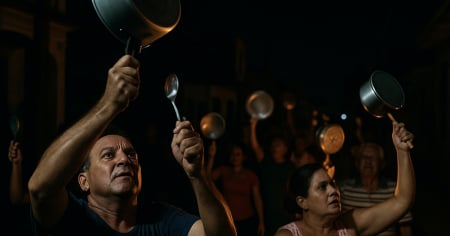
The Cuban Deputy Foreign Minister Carlos Fernández de Cossío denied the existence of imprisoned protesters in Cuba and dismissed reports from organizations like Amnesty International and Human Rights Watch that denounce repression and hundreds of arbitrary detentions on the island.
Fernández de Cossío stated that there are no incarcerated protesters in Cuba, during an interview with journalist Mehdi Hasan from Zeteo, amidst the sessions of the United Nations General Assembly in New York.
“Arbitrarily, no,” he replied when directly asked if there were people imprisoned for protesting against the government.
Hasan reminded about the reports from Amnesty International and Human Rights Watch that denounce systematic repression against dissent, with hundreds of critics and protesters detained.
The deputy head of Cuban diplomacy questioned the credibility of those reports and described them as lacking evidence.
The Cuban official accused Amnesty International of being funded by organizations opposed to the Cuban government, which, according to him, explains the bias in their reports.
However, the journalist replied that the organization has also strongly criticized governments such as the United States, Israel, Venezuela, Brazil, and Argentina.
During the exchange, the Deputy Foreign Minister maintained his refusal to acknowledge cases of political repression in Cuba, while insisting on discrediting international NGOs and questioning the legitimacy of their allegations.
He was also questioned about the human rights record of Cuba, the lack of democratic freedoms, the absence of a free press, and the allegations that the island harbors individuals labeled as “terrorists” by the administration of Donald Trump.
De Cossío defended the Cuban political model and rejected the criticisms.
On the other hand, it stated that Havana will provide its “full political support” to the government of Nicolás Maduro.
However, he avoided specifying whether that support could translate into military assistance; rather, he was cautious and described the question as "dangerous," while asserting that "Cuba will not go to war with the United States, but will provide total political support to Venezuela, solidary support," he emphasized.
When asked about the economic limitations of the island, Fernández de Cossío stated that Cuba is facing a critical situation due to pressures from Washington.
"The United States is trying to disconnect Cuba from the global economy. What country can sustain itself if the most powerful economy in the world pressures and threatens other governments not to have ties with Cuba?" he questioned.
The dialogue took place parallel to the debates of the UN General Assembly, where another topic that dominated the agenda was the conflict in Gaza. The Cuban diplomat described the Israeli offensive as “genocide” and criticized the United Nations for its “inability to act.”
Cuba closed the month of August 2025 with 1,185 political prisoners and prisoners of conscience, the highest number recorded to date, reported the organization Prisoners Defenders on September 10, labeling the figure as a new monthly record on the island.
In its most recent report, the Madrid-based organization documented the entrance of 13 new political prisoners just in August, while there were four releases, three due to the completion of their sentences and one due to forced expatriation, that of activist Aymara Nieto Muñoz, who was released on the condition of leaving the country.
Nieto was transferred directly from prison to the airport, without being able to say goodbye to her oldest daughter, and deported to the Dominican Republic along with her husband and younger daughters.
Since July 1, 2021, until the end of August 2025, Prisoners Defenders has recorded a total of 1,882 individuals classified as political prisoners in Cuba, nearly all of them citizens with no political affiliation who have been imprisoned after peacefully protesting against the regime.
The report warned that at least 33 of the 1,185 political prisoners were detained while still minors. Of those, 30 are still serving sentences and three are being processed without judicial oversight.
Additionally, 122 women continue to be imprisoned for political or conscientious reasons.
A total of 702 are categorized as prisoners of conscience, 447 as conscientious objectors, and 36 as other political prisoners, classifications that reflect serious violations of human rights, due process, and judicial neutrality.
Moreover, another report released in June revealed that in the first six months of the year there were 24 deaths in state custody and 160 reports of torture, including beatings, deliberate denial of medical care, and psychological torture. Of the victims, at least 56 were prisoners for political reasons.
Frequently Asked Questions About the Human Rights Situation in Cuba
Are there protesters imprisoned in Cuba according to the government?
The Cuban government denies the existence of jailed protesters on the island. According to Vice Chancellor Carlos Fernández de Cossío, there are no individuals imprisoned for protesting against the government. However, reports from organizations such as Amnesty International and Human Rights Watch denounce the existence of hundreds of arbitrary detentions and systematic repression against dissent in Cuba.
How many political prisoners are there in Cuba according to independent reports?
According to the organization Prisoners Defenders, there are 1,185 political and conscience prisoners in Cuba as of August 2025. This number includes individuals imprisoned for peacefully protesting against the regime and minors detained for political reasons.
How does the Cuban regime justify repression against opponents?
The Cuban regime justifies repression by claiming that opponents commit crimes. Miguel Díaz-Canel has asserted in interviews that "counter-revolutionaries" are financed by the United States to commit vandalous and terrorist acts, and that they are not being judged for their political opposition but for their crimes.
Filed under: