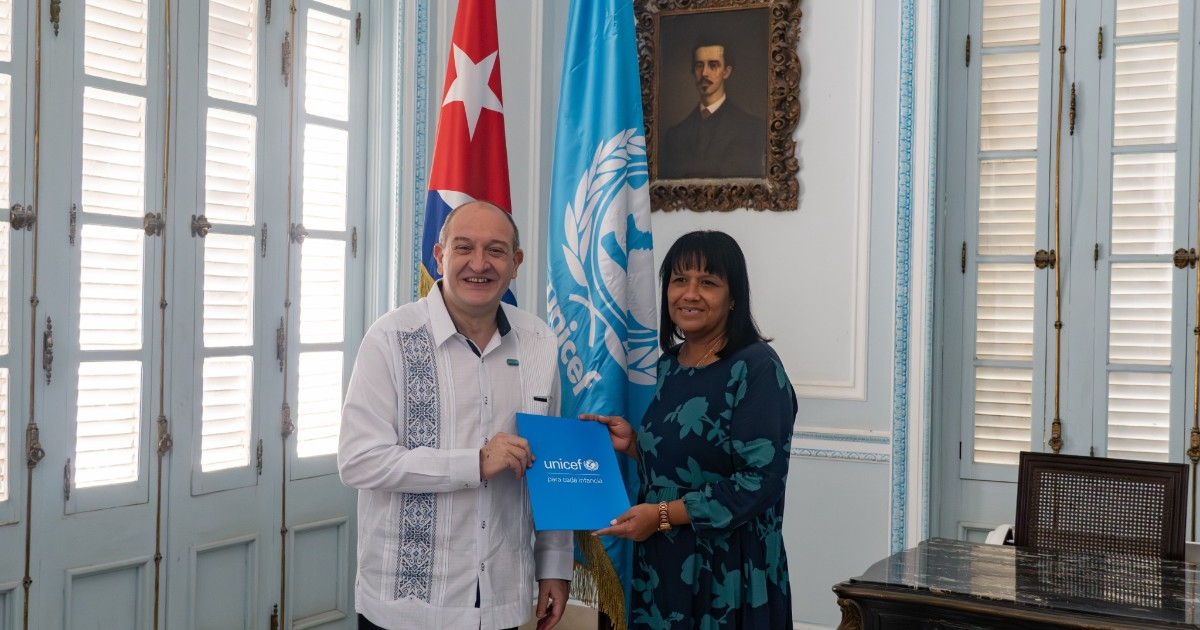
The Guatemalan Luis Fernando Carrera Castro was inaugurated this Wednesday as the new UNICEF Representative in Cuba, in a ceremony where he submitted his credentials to the Deputy Minister of Foreign Affairs, Anayansi Rodríguez Camejo.
"I received credentials from Luis Fernando Carrera Castro as the Representative of the United Nations Children's Fund. We conveyed our intention to continue strengthening the close relationship of cooperation and dialogue with the UNICEF office in Cuba for the well-being of our children and adolescents," said the diplomat on X.
Carrera Castro takes on the role with more than three decades of experience in public policy, social development, international cooperation, and child rights advocacy, noted UNICEF in Cuba on its Facebook page. Previously, he served as UNICEF's Representative in Mexico since 2021, where he led an office of over 220 professionals focused on social protection, nutrition, education, and humanitarian response for migrant children.
Throughout his career within the organization, which dates back to 1994, he also held positions in Indonesia, Panama, Cape Verde, Ecuador, Guatemala, and Costa Rica.
Outside of UNICEF, the new representative has a political profile: he served as the Minister of Foreign Affairs of Guatemala from 2013 to 2014, Secretary of Planning of the Presidency from 2011 to 2012, and as Ambassador and Permanent Representative of Guatemala to the United Nations in 2014 and 2015. He also led the Central American Institute for Fiscal Studies (ICEFI) and the Soros Foundation Guatemala, in addition to advising governments and UN agencies on governance and human rights issues.
He is an economist graduated from the National University of Costa Rica and holds a Master's in Economics and Development Policy from the University of Cambridge in the United Kingdom.
Carrera Castro takes on the representation at a particularly significant moment for bilateral cooperation: in February of this year the Executive Board of the organization approved the Cuba-UNICEF Cooperation Program 2026-2030. This program aims to strengthen a comprehensive system for the protection of children's rights integrated with climate-resilient local development strategies.
"Cuba faces a high exposure to extreme events: it is estimated that 1.2 million girls and boys are exposed each year to between two and four severe weather phenomena (...) This situation is compounded by persistent structural gaps, such as low coverage of early childhood education, interruptions in access to safe water, and the presence of violence in family and community environments," UNICEF stated.
In the context of this new cycle, UNICEF has already implemented several concrete initiatives on the island: donated 100 oxygen concentrators to maternal and child hospitals in seven provinces, distributed over 213,000 bottles of prenatal supplements for approximately 30,430 pregnant and breastfeeding women, and supports 30 schools in eastern Cuba with water, sanitation, and hygiene, benefiting more than 5,000 students.
Since years ago, children have been suffering from the severe crisis in Cuba. According to a report from UNICEF itself published in 2024, approximately 9% of children under five were experiencing food insecurity. The Minister of Food Industry acknowledged in June of this year that more than 100,000 children were not receiving their daily milk supply.
Upon taking office, Carrera Castro expressed her commitment to "continue strengthening collaborative efforts with national institutions, partners, communities, and youth to ensure the protection of the rights of every girl, boy, and adolescent in the country."
Related videos:
Filed under: