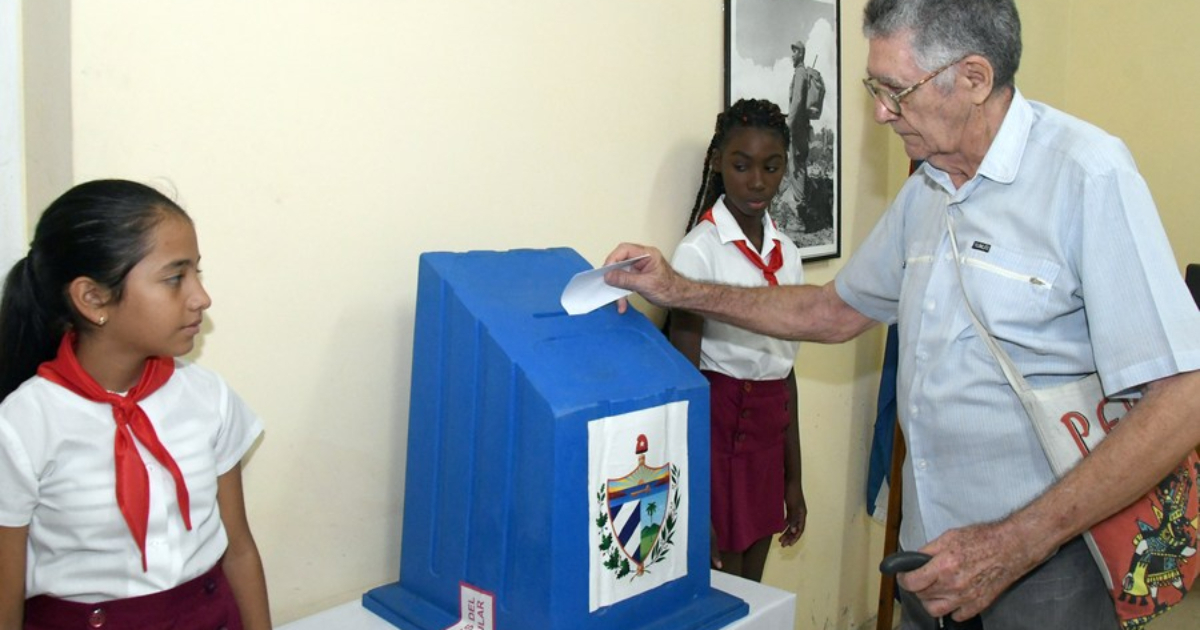
87% of Cubans strongly disagree that citizens can influence the country's political decisions, while 85% express the same rejection of the claim that they can publicly protest against the Government, according to a national survey conducted within Cuba by the International Republican Institute (IRI).
The results of the study published this Wednesday reveal a profound disconnection between the citizens and the institutions that hold power, extending beyond the rejection of Miguel Díaz-Canel and other leaders of the regime.
The 89% of respondents disagree that the current Government represents them, while a similar proportion rejects the idea that the current political system is the best for Cuba. Additionally, 78% demand deep and urgent changes.
These figures contrast with the official narrative, which presents the socialist system as an expression of the popular will and its institutions as instruments of democratic participation.
The establishes in its article 3 that sovereignty resides inalienably in the people, but article 5 enshrines the Communist Party as the superior leading political force of society and the State. Additionally, article 4 declares the socialist system irrevocable.
The contradiction is essentially political: citizens are formally recognized as the bearers of sovereignty, but they lack the ability to choose between alternative political projects capable of challenging the PCC for power or altering the foundations of the system through democratic competition.
The absence of political pluralism is coupled with severe restrictions on the exercise of civil rights. Although the Constitution recognizes freedoms of expression, assembly, and protest, their practice has been conditioned by the actions of repressive bodies and the penalties imposed on those who publicly challenge the regime.
The protests on July 11, 2021, were the most significant example of that contradiction. Thousands of Cubans took to the streets to demand freedom and better living conditions, and the government's response included arrests, legal proceedings, and prison sentences.
Repression has not disappeared in 2026 either. According to a report by Cubalex featured in CiberCuba, the organization documented 1,894 events of human rights violations during the first half of the year, in a context of increasing social protests and repressive actions against citizens unrelated to opposition groups.
Fear is another obstacle to citizen participation. The research FOCO Cuba: Opinion, Self-Censorship, and Civic Action, conducted by Cubadata for Diario de Cuba between May and June 2026, found that 61.9% of its 2,214 participants feared reprisals against themselves or their family members for expressing critical opinions, while 58.9% acknowledged that they often avoided discussing politics.
Although that study used a non-probabilistic digital sample, its results provide an element for interpreting the apparent paradox of a deeply discontented society where public demonstrations do not match the same scale as the rejection expressed in surveys.
The issue becomes particularly relevant when the Cuban regime claims its political legitimacy in the name of the people. Popular sovereignty is not exhausted in its constitutional proclamation: it requires that citizens can participate, disagree, organize, and decide who holds power.
The IRI survey suggests that a significant majority of Cubans do not recognize those possibilities within the current system. Moreover, the demand for profound transformations reaches 85% among young people aged 18 to 35, which is precisely the group that will have to face the consequences of current political decisions for the longest time.
The study was conducted by NORC at the University of Chicago through in-person interviews with 1,199 adults residing in Cuba between July 22 and September 7, 2026. The research utilized a national probabilistic sampling method and reports a maximum margin of error of ±4.2 percentage points for the mid-range estimates of the total sample, with a confidence level of 95%.
Related videos:
Filed under: