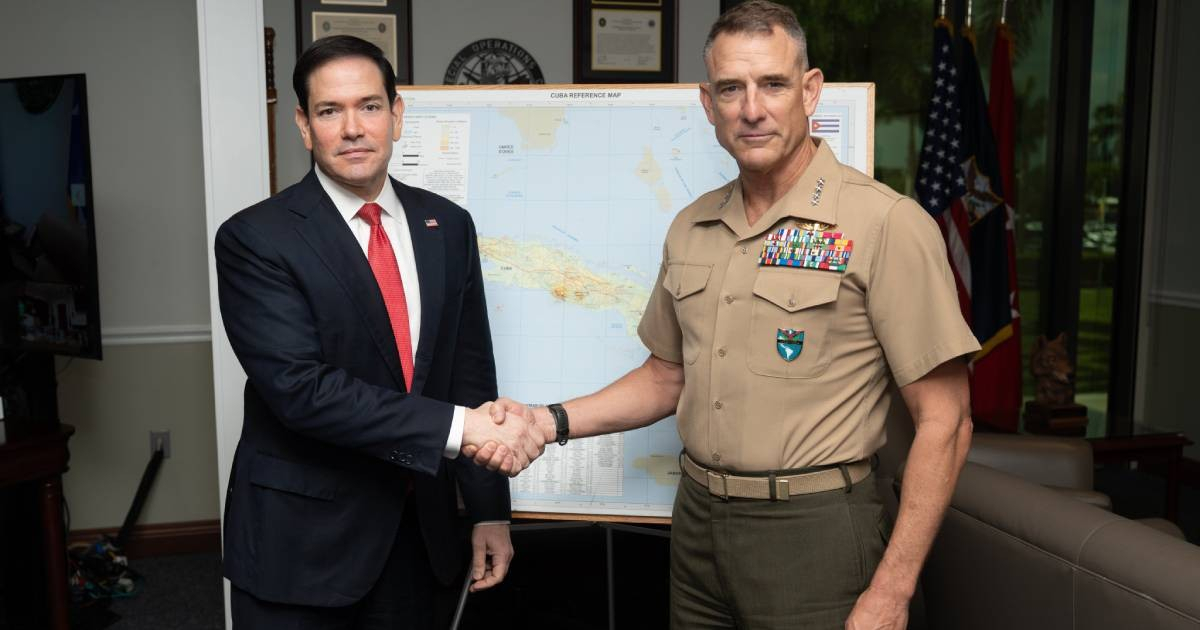
When Donald Trump promised again that the Cuban regime will not survive his presidency, the reactions of many Cubans ranged from hope to disbelief to despair.
Some called for immediate intervention; others mocked the unfulfilled promises. One phrase, repeated in various forms, summed up the exhaustion: “There will no longer be a people to liberate.”
Behind those reactions lies a reality that transcends the U.S. president: a segment of the Cuban population seems to have placed their hopes for political change in the United States, which they are unable to achieve effectively within their own country.
The paradox is particularly profound in a nation whose history is marked by independence struggles and that has been enduring for almost seven decades the elites of the dictatorship claiming national sovereignty as the foundation of their legitimacy, while assimilating all of this —homeland, nation, political system and government— to the so-called "revolution," its heroes and historical leaders, and the irrevocable nature of socialism enshrined in the regime's Constitution.
Why do so many citizens expect a foreign power to decisively contribute to the recovery of the freedoms, political rights, and national dignity that have been taken from them? What has happened to the capacity for organization, mobilization, and resistance within Cuban society?
The responses point less to a supposed political indifference among citizens and more to the cumulative effects of a system designed to prevent discontent from evolving into a viable alternative to challenge those in power.
A dissatisfied society, but subdued by fear
The absence of a sustained national mobilization does not necessarily imply acceptance of the regime.
The survey FOCO Cuba: Opinion, Self-Censorship, and Civic Action, conducted by Cubadata for Diario de Cuba between May and June 2026, found that 60.4% of the 2,214 participants considered political change urgent, while 61.9% feared reprisals against themselves or their family members for expressing their opinions.
Another 58.9% acknowledged that they almost always avoided discussing politics. And 67.8% believed that citizens' responses would be different if they could express themselves without fear.
Although this is a digital sample that is not representative of the entire Cuban population, the results reveal a fundamental contradiction: the desire for change can coexist with silence and apparent passivity.
Repression does not need to imprison millions of people to influence the behavior of many. It is enough to turn the punishment of a few into a warning for the others.
On July 11, 2021, it was demonstrated that Cuban society retained the ability for spontaneous mobilization. Thousands of citizens took to the streets in numerous towns to demand freedom and better living conditions.
The state's response, however, also imparted a lesson: protesting could lead to years in prison, job loss, family persecution, or exile.
Five years later, Human Rights Watch continued to report that hundreds of protesters remained imprisoned.
The experience helped to reinforce a fear that had already existed long before July 11. The regime not only represses protests: it monitors, identifies, isolates, and punishes those who may become opposition figures.
The destruction of the tools to change power
The main difficulty of Cuban society does not seem to be the lack of reasons to protest. It is the scarcity of independent mechanisms capable of transforming the rejection of the regime into an organized political force.
For decades, the Communist Party has monopolized political representation, while official unions, student organizations, and numerous social associations have operated under the subordination of the institutional system.
Cubans cannot freely create parties that compete for power, organize democratic elections, or build independent unions without facing legal and repressive obstacles.
Freedom House notes in its 2026 report that the Cuban regime prohibits political pluralism, severely restricts civil liberties, and suppresses the independent press.
These restrictions have consequences that go far beyond censorship.
A society learns to exercise democracy by practicing it: debating, organizing, choosing representatives, negotiating interests, and building agreements. When these experiences disappear for generations, the habits, institutions, and networks of trust necessary to develop an effective political opposition are also weakened.
It does not mean that Cubans are politically ignorant or incapable of governing themselves democratically. It means that the regime has deprived several generations of the opportunities to acquire and practice a democratic political culture in conditions of freedom.
This disarticulation should not be confused with a lack of resistance. The Varela Project, the Ladies in White, UNPACU, the San Isidro Movement, independent journalism, and the mobilizations of July 11, among other examples, demonstrate that significant civic and political initiatives have existed.
But its leaders have faced imprisonment, surveillance, harassment, and exile. Repression has hindered their continuity, coordination, and ability to reach broad social sectors.
Even today, numerous local protests persist. Cubalex documented 766 during the first half of 2026. What has not emerged from these scattered expressions is a national structure capable of transforming discontent into an effective alternative for governance.
When emigrating replaces transforming
Another decisive factor added to repression: emigration.
In a democratic society, discontent can be channeled into electoral participation, social movements, or the creation of new political organizations. In Cuba, for many citizens, the most accessible option has been to leave the country.
A survey by Cubadata conducted between July and August 2026 found that 49.9% of its 1,551 participants identified emigration as their preferred future strategy. Another 45.5% did not expect significant political changes.
The economic crisis deepens this situation. In the same study, 42.2% acknowledged spending a significant part of their time addressing basic needs such as food, water, transportation, medicine, or electricity.
Everyday survival consumes energies that, under other circumstances, could be allocated to social and political organization.
Emigration, for its part, offers an individual escape from situations that require collective solutions. It allows one to flee from the system—which often fosters it as a safety valve—but it also deprives the country of its citizens, professionals, youth, and potential leaders.
A difficult-to-break circle is formed: repression discourages organization; the crisis forces a focus on survival; emigration weakens the social fabric; and the lack of internal alternatives bolsters the hope for an external solution.
United States as the last hope
This reality helps to understand why so many Cubans look towards Washington.
The survey FIU Cuba Poll 2026, conducted by Florida International University among Cuban-Americans residing in Miami-Dade, found that 73% of its 1,004 participants supported U.S. military action aimed at overthrowing the Cuban regime.
Seventy-seven percent supported a maximum pressure policy, while sixty-nine percent believed that this strategy could lead to a regime change.
These results pertain to the Cuban-American community in Miami-Dade and cannot be extrapolated to residents on the island. However, they indicate the extent to which U.S. intervention has become an option supported by a significant portion of the exile community.
Within Cuba, the relationship with the United States also has surprising dimensions.
The Cuba Survey, organized by a coalition of independent media, including CiberCuba, provides particularly revealing data. The survey, conducted between April and May 2026, gathered 42,263 valid responses, approximately 58% from residents on the island.
Among all participants, 60.9% supported a direct military intervention by the United States, while 64.9% expressed support for the overthrow of the regime “by any means necessary, including armed action.” Additionally, 54.3% supported sanctions against government officials and 49% favored increased international diplomatic pressure.
Although voluntary participation prevents extrapolating these percentages to the entire Cuban population, the results show that, among those who responded, the option of foreign intervention has considerable support, even within Cuba.
A study from the Americas Barometer released in October found that, among 1,095 Cubans consulted via the internet, 34% preferred an independent republic as their institutional future, compared to 30% who favored a status similar to that of Puerto Rico and 29% who supported annexation to the United States.
The sample is not representative of the entire population, but the result raises a fundamental issue: the erosion of trust in the Cuban state seems to extend, among some citizens, to the very conception of national independence.
It is important to distinguish, however, between seeking U.S. assistance to restore democracy and aspiring for Cuba to lose its status as an independent state. These are different positions that should not be conflated.
Sovereignty is not lost by receiving help to achieve freedom
History shows that a nation can regain its freedom with foreign assistance and maintain or rebuild its sovereignty.
The liberation of Western Europe from Nazism would have been much more difficult without the military intervention of the United States, along with the decisive contributions of other allies and European resistance movements.
France, Belgium, the Netherlands, and other liberated nations regained their democratic institutions. West Germany initiated a political reconstruction process that would culminate, decades later, in the reunification of the country.
The case of Eastern Europe offers a contrast: there, the defeat of Nazism was followed by the imposition of regimes subordinate to Moscow.
The difference shows that foreign intervention does not solely determine the political outcome. What matters are its objectives, its limitations, and the real possibilities of self-determination for the affected societies.
Cuba knows both sides of that experience.
In 1898, the intervention of the United States was crucial in defeating Spain, following decades of struggle by the Cuban independence fighters. However, the subsequent military occupation and the Platt Amendment severely constrained the sovereignty of the Republic that was born in 1902.
That historical experience compels us to distinguish between external aid that fosters freedom and intervention that ultimately subordinates a nation to the interests of another power.
It is also important to remember that the historical and legal contexts of World War II, Cuban independence, and a potential current U.S. intervention are different.
What those precedents demonstrate is that receiving foreign aid does not necessarily imply renouncing sovereignty, but it also does not guarantee that it will be respected.
The challenge that would come next
The capture of Nicolás Maduro on January 3, 2026 provides an additional warning.
The U.S. operation removed the Venezuelan leader from power, but it did not automatically dismantle the political, military, and intelligence structures of Chavismo.
A significant portion of that apparatus continued to operate under the interim government of Delcy Rodríguez, although subjected to new pressures and commitments to transformation.
In Cuba, a potential departure of Raúl Castro, Miguel Díaz-Canel, or other leaders would not, by itself, ensure the establishment of a democracy.
The transition would have to confront the Communist Party's control over the institutions, the economic power of the Armed Forces, the repressive apparatus, and the absence of competitive electoral mechanisms.
External aid could decisively alter the balance of power, but the reconstruction of a democratic nation would require ensuring that citizens could organize, freely choose their representatives, exercise their rights, and hold their governors accountable.
Here lies the fundamental issue: it is not necessarily about choosing between a liberation achieved from within or with foreign assistance, but rather ensuring that any change allows Cubans to regain the political prominence that has been taken from them.
For decades, Castroism has portrayed sovereignty as the property of the State and loyalty to the regime as synonymous with patriotism. This appropriation has been used to delegitimize dissent and justify restrictions on fundamental rights.
But national sovereignty does not belong to a party, a family, or a military leadership. Its legitimate holder is the people.
For this reason, the hope that many Cubans place in the United States should not be interpreted as a renunciation of their independence. It may express, precisely, the desire to regain the ability to determine their own destiny.
The real tragedy is that a society with a long tradition of struggles for freedom has come to perceive that it needs external intervention to fully reclaim that right.
The Cuban dictatorship has not only taken away freedoms: it has also weakened, for generations, the collective tools needed to reclaim them.
And that can be one of the most difficult legacies to overcome when the regime finally comes to an end.
Related videos:
Filed under: