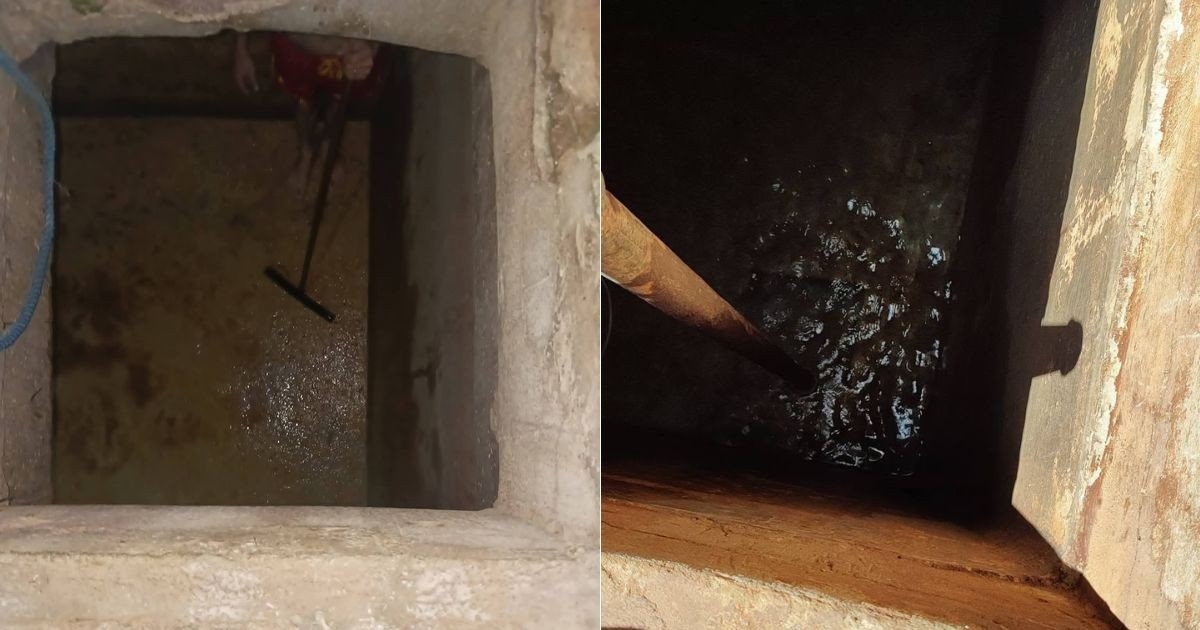
A resident of building H-37, zone 13 of Alamar, Habana del Este, issued a cry for help on Facebook this Saturday to report that their building has been without water in its cistern for almost a year, describing it as "a situation that threatens the most basic living conditions".
Rafael Rodríguez Carmona, the author of the publication, explained that the problem originated about a year ago when workers from Aguas de La Habana came to the building to repair leaks. Since that intervention, water has stopped entering the building's cistern and has never returned. "Almost a year later, we are still waiting for a solution!" he wrote.
The neighbors of H-37 turned to the Municipal Government seeking a response. According to Rodríguez Carmona, they were greeted with courtesy, but without results: "We were treated kindly and received good words, but unfortunately, we did not manage to resolve the problem. Everything ended in promises. The reality remains the same: we do not have water and we also do not have a concrete answer that would allow us to know when this situation will come to an end."
The author of the statement described what he perceives in the neighborhood as "a troubling combination of inactivity, apathy, lack of resources, and absence of effective responses," and rejected the version offered by state media: "Contrary to what some reports from television convey, the problem in our neighborhoods does not seem to be diminishing; on the contrary, it is becoming increasingly difficult to endure."
One of the most dramatic consequences she describes is the forced displacement of elderly people: "There are families who are removing their elderly from their homes in Alamar and relocating them to relatives' houses in other municipalities, simply because they do not have water to ensure basic hygiene and care. What greater evidence of the severity of this situation could there be?"
Parallel to this reality, an informal market for the sale and transport of water has emerged, which many cannot access. "Having water, an essential resource for life, is becoming a luxury that not everyone can afford," warned Rodríguez Carmona. In Havana, a water truck can cost between 18,000 and 50,000 Cuban pesos, an amount equivalent to between 5.6 and 15.6 minimum monthly salaries, which have been set at 3,210 pesos since July 2026.
The case of H-37 is no exception. Alamar, a large residential area characterized by its numerous multifamily buildings, is located in the Havana municipality of La Habana del Este. Its water supply largely depends on the El Gato system and the hydraulic infrastructure of the Alamar Tanks, which provide water to over 90,000 residents of La Habana del Este
A large portion of the country’s hydraulic infrastructure has gone without significant renewal for decades, resulting in water losses of between 40% and 70% before reaching households. More than 60% of supply interruptions are attributed to power outages, as over 80% of the aqueducts rely on the National Electroenergetic System.
On a national scale, the water crisis has steadily worsened throughout 2026. At the beginning of the current month, the National Institute of Hydraulic Resources reported 2,681,770 people affected by interruptions in supply, which amounts to 34.5% of the Cuban population. In that same context, seven major leaks were identified in the South Basin pipeline, a system of over 60 kilometers with pipes over 70 years old.
The regime has responded with inspection visits: on November 12, Miguel Díaz-Canel toured the Alamar Tanks as part of the follow-up to a rehabilitation program for water supply in Havana, and announced measures such as the installation of generators and solar parks of 200 MW for the aqueducts. However, residents of Alamar claim that these actions do not lead to real improvements on the ground.
Rodríguez Carmona concluded his publication with a direct demand to the authorities: "Alamar needs solutions, not more promises. We need transparent information, clear explanations, and, above all, concrete actions." "Water is not a privilege. It is a right and an essential necessity for living with dignity," he concluded.
Related videos:
Filed under: