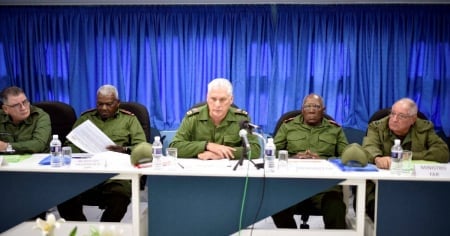
For the first time, the United States government sanctioned Cuban leader Miguel Díaz-Canel this Friday for his involvement in "serious human rights violations," coinciding with the anniversary of the protests on July 11, 2021, in the island. The measure, announced by the State Department, includes a ban on entry to the country for both the president and his immediate family members.
In an exclusive statement to the Miami Herald, officials from the Trump administration declared that the sanctions were imposed under a clause of the Department of State Appropriations Act for fiscal year 2025, which prohibits entry into the country for foreign officials involved in significant corruption or human rights abuses.
Alongside Díaz-Canel, Defense Minister Álvaro López Miera and Interior Minister Lázaro Alberto Álvarez Casas were also sanctioned, along with their respective close family members.
The U.S. administration stated that these sanctions are part of its commitment to holding the Cuban regime accountable for the brutal repression following the 2021 demonstrations. “The United States will never forget the tenacity of the Cuban people four years ago as they demanded freedom and a future free from tyranny,” a senior official told the Miami Herald.
Additionally, visa restrictions were imposed on several unidentified Cuban judicial and penitentiary officials accused of being responsible for or complicit in arbitrary detentions and acts of torture against the protesters of July 11th. For reasons of immigration confidentiality, the names of those affected were not disclosed.
As part of the diplomatic offensive, the State Department also updated its List of Prohibited Accommodations in Cuba, adding eleven new hotels, including newly opened luxury properties in Havana, linked to the military conglomerate GAESA.
These sanctions could prevent Díaz-Canel from attending international events, such as the UN General Assembly, where he has previously participated. His presidential term is set to conclude in 2028.
The measure also revives similar precedents: in 2019, former President Donald Trump imposed comparable sanctions on Raúl Castro and his children.
With this decision, Washington strengthens its pressure policy against the ruling elite of Cuba and reiterates its condemnation of the systematic repression against opponents, many of whom remain imprisoned for their participation in the protests of July 2021.
Frequently Asked Questions about U.S. Sanctions Against Díaz-Canel and His Regime
Why did the U.S. impose sanctions on Miguel Díaz-Canel and his family?
The U.S. sanctioned Miguel Díaz-Canel for his involvement in serious human rights violations in the context of the protests on July 11, 2021, in Cuba. The sanctions include a ban on entry to the country for him and his immediate family members. This measure is part of the U.S. commitment to holding the Cuban regime accountable for the repression of protesters and dissenters.
What other figures from the Cuban regime have been sanctioned by the U.S.?
In addition to Díaz-Canel, Defense Minister Álvaro López Miera and Interior Minister Lázaro Alberto Álvarez Casas, along with their close family members, were also sanctioned. These sanctions reinforce the U.S. pressure policy on the Cuban regime's leadership due to its repressive actions.
What impact do these sanctions have on the relations between the U.S. and Cuba?
Sanctions exacerbate tensions between the U.S. and Cuba, reinforcing the isolation of the Cuban regime. U.S. policy aims to pressure for changes in human rights and democracy on the island, while the Cuban government accuses the U.S. of interference and of attempting to destabilize the country. This dynamic maintains an atmosphere of diplomatic and political friction between the two nations.
What additional measures has the U.S. taken to pressure the Cuban regime?
In addition to personal sanctions, the U.S. has strengthened the economic embargo and has updated the List of Prohibited Accommodations in Cuba, including hotels linked to GAESA. Visa restrictions have also been imposed on Cuban judicial and prison officials, accused of complicity in arbitrary detentions and torture. These measures are part of a broader strategy to weaken the repressive apparatus of the regime.
Filed under: