
Related videos:
A new solar park covering 32 hectares was inaugurated in Havana this Saturday while the energy crisis on the island continues.
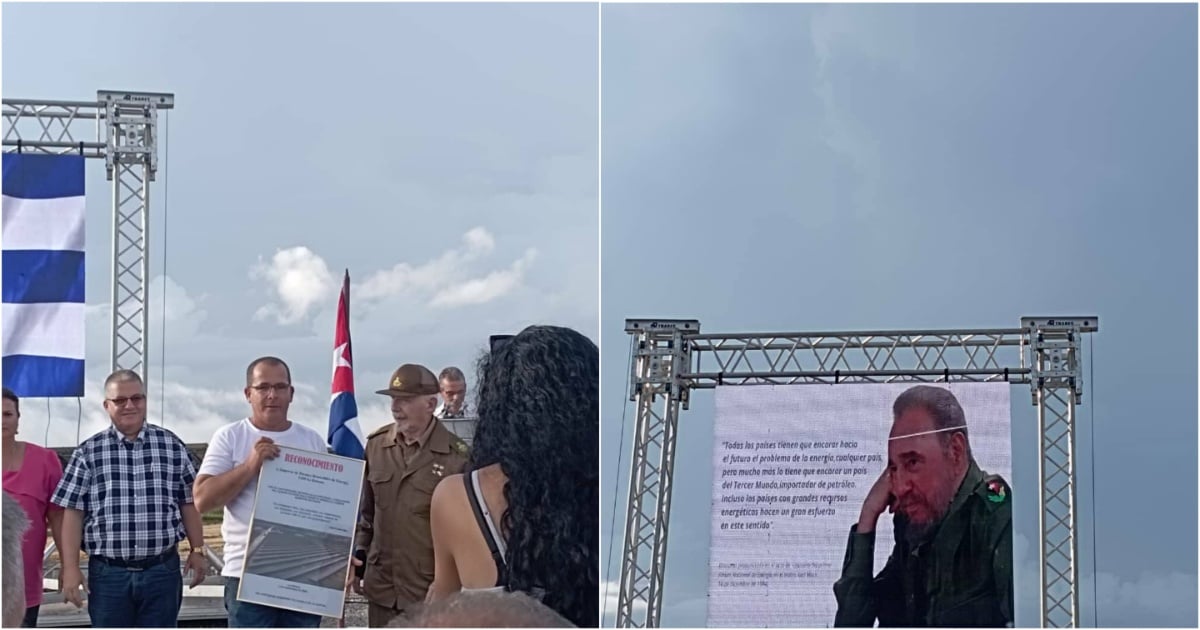
The second park built in the Havana municipality of Boyeros, a few meters from the national sanctuary of San Lázaro (El Rincón), was inaugurated, as is customary, by the nonagenarian commander Ramiro Valdés Menéndez, one of the historic figures of the regime.
The 21.8 MW park features a statue of Fidel Castro, “the greatest visionary this beautiful homeland has ever had,” as stated in the post by the Empresa Fuentes Renovables de Energía (EMFRE), although the deceased dictator requested that his image be avoided.
In addition to Valdés Menéndez, the inauguration was attended by "the governor of Havana Yanet Hernández, the Vice Prime Minister Argelio Jesús Abad Vigoa, executives from EMFRE, workers, and guests."
While the regime continues to invest in solar energy, it was reported this Saturday that the Felton thermoelectric power plant (CTE), one of the cornerstones of electricity generation in Cuba, has just gone offline and will remain disconnected for at least 20 days, exacerbating the already collapsed energy situation on the Island.
Energy crisis
The news hits at the worst possible moment.
According to reports from the Electric Union (UNE), the National Electric Service (SEN) was affected for 24 hours on Friday and continued to be disrupted throughout the early hours of today.
The highest impact due to a generation capacity deficit occurred at 8:20 PM and reached 1861 MW, coinciding with the peak demand time, and exceeding the planned levels due to the failure of unit 3 at CTE Santa Cruz to come online.
Solar parks
At the end of August, the Ministry of Energy and Mines (MINEM) reported that 27 photovoltaic solar parks are now synchronized out of the 51 planned for this year, which represents 53% of the projected plan.
The regime institution pointed out on social media X that these advancements are part of the National Electric System Recovery Program, which aims to "reduce" blackout hours and "move towards the country's energy" sovereignty, with greater use of renewable sources.
The 27 parks currently in operation contribute over 580 megawatts during midday, which, according to the authorities, helps reduce the impact during that peak demand period.
Although the government insists on showcasing these advancements as a step towards energy diversification, the population continues to experience prolonged blackouts exceeding 12 hours a day in several provinces, which generates skepticism about the true impact of these projects on daily life.
With 47% of the parks still pending installation, the challenge for the government will be to ensure that these investments truly contribute to alleviating the energy crisis striking the island.
Frequently Asked Questions about the Energy Crisis in Cuba and Solar Parks
What is the new solar park inaugurated in Havana?
The new solar park in Havana is a 21.8 MW facility located in the municipality of Boyeros. It was inaugurated with the presence of historical figures from the Cuban regime, including Ramiro Valdés Menéndez. This park is part of the government's efforts to increase the use of renewable energy amidst a severe energy crisis.
What is the current situation of the energy crisis in Cuba?
Cuba is facing a serious energy crisis with widespread blackouts and a power generation deficit exceeding 1,800 MW during peak hours. The situation is critical due to a lack of maintenance of thermal power plants, frequent outages, and fuel shortages. Although the government has inaugurated several solar parks, they are insufficient to meet the country's electricity demand.
How do solar parks contribute to the energy crisis in Cuba?
Solar parks contribute to the Cuban electrical system, but their impact is limited due to the lack of energy storage systems. This means that the energy generated can only be used during the day, when there is sunlight, and cannot be stored to meet nighttime demand, which is when consumption is at its highest.
What challenges does the Cuban government face in resolving the electricity crisis?
The Cuban government faces several challenges in resolving the electricity crisis, including the modernization of the energy infrastructure and the lack of investment. Furthermore, without efficient management and energy storage systems, efforts to expand the use of renewable energy will remain insufficient to address the issue of prolonged blackouts.
Filed under: