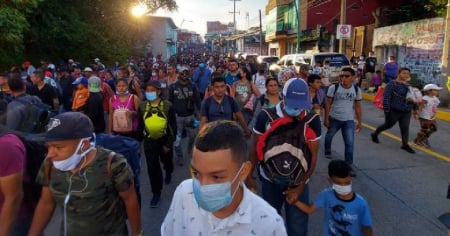
A migrant caravan, predominantly made up of Cubans, will leave Tapachula heading to Mexico City in the coming days.
Despite the operations carried out by the National Institute of Migration (INM) around the Bicentenario park in the center of that city located in the state of Chiapas, the migrants remain resolute in their decision, stated Diario del Sur.
This local newspaper reports that Cuban migrants planning to depart on October 1 are seeking to obtain legal status in Mexico so they can work and send money back to the island.
"I am not afraid of anything; I lost that fear along the way, and whatever comes, we will face it. We are heading towards success, moving forward, we are going to Mexico City," said Daniel González, a Cuban who plans to be part of the caravan.
This Cuban has been in Tapachula for a year and a half trying to regularize his status.
"I went through the process for the first time at the Comar and they denied me. I tried again and they denied me about two months ago. I went to Immigration to find out how I could apply for a humanitarian visa, and they told me they're not issuing them. However, if you pay a lawyer at the Comar, the permit magically appears," he lamented
González reported that he has been in Tapachula for one year and four months, during which he has tried unsuccessfully to regularize his immigration status. Therefore, he is determined to leave in a caravan on October 1, despite the risks.
Therefore, González believes that he has no choice but to join the caravan since his rights are not being respected.
Diario del Sur also interviewed the Cuban Lidia Álvarez, who cited the lack of opportunities and the discrimination faced in the city by some Mexican individuals as reasons for joining the caravan.
"We have no hope here, not even remotely. Lawyers are charging between 10,000 and 15,000 pesos, and we barely earn 200 pesos a day. It’s impossible to pay for a procedure like that. All we want is the chance to legalize our status," commented this Cuban woman.
Álvarez denounced the discrimination that the Cuban community in Tapachula faces.
This Cuban says that on the island she and her peers experienced too much exploitation, repression, and abuse, and what they ask for here is dignity, as they don't want anything handed to them, only to be allowed to move forward as human beings.
Despite the operations, this Cuban does not consider any other option.
Tentative departure on October first
After months of waiting for an asylum resolution from the Mexican Commission for Refugee Assistance (Comar) and amid reports of corruption, xenophobia, and precarious conditions, Cubans have chosen the extreme option.
The tentative departure is scheduled for October 1, according to the migrants themselves, who communicated this through WhatsApp groups and social media, where they initiated the call and the first agreements to march in an organized manner, reported the local Diario de Chiapas.
Cubans claim that the conditions in Tapachula are unsustainable: there is no formal employment, rents are high, food is scarce, and many face discriminatory treatment. In addition, there is the slow processing of immigration procedures and the systematic rejection of asylum requests.
“We are determined to leave Tapachula; it is unbearable to live here due to rampant xenophobia, a lack of jobs, and the work we can find requires us to work up to 12 hours for just 150 pesos a day,” declared Brian Balcón, Cuban migrant involved in organizing the caravan.
The affected individuals have reported that some have been waiting for up to eight months or a year for a resolution from Comar. They claim that even those who present documents evidencing political persecution or death threats are denied without justification.
They also pointed out that under the management of Carmen Yadira de los Santos, the current head of the local Comar office, corruption has worsened.
"Only those who have money are attended to quickly and manage to find shelter," commented one of the organizers.
This caravan does not aim to reach the United States immediately, but rather to move to cities like Mexico City or Monterrey, where they hope to find better job opportunities and more dignified living conditions.
The preparations include open assemblies at Bicentenario Park, a usual meeting point for migrant caravans in Tapachula. From there, they plan to coordinate the departure and logistics for the collective movement.
Tapachula has become a migratory bottleneck, with thousands of people stranded while awaiting paperwork, in conditions that have been criticized by national and international human rights organizations.
Frequently Asked Questions about the Cuban Migrant Caravan in Tapachula
Why are Cuban migrants organizing a caravan from Tapachula?
Cuban migrants are organizing a caravan from Tapachula due to the unsustainable conditions in the city, such as lack of formal employment, high living costs, and discrimination. Additionally, they face long waiting times to receive responses to their asylum requests before the Mexican Commission for Refugee Assistance (Comar), which drives them to seek better opportunities in other cities in Mexico.
What are the main challenges faced by Cuban migrants in Tapachula?
Cuban migrants in Tapachula face several challenges, including the lack of formal employment, high rental costs, food shortages, and discrimination. They also report corruption in the asylum processes and the slowness of immigration procedures, which complicates their integration and stability in the city.
What do Cubans hope to achieve by joining the migrant caravan?
By joining the caravan, Cubans hope to reach cities like Mexico City or Monterrey, where they trust they will find better job opportunities and more dignified living conditions. They seek to regularize their immigration status and access work permits that will allow them to settle legally in Mexico.
What complaints have Cuban migrants made about their situation in Tapachula?
Cuban migrants have reported corruption, xenophobia, and precariousness in Tapachula. They point out that some lawyers charge large sums to expedite asylum processes, and those who cannot pay face systematic rejections. They also criticize the discrimination from some local residents and the unfavorable working conditions they have to endure.
Filed under: