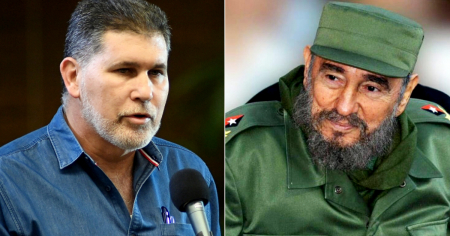
The Cuban regime announced this Friday the promotion of Oscar Pérez-Oliva Fraga to the position of Deputy Prime Minister of the Republic of Cuba, a decision approved by the Political Bureau of the Central Committee of the Communist Party and ratified by the Council of State, at the proposal of Miguel Díaz-Canel.
The 54-year-old official will simultaneously maintain his responsibility as Minister of Foreign Trade and Foreign Investment (MINCEX), a position he has held since May 2024, when he replaced the historical negotiator of the regime, Ricardo Cabrisas Ruiz, who passed away in mid-September at the age of 88—just a year and a half after his replacement—and notably, the former General Raúl Castro Ruz did not attend his funeral.
According to a brief note circulated in official media, Pérez-Oliva Fraga is an electronic engineer and has developed his career "from the ground up" within the state business system.
Before joining the Council of Ministers, he served as the general director of the company Maquimport, director of Business Evaluation at the Mariel Special Development Zone (ZED Mariel), and later as deputy minister and first deputy minister of MINCEX, until he was promoted to minister.
A new face of the same power
Although the regime presents its rise as a demonstration of continuity and technical expertise, Oscar Pérez-Oliva Fraga belongs to the powerful Castro Ruz family clan, which again highlights the influence of nepotism within the Cuban ruling elite.
The new vice prime minister is the grandson of Angelita Castro, sister of the dictator Fidel Castro, and the nonagenarian general, and the son of the biologist Mirsa Fraga Castro. Furthermore, he is the nephew of José Antonio Fraga Castro, who chaired the state-owned company LABIOFAM until 2014.
His family ties make him a direct great-nephew of the Castro brothers, a relationship that, according to analysts, has been crucial for his rise within a state apparatus where familial and political loyalty remains more critical than technical expertise or effective management.
During his time at the ZED Mariel, Pérez-Oliva worked under the supervision of the late General Luis Alberto Rodríguez López-Calleja, former son-in-law of Raúl Castro and head of the military conglomerate GAESA, the business holding that controls the dollarized Cuban economy.
That experience solidified their ties to the economic structure of the military, which continues to dominate the finances, foreign investment, and foreign trade of the island.
The rise of Pérez-Oliva Fraga also brings back memories of the scandals that surrounded his uncle. Fraga Castro, former director of LABIOFAM, was implicated in alleged financial irregularities and money laundering operations within the biotechnology group.
Independent investigations published by CiberCuba revealed that during his tenure, LABIOFAM may have been used to move funds abroad and carry out opaque transactions linked to companies controlled by the Castro family's circle.
In 2014, following a series of internal controversies and public complaints, Fraga Castro was discreetly dismissed, although a formal investigation was never made public, which reinforced the perception of impunity within the family circle of power.
The invisible thread of economic power: From López-Calleja to Pérez-Oliva Fraga
The appointment of Oscar Pérez-Oliva Fraga as deputy prime minister cannot be understood merely as a technical or administrative promotion.
Behind his career lies a web of direct relationships with the most opaque financial structures of the regime, the very same ones that have allowed the Castro leadership to control the nation's finances and its international standing for decades.
Pérez-Oliva was one of the trusted aides of General Luis Alberto Rodríguez López-Calleja, who passed away in July 2022 at the age of 62 from a sudden cardiorespiratory arrest, as reported by a brief official statement.
López-Calleja, head of the military conglomerate GAESA - a supposedly state-run entity that controls tourism, foreign trade, banking, and major investments in the country - was the son of Army General Guillermo Rodríguez del Pozo (1929-2016), a fighter in the Rebel Army and a close collaborator of Raúl Castro since the days of the Sierra Maestra.
From the marriage of López-Calleja and Déborah Castro Espín (daughter of Raúl Castro and Vilma Espín) was born the now Lieutenant Colonel Raúl Guillermo Rodríguez Castro, nicknamed "El Cangrejo", chief of the escort and personal assistant to his elderly grandfather, as well as a lover of the good life, yacht outings, lobster banquets, luxurious parties in hotels in the keys, and exclusive nightclubs in Havana.
“El Cangrejo” is the brother of Vilma Rodríguez Castro, the partner of the Cuban artist Arles del Río and linked to the rental business of a luxury property in Havana through the American company Airbnb.
Under the tutelage of López-Calleja, and linked to this family network, Pérez-Oliva Fraga held roles in the ZED Mariel, a flagship project of Cuba's "controlled opening" of its economy, which has today become a symbol of opacity, favoritism, and financial failures.
It is important to remember that the establishment of the ZED Mariel was directly linked to one of the largest corruption scandals in the region, the case of the Odebrecht construction company (which resulted in the imprisonment of President Lula da Silva) and the unpaid debt of the Cuban regime amounting to 600 million dollars with the National Bank for Economic and Social Development of Brazil.
This connection places Pérez-Oliva Fraga in the same line of power that has historically managed the financial entanglements of Castroism: from the group of Ricardo Cabrisas, a key figure in external debt and agreements with Russia and China, to the LABIOFAM case, led by his uncle Fraga Castro, involved in shady operations and the diversion of funds through state biotechnology.
Everything indicates that their promotion is not based on economic merit, but rather on a continuation of the familial-military trust scheme that maintains control over money in Cuba. Essentially, it is the succession of a "famiglia" that does not relinquish the economic helm and seeks to ensure its permanence in the circuits where real power flows: foreign currency, investments, and contacts with businesses and foreign governments allied to the regime.
Between the economic crisis and international distrust
The appointment of Pérez-Oliva comes amidst a deep economic crisis that is affecting all sectors of national life: shortages, inflation, blackouts, mass emigration, and the collapse of the Cuban peso in the informal market.
Since MINCEX, its main challenge has been to attract foreign investment in a context of a lack of confidence among international investors, bureaucratic obstacles, lack of transparency, and a legal framework that continues to discriminate against Cubans living abroad.
After more than a year of his management as minister, the results remain limited. Official figures show a sustained decline in foreign investment, while the Mariel Special Development Zone fails to establish itself as a regional attraction.
Despite this, the regime has decided to promote him, a move that reinforces the notion of rewarding loyalty to the system more than administrative efficiency.
A political rise rather than a technical one
The position of Deputy Prime Minister is one of the highest within the Council of Ministers and grants Pérez-Oliva Fraga a direct seat in the strategic decisions of the government, under the supervision of the Prime Minister, Manuel Marrero Cruz, and the appointed leader Miguel Díaz-Canel, a bureaucrat of the Communist Party whom experts agree is seen as a puppet of the Castro clan.
However, the appointment of Pérez-Oliva Fraga can also be interpreted as an attempt by the regime to refresh its image without altering the actual power structure, which remains controlled by the Communist Party and the military and business elite inherited from the Castros.
His promotion reaffirms that, more than six decades after the beginning of Castroism, the descendants of the family continue to hold key positions in the state, ensuring the continuity of political and economic control in the country.
While the Cuban people face the effects of an unprecedented crisis, the rise of a new Castro through political nepotism symbolizes that, under the Cuban dictatorial and totalitarian regime, power is not earned by merit, but by血 and loyalty to the system.
Filed under: