
Related videos:
The editorial published by the newspaper Granma titled "Every Day of the Revolution is a Victory" sparked a wave of reactions on social media, where hundreds of Cubans expressed fatigue, irony, and frustration towards the official narrative.
The text, shared on the official media's Facebook page, echoed the words of Miguel Díaz-Canel during the XI Plenary of the Central Committee of the Communist Party of Cuba (PCC), where he stated that “every day of the Revolution is a victory.” In a triumphant tone, the editorial called to “fight the economic and ideological battle” heading towards 2026, “the year we will celebrate the centenary of the Commander in Chief,” and advocated for the idea of a “creative resistance” of the people.
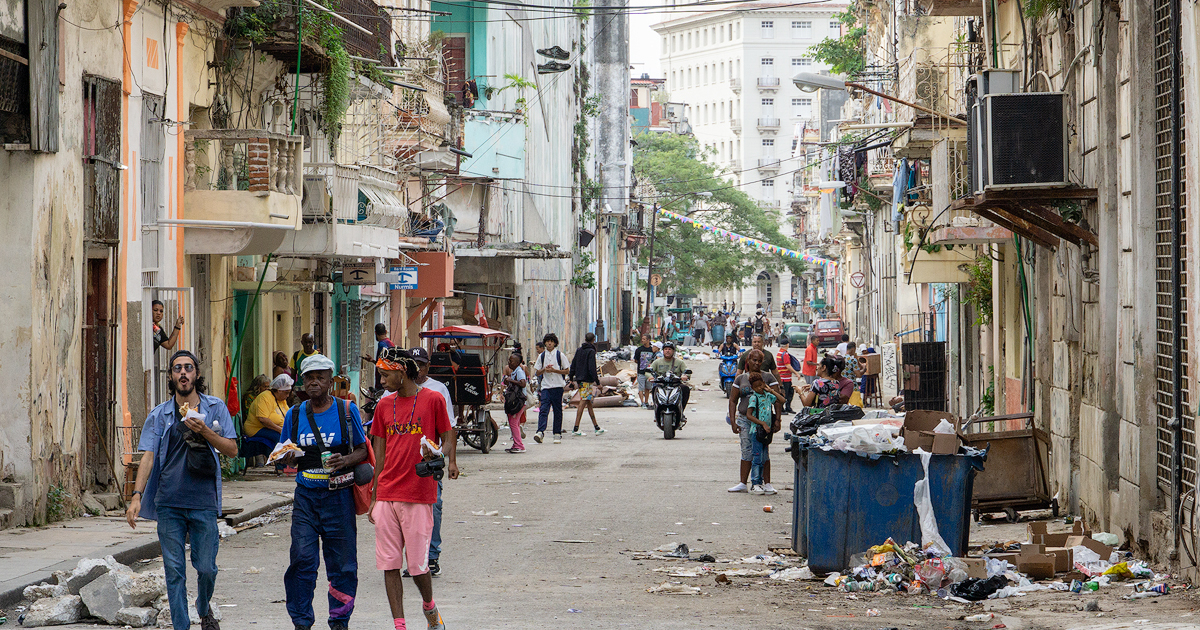
But the post provoked an overwhelming response. Hundreds of users questioned the triumphalism and contrasted the message with the reality of the country, marked by blackouts, inflation, scarcity, and the deterioration of basic services. "No ideology is worth more than a human being. Governing is not about demanding eternal resistance; it is about guaranteeing dignity," wrote one person in one of the most shared responses.
Most comments agreed on highlighting the disconnect between the official discourse and everyday life. "Every day of the Revolution will be a victory for you, who do not suffer from hunger or blackouts; for mine, it's just another day of crisis, exhaustion, and pain," wrote another user. Another summarized: "If keeping a people in absolute misery is a victory, then yes, every day the Revolution is a victory."
Among the most critical messages, several denounced the privileges of the ruling elite in contrast to the poverty of the majority. “You live like the rich; the people die from selfishness,” pointed out one. Another quipped: “Every day that goes by, you have to be thankful for being in power and not in prison.”
Broader analyses also emerged regarding the Party's management and the unfulfilled promises of recent years. "Since 2011, the promises have been repeated and the results have worsened. It is not a lack of diagnosis or the people's sacrifice. It is a lack of will to change the system," stated a lengthy comment that garnered dozens of endorsements. Another added, "The promises from the Party's congresses have always been the same: to produce more, correct distortions, perfect the model. But the only thing that gets perfected is the scarcity."
Irony also played a starring role. “Every day of the Revolution is a victory... but a victory over what exactly and with what score?” asked an internet user. Another wrote: “If this is a winning streak, the standings haven’t been updated in years.”
There were those who used humor as a form of protest. "Is this Granma or the humorous tabloid Palante?" one commented, while another summarized: "Psychiatric patients running a country." A third user added: "What are these people smoking? Every day a victory... can they name one?"
Other messages, more reflective in nature, questioned the gap between revolutionary rhetoric and the values it claims to uphold. "A Revolution that does not place life at its center ceases to be a Revolution. What is a triumph for those in power is an imposed sacrifice for the people," one comment expressed. Another noted, "They talk to us about unity, but state policies have divided us into classes, currencies, and electric zones. There can be no unity where there is no equality."
Even a recent quote from the leader was brought up —“No one is going to give up here”— to underline the gap between slogans and reality. “The country is sinking, and you all keep talking about resistance,” wrote one person. “We are moving toward the Stone Age,” another quipped. “Each year, we are sinking deeper into misery,” added a third.
The responses transformed the Granma publication into a space for collective catharsis where citizens' discontent was expressed without filters. From indignation to sarcasm, the messages reflected a common point: the contrast between the rhetoric of victories and the daily life of a people worn down by precariousness, blackouts, and a lack of hope.
While the official discourse insists on resistance and dignity against the external enemy, the digital conversation reveals a country tired of slogans and increasingly willing to openly question the power's narrative. The growing rejection of the official narrative demonstrates a nation where the story of victories no longer convinces a people exhausted by the crisis.
Filed under: