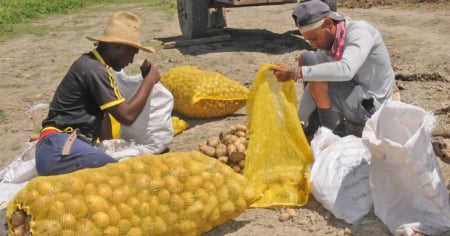
The XIII Congress of the National Association of Small Farmers (ANAP) was held at the Palace of Conventions in Havana with a slogan that encapsulates the precariousness of Cuban agriculture: “planting more with less.”
Thus affirmed Félix Duarte Ortega, president of the organization, during the presentation of the central report of the event, where setbacks in production, loss of labor force, and the decline of agricultural cooperatives were recognized, according to a report from the Cuban Television Information System.
Duarte Ortega noted that since the last congress, the farmers' movement has grown by more than 12,000 new members, but he acknowledged that the Agricultural Production Cooperatives (CPA) have decreased by 49, and the Credit and Service Cooperatives (CCS) by 65, due to "organizational problems, labor instability, and poor productive economic results."
In the midst of this situation, the leader advocated for "seeking alternatives that encourage us to grow more with what we have," focusing efforts on staple crops such as sweet potatoes, cassava, plantains, and taro, in order to increase local self-sufficiency.
He also reiterated the need to tackle crimes such as theft and illegal slaughter of livestock, a problem that the regime has been unable to solve for years, as well as corruption, misuse of land, and lack of control over the cattle population.
The highest representative of the ANAP assured that, in light of the severe financial constraints facing the country, the Cuban peasantry must make the most of the productive resources to meet the economic plan, in accordance with the Law of Food Sovereignty and Nutritional Education approved by the government.
Nevertheless, beyond the usual triumphalist discourse, the event unveiled the structural difficulties faced by Cuban agriculture and the scarcity of resources that producers must contend with.
In recent years, the Cuban countryside has faced a progressive decline that calls into question the viability of the current agricultural model. By August 2024, a Cuban farmer publicly denounced the impossibility of producing due to the scarcity of basic resources such as fertilizers, fuels, and tools, conditions that have left many producers “desperate and without institutional support.”
Months later, it was revealed that the Cuban government removed the land from 137 farmers in Ciego de Ávila due to alleged contract violations. Several affected parties pointed out that the measure was arbitrary and disconnected from the real conditions of agriculture, where the challenges to meet production commitments are structural and not necessarily attributable to the will or capacity of the farmers.
In April, farmers in Pinar del Río were forced to puncture pipes to obtain water for irrigation, a desperate practice that highlights the lack of access to adequate water infrastructure in rural areas, essential for sustaining any planting efforts amid rising temperatures and unpredictable rainfall.
Additionally, the levels of insecurity in the countryside have led to extreme measures. A Cuban farmer sold his herd due to the uncontrolled increase in thefts and the inaction of the authorities. The loss of animals represents an unsustainable economic blow for small producers, who also face bureaucratic hurdles in accessing justice and effective protection.
Frequently Asked Questions about the Agricultural Crisis in Cuba and the ANAP Congress
What is the current situation of the agricultural sector in Cuba according to the ANAP Congress?
During the XIII Congress of the ANAP, significant setbacks in productivity were acknowledged in the Cuban agricultural sector. A decrease in cooperatives and a loss of workforce have been observed, as well as organizational and economic issues. Additionally, the Congress emphasized the need to seek alternatives to plant more with fewer resources, focusing on staple crops such as sweet potatoes, cassava, bananas, and taro.
What measures does the Cuban government propose to improve agricultural production?
The Cuban government insists on strengthening socialist cooperativism as a solution to the agricultural production crisis. The aim is to reinforce the internal organization of cooperatives and optimize their operations. Additionally, territorial self-sufficiency is being promoted, and the need to combat crimes such as theft and illegal slaughter of livestock is reiterated.
Why do problems in the agricultural sector persist despite government initiatives?
Despite the initiatives, problems persist due to structural deficiencies in the socialist model, a lack of real incentives for producers, and a bureaucratic system that stifles innovation and efficiency. Furthermore, the government's centralized control prevents true decentralization and private participation in the sector.
What role does the Food Sovereignty Law play in the current agricultural crisis in Cuba?
The Law of Food Sovereignty has been one of the government's strategies to address the agricultural crisis, but its implementation has been insufficient to meet the needs of the population. The failure of the food sovereignty project is due to the structural deficiencies of the model and the lack of resources and autonomy for producers.
Filed under: